



What is a GST Registration Certificate?
A GST Registration Certificate is an official document issued by the government confirming a business's registration under the Goods and Services Tax (GST) regime. It signifies compliance with tax regulations and enables businesses to collect GST from customers, claim input tax credits, and conduct inter-state transactions legally. This certificate is crucial for businesses as it grants access to various benefits, including legal recognition, simplified tax compliance, and eligibility for certain government schemes and contracts. Moreover, it enhances credibility and trust among customers and business partners.
Who Should Obtain a GST Registration Certificate?
Businesses must obtain GST registration if their aggregate annual turnover exceeds ₹40 lakh for goods or ₹20 lakh for services in normal states, and lower thresholds like ₹20 lakh or ₹10 lakh in special category states. Mandatory registration also applies to inter-state suppliers, e-commerce operators, casual taxable persons, non-residents, and those registered under pre-GST laws like VAT or service tax, regardless of turnover. TallyPrime simplifies managing multiple GST registrations for businesses with branches by allowing setup of GSTIN details per location.
Sample GST Registration Certificate
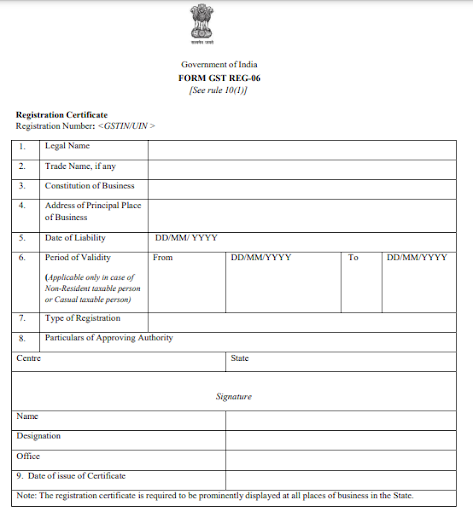
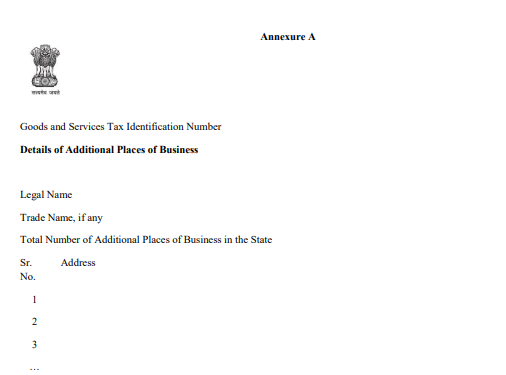
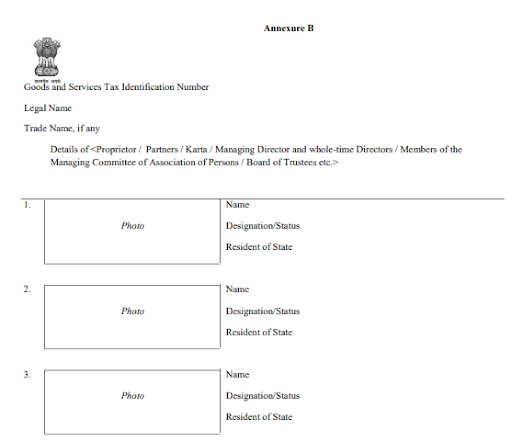
Why Is the GST Registration Certificate Important?
The certificate authenticates legal compliance, enabling input tax credit (ITC) claims, interstate transactions, and smooth business dealings like opening bank accounts or tenders. It builds credibility with customers and vendors while protecting against disputes and penalties for non-compliance. In TallyPrime, entering GST details from the certificate ensures accurate invoicing and return generation.
Documents Required for GST Registration
Whether you're an individual entrepreneur, a company, or part of a partnership, understanding the specific documents needed—and their format—is crucial for a seamless registration process.
For individuals, essential documents include:
- Aadhaar card
- PAN card
- Passport-sized photograph
- Address proof (e.g., passport, driving license, utility bills)
For companies:
- Certificate of incorporation
- PAN card of the company
- Address proof of the company's place of business
- Bank account statements
For partnerships:
- Partnership deed
- PAN card of the partnership firm
- Aadhaar card of partners
- Address proof of the principal place of business
Ensuring these documents are correctly formatted and meet the specified requirements ensures a smooth GST registration process, setting your business up for success in the unified tax regime.
How to get GST Registration Certificate?
The registration process for obtaining GST Registration certificate can be easily understood from the three step process outlined below:
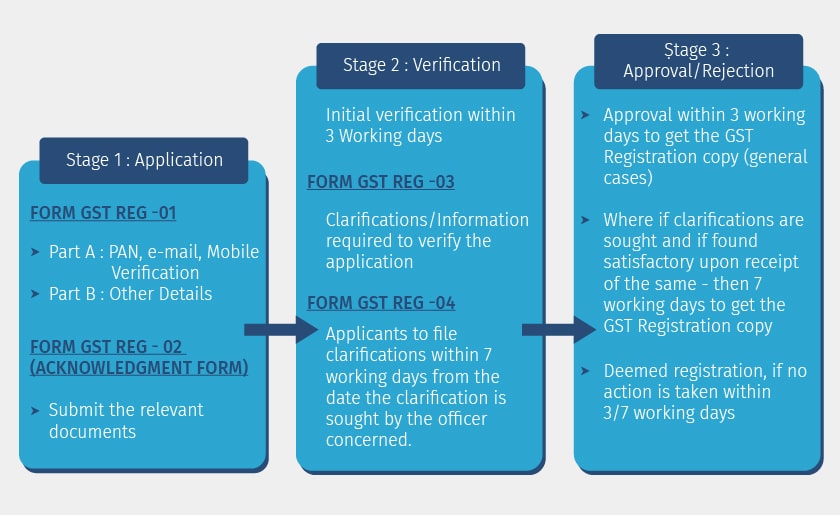
The above is applicable to inter-State suppliers, voluntary registrations, casual taxable persons and persons liable to reverse charge. The GST Registration Certificate is then issued in Form GST REG-06.
How to download GST Registration Certificate
The GST Registration certificate download could be done by visiting the GST Portal at www.gst.gov.in by following the simple steps listed below:
Step 1: Log in to the GST Portal
Step 2: Go to 'Services' > 'User Services'>'View/Download GST Registration Certificate'
Step 3: Click on 'Download' icon and a GST registration certificate download.pdf file will be downloaded
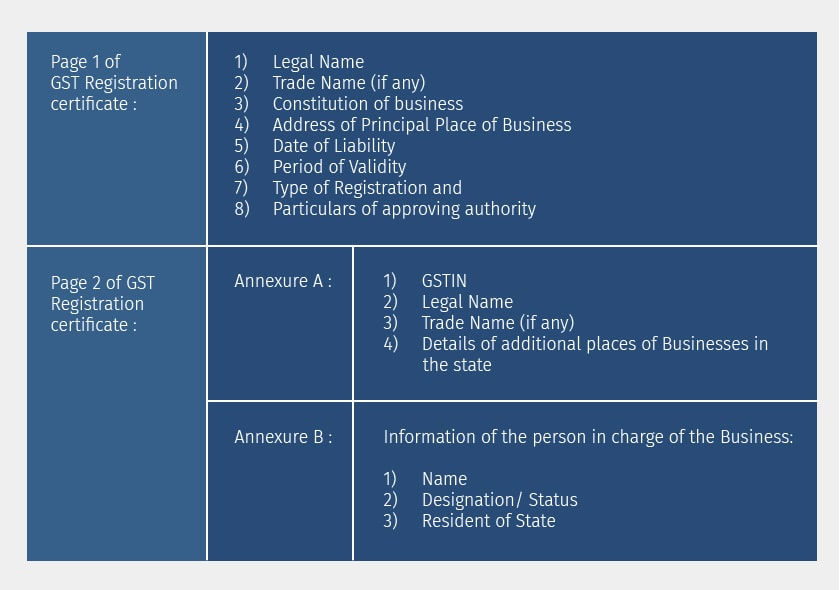
Information available in the GST Registration Certificate copy
Validity and Renewal of GST Registration Certificate
Regular taxpayers' GST registration, including the certificate, has lifelong validity without periodic renewal if returns are filed on time and no cancellation occurs. Casual and non-resident registrations last 90 days, extendable via application. No expiry for normal cases, but voluntary cancellation or authority action ends it; track status on GST portal.
How to Use and Display the GST Certificate
Access the GST certificate via the official portal by logging into www.gst.gov.in with valid credentials, then navigating to Services > User Services > View/Download Certificates. All issued certificates appear in chronological order (newest first); click the download icon for a PDF version of the Registration Certificate. Amended certificates, if any, are also listed with updated details like the standardized address format: Floor No., Building No./Flat No., Name of Premises, Road/Street, Landmark, Locality, City, District, State, PIN Code.
Display Requirements: Every registered person must display the GST Registration Certificate at a prominent location—visible to customers—at the principal place of business and every additional place. Common methods include framing the A4-sized printout or pasting it near the entrance or billing counter. Additionally, display the GSTIN on the name board or signboard at all business entrances for easy verification.
Usage in Business Operations: Use the certificate to verify compliance during audits, tenders, or bank dealings, and quote the GSTIN on all invoices, receipts, and promotional materials. Composition scheme taxpayers must also declare "Composition Taxable Person, not eligible to collect tax on supplies" on bills and signboards. Non-display can attract a general penalty up to ₹25,000 under Section 125 of CGST Act
GST Registration, GST Registration Eligibility, Documents Required for GST Registration, How to Check GST Registration Status, GSTIN
GST
GST Software, GST Calculator, GST on Freight, GST Exempted Goods & Services, Reverse Charge Mechanism in GST, GST Declaration
GST Rates & Charges
GST Rates, GST Rate Finder, HSN Codes, SAC Codes, GST State Codes
GST Returns
GST Returns, Types of GST Returns, New GST Returns & Forms, Sahaj GST Returns, Sugam GST Returns














