










- Meaning of financial statements
- Periodicity of financial statements
- Users of the financial statements
- Types of financial Statements
- How to prepare financial statements
Introduction to Financial Statements
Financial statements are formal reports that summarize the financial activities and position of a business. They help business owners, investors, lenders, and regulators understand whether the business is profitable, financially stable, and capable of meeting its obligations.
Meaning of financial statements
Financial statements refer to reports prepared to evaluate the performance, financial health and the liquidity position of the business. Financial statements are prepared using the transactions accounted in the books of the account. In simple words, all the accounting data is consolidated into a financial statement in a manner which is generally accepted and understood.
Features of Financial Statements
|
Feature |
Meaning |
|
Structured format |
Prepared in a standard accounting format |
|
Based on accounting records |
Uses transactions recorded in books of accounts |
|
Shows financial position |
Helps understand assets, liabilities, and capital |
|
Shows profitability |
Helps evaluate profit or loss |
|
Useful for decision-making |
Helps owners, investors, banks, and management |
|
Comparable |
Can be compared across periods |
Periodicity of financial statements
Traditionally, financial statements were prepared annually i.e. after the closure of the accounting period. With modern-day business operations and requirements, the business owners depend on the financial statements for decisions making. As a result, businesses prepare financial statement monthly, quarterly and half-yearly as well. The insights from the financial statements are reliable and help business owners to make confident decisions.
Users of financial statements
Financial statements are used by internal users as well as external users. The financial statements depict the overall financial health of the business and help users to make better business decisions.
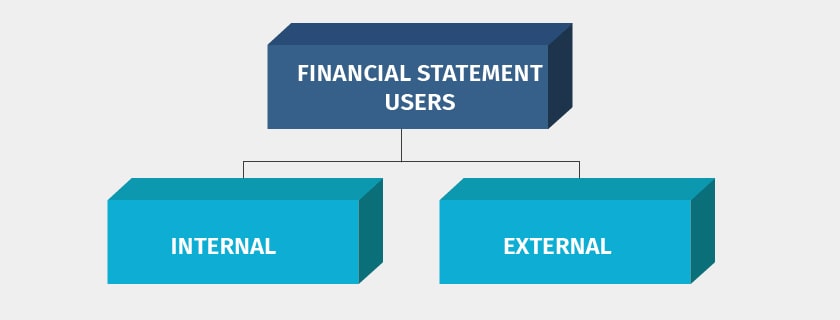
- Internal users:Internal users of financial statements are management, employees, Owners etc.
- External users:Regulatory, tax authorities, banks, unions, investors, creditors etc. are the external users of financial statement.
Types of financial statements
Using the accounting records, 3 types of financial statements are prepared by the company. These 3 types of financial statements provide insights about the financial health, profitability and liquidity of the business. Following are the 3 types of financial statement:
- Balance sheet
- Profit and loss account
- Cash flow statements (CFS)
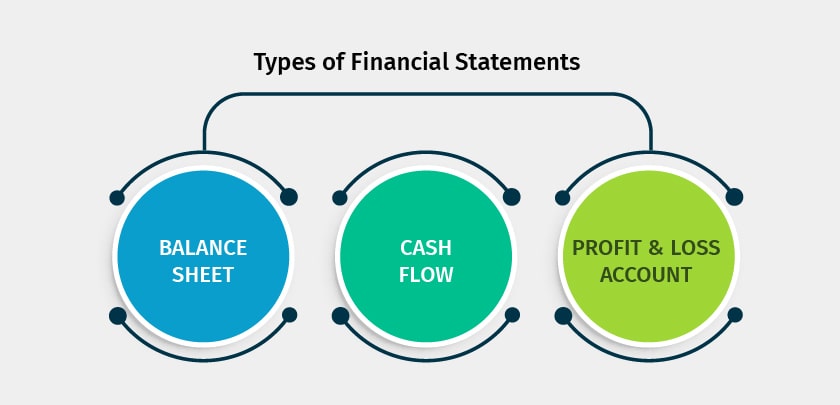
- Balance sheet: Balance sheet is a type of financial statement that summarizes the company’s assets, liabilities and the amount owned by the business owners. This financial statement broadly consists of assets and liabilities. A balance sheet helps the stakeholders to evaluate the efficiency in working capital, asset portfolio and the financial strength.
- Profit and loss account: This statement reveals the performance of the business in terms of profit or loss for a specified period. Using this financial statement, net profit is calculated after considering the gross profit/loss and all other indirect expenses or incomes.
- Cash flow statements: Cash flow statement projects the organization ability to generate cash inflow, cash outflows to meet its obligations or commitments and investment.
Apart from the main financial statements, businesses may also prepare supporting financial reports such as trial balance, notes to accounts, statement of changes in equity, receivables and payables reports, and management reports. These reports provide additional details for analysis, compliance, and decision-making.
How to prepare financial statements
All the financial statements are prepared using the accounting transactions recorded in the books of the accounts. Preparing financial statements is one of the outcomes of accounting i.e. analyzing and interpreting the business transactions.
The following are the steps to prepare a financial statement:
- Recording transactions in a journal book
- Preparing ledger accounts
- Preparing trial balance summarizing the closing balance of ledger accounts
- Using trial balance, you need to prepare profit and loss account and balance sheet.
Cashflow statement is an independent financial statement which compliments balance sheet and income statement. Cash flow statement is prepared considering the operating activities, investing activities and financing activities.














