










Introduction: The Problem of "The Invisible Shop Floor"
In my 20 years of auditing manufacturing units and implementing TallyPrime, I’ve lost count of how many times a CFO has told me, "I know the stock is physically in the factory, but I can’t find it in the books." This is the "Invisible Shop Floor" phenomenon.
The root cause is almost always the same: a heavy reliance on disconnected spreadsheets and WhatsApp-based approval cycles. When your production planning lives in Excel and your accounting lives in Tally, you suffer from "data decay" a 2 to 3-day reconciliation lag that results in unmatched stock and skewed financial ratios.
TallyPrime solves this by unifying operational movements and accounting ledgers. It moves the conversation from "I think we have it" to "Here is the exact valuation of our WIP," ensuring your physical stock and digital records remain in a state of constant reconciliation.
What is a Bill of Materials (BOM) and Why is it the Foundation?
In technical terms, a Bill of Materials (BOM) is the "recipe" that defines the standard consumption pattern for a finished stock item. In TallyPrime, setting up an accurate BOM is not just an inventory task; it is a Closing Stock valuation requirement.
If your BOM is inaccurate, your cost of goods sold (COGS) will be wrong, and your Balance Sheet's inventory valuation will be a guess. When you define a BOM:
- Consumption Prediction: Tally automatically calculates the exact raw material quantities required for a production batch.
- Valuation Integrity: It ensures that "Additional Costs" (like labor or power) are proportionately absorbed into the value of the finished product.
- Inter-Godown Accuracy: It allows the system to trigger the correct "Transfer of Own Consumed Goods for Production" from the stores to the floor.
Know more about Bill of Materials (BOM) – Definition, Examples, Format and Types
How Do You Record the Actual Production Process?
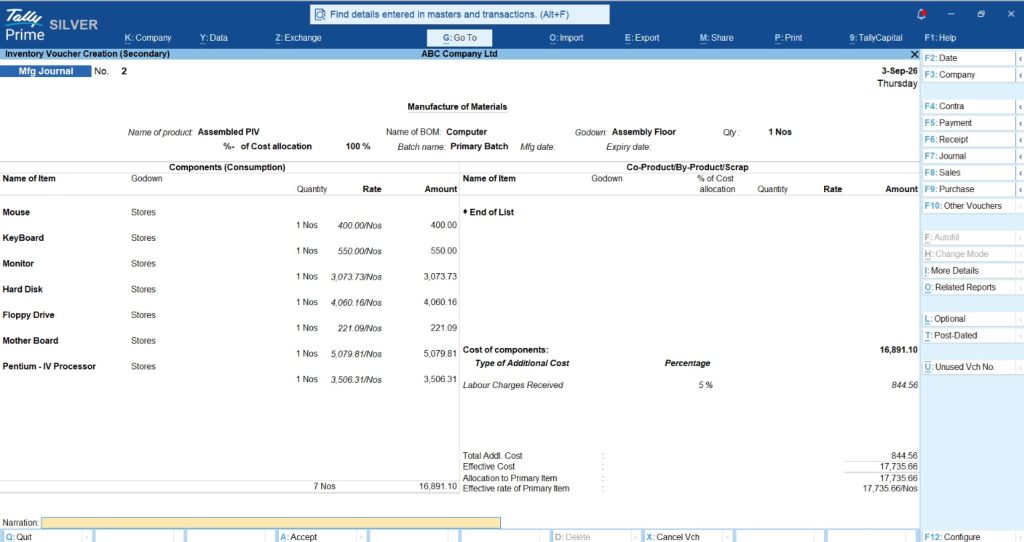
To record the transformation of materials, we use the Manufacturing Journal Voucher Type. This is a specialized class of the Stock Journal that performs a simultaneous dual entry:
- Debit (Inward): The creation of the Finished Good.
- Credit (Outward): The consumption of Raw Materials based on the BOM.
By recording production this way, the system automatically handles the "birth" of the product and the "death" of the components in one transaction. This is where you also account for By-Products, Co-Products, and Scrap, ensuring that even your waste has a ledger footprint.
Can TallyPrime Really Track Work-in-Progress (WIP)?
Yes, provided you move beyond a single-godown mindset. In my audits, I always recommend a Godown Hierarchy to map the physical flow:
- Raw Material Store (RM): For bulk purchases.
- Shop Floor WIP: For materials currently in the machines.
- Quality Control (QC): For finished items awaiting final sign-off.
When you move materials from RM to the Shop Floor using a Stock Journal, they are technically in "WIP" status. You can view the value of these items anytime via the Godown Summary report.
For projects requiring granular cost tracking, use Job Costing. Record Journal for direct expenses (like daily-wage labor or emergency cash purchases) directly to a specific Cost Centre or Project, ensuring the WIP valuation includes both material and "burnt" cash costs.
Also read about Affordable Batch Manufacturing and Expiry Tracking for Small Manufacturers
Example: From Raw Steel to Finished Part
Consider an automobile component manufacturer. Here is the professional workflow in TallyPrime:
- Step 1: Inward Movement: Raw steel sheets are recorded via a Purchase Voucher.
- Step 2: The Recipe: A BOM is defined for a "Steel Bracket," including hardware and a 2% expected scrap variance.
- Step 3: WIP Transfer: Steel is moved to the "Shop Floor WIP Godown" using a Stock Journal.
- Step 4: Consumption & Birth: The Manufacturing Journal is saved. Tally pulls the BOM, consumes the steel from the Shop Floor Godown, and adds the finished Brackets to the "Finished Goods" store.
The Result: Under a systematic Tally workflow, inventory variance stays near zero. Compare this to the "Excel way," which typically sees a 12% average inventory variance due to missed manual entries and "WhatsApp lag."
The "Excel Trap": Why Manufacturers Outgrow Spreadsheets
Excel is a consultant’s best friend but a manufacturer’s worst enemy when used as a primary database. Relying on spreadsheets alongside Tally creates a massive "Hidden Cost":
- ₹4.8 Cr Locked in Unmatched Stock: In my experience with mid-sized units, this is the average value of capital tied up simply because the system doesn't reflect physical reality.
- 3x Redundant Entries: Data is entered for the warehouse, again for production, and finally for the accounts team.
- 48+ Hour Approval Cycles: When purchase requests happen via email or WhatsApp, the lag in approval creates production bottlenecks that kill cash flow.
- Reporting Delays: Management often operates on a 2–3 day reconciliation lag, meaning decisions are always based on "old news."
Conclusion & Actionable Checklist
Control over your Work-in-Progress is the difference between a profitable factory and a cash-strapped one. If your WIP isn't reflected in your system, your Profit & Loss statement is essentially a work of fiction.
The "Senior Consultant" Production Checklist:
- Enable Multiple Godowns: Create a hierarchy (RM Store -> WIP Floor -> QC Hold).
- Standardize BOMs: Audit your "recipes" quarterly to ensure they match actual floor consumption.
- Voucher Class Setup: Create a dedicated "Manufacturing Journal" with pre-filled cost headers.
- Job Costing: Enable "Allow cash accounts in journals" for accurate Job Costing.
- Variance Analysis: Weekly, compare your BOM-predicted consumption against actuals in the Stock Summary to identify theft or wastage.
"The Balance Sheet starts on the shop floor; if your WIP isn't in Tally, your Profit & Loss is just a guess."














