










The AI Promise vs. Data Reality
AI tools don't fix dirty data, they amplify it. Before you attempt to automate your invoice processing or document workflows, you must clean your core accounting masters. Feeding unstructured master data into an automated system will only generate errors faster and at scale.
In my 20 years of working with growing businesses across manufacturing, retail, pharmacy, construction, dealerships, and e-commerce, I have seen hundreds of owners eagerly adopt cutting-edge automation, only to be hindered by mismatched inventory units or duplicate vendor accounts. When evaluating business management software, technology is only as effective as the underlying data it reads.
Preparing your books for artificial intelligence is not an expensive or overwhelming IT overhaul. It is straightforward, non-technical financial housekeeping that any business owner can oversee starting today. By standardizing your master records now, you create the exact foundation required for AI to process financial documents seamlessly.
Checkpoint 1: Are Your Ledger and Party Names Consistent?
When an AI document reader scans an incoming bill, it extracts the vendor or customer name and matches it against your chart of accounts. If your party list contains duplicate records, auto-mapping fails or posts to the wrong account.
A frequent mistake in SME accounting is creating separate ledgers for the same entity, such as maintaining "A & Co - S/Dr" under Sundry Debtors and "A & Co - S/Cr" under Sundry Creditors.
For instance, in a construction project where a subcontractor provides structural work but also purchases raw materials from you, or in an e-commerce setup with buyer-seller offsets, creating dual ledgers splits party balances and hides the true net position.
In my past consulting work with a multi-branch distributor, having triplicate ledgers for a single party forced accountants to spend minutes guessing which account to pick per bill, distorting vendor statements.
TallyPrime handles obverse balances naturally within a single account, permitting both debit and credit entries under Sundry Debtors or Sundry Creditors. Instead of splitting accounts, Tally’s sub-grouping best practices organize parties under functional or geographical sub-groups like Domestic Debtors or Trader Creditors (Tax Registered). Clean party masters enable modern AI invoice processing to auto-map party names accurately from scanned documents and retain your corrections for all future entries.
Checkpoint 2: Are Your GST Details and Master Classifications Accurate?
AI document tools extract tax numbers and line-item amounts directly from bills, but they rely on your master data setup to verify statutory compliance. Incorrect tax classifications in your masters will lead to return upload rejections during GSTR filings.
To ensure seamless compliance, maintain rigorous master data standards across three key areas:
- GSTIN Validity & Registration Status: Operating with invalid, suspended, or inactive GSTINs causes instant portal rejections. Furthermore, keep statutory digit requirements aligned with your Aggregate Annual Turnover (AATO): businesses with AATO up to ₹5 Crore must report 4-digit HSN codes, while those with AATO above ₹5 Crore require 6-digit HSN codes.
- State & Place of Supply: Accurate state settings ensure proper tax component calculation (IGST vs. CGST/SGST).
- Type of Supply & UQC Rules: Pay close attention to HSN classification rules. If an HSN code begins with '99', the Type of Supply must be explicitly set to Services, and the Unit Quantity Code (UQC) must be set to NA. Selecting OTH (Others) for service HSN codes is a widespread trap that triggers portal upload errors (The UQC entered is not valid). Conversely, if the HSN does not start with '99', classify the Type of Supply as Goods.
To clean your tax data effortlessly before enabling automation, open TallyPrime's built-in Validate Party GSTIN/UIN report and press Alt+L (Fetch Details Using GSTIN/UIN) inside the report to verify GSTIN statuses live against the portal and correct party records in bulk.
Checkpoint 3: Have You Standardized Your Stock Item Names and Units?
Line-item extraction is a core benefit of AI billing tools, but it encounters issues when inventory masters lack standardized names or unit definitions. If invoice descriptions vary or measurement units are missing, automated line-item mapping fails.
This issue appears across multiple industries:
- A pharmacy purchases medicines in outer cartons or boxes but dispenses them to patients in individual strips or tablets.
- A manufacturing plant orders raw steel in metric tonnes but consumes and tracks structural components in pieces.
- A retail or dealership outlet receives bulk cases from distributors but bills customers per unit.
To resolve line-item extraction errors, define a clear Primary Unit of Measurement and map the appropriate statutory Unit Quantity Code (UQC) for every stock item. When vendors bill in alternate units, configure clean conversion factors directly inside the stock master.
For instance, if your primary unit is Pieces and the alternate unit is Box, set the default conversion rate (e.g., 100 pieces = 1 box).
TallyPrime allows flexible overrides during voucher entry (such as adjusting to 56 pieces = 1 box for a specific shipment). When structured conversion rates exist, AI engines map incoming bill lines to your exact stock masters without manual re-keying.
Checkpoint 4: Is There a Difference in Your Opening Balances?
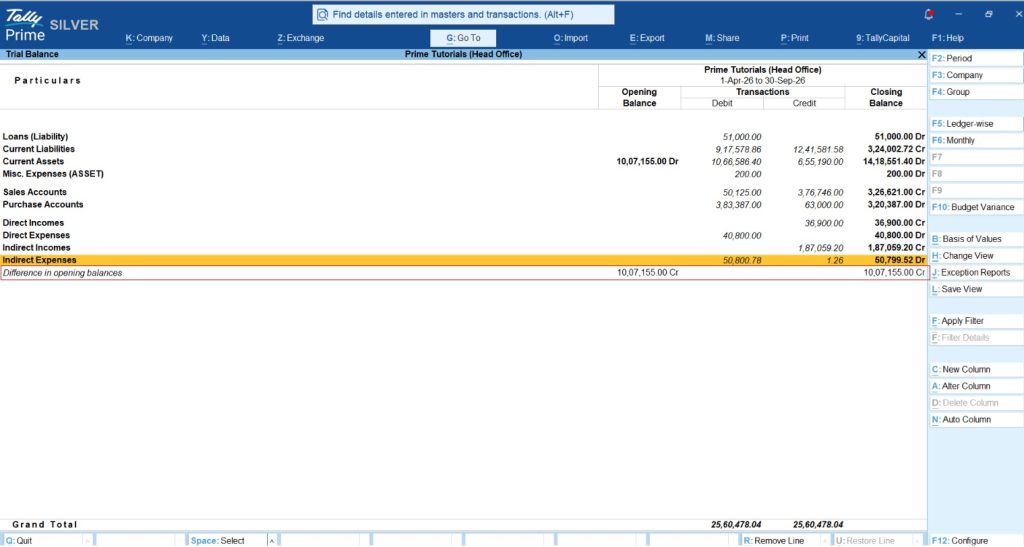
An unbalanced Trial Balance or an unresolved "Difference in opening balances" line indicates that your underlying books are mathematically inconsistent. Processing automated entries on top of an unbalanced ledger distorts financial statements like the Balance Sheet and Profit & Loss account.
Root cause diagnostics show that opening balance imbalances typically arise from three common accounting events:
- Manual Entry Errors: Human mistakes when keying in initial debit or credit values during company setup.
- Data Split Discrepancies: Carried-forward opening balance errors that occur when splitting company data at year-end.
- Import & Sync Overwrites: Importing or synchronizing ledgers from external software or branches that accidentally overwrites established opening balances.
To identify and eliminate opening balance differences, use this simple workflow:
- Access the Trial Balance: Press Alt+G (Go To) > type Trial Balance > press Enter (or go to Gateway of Tally > Display More Reports > Trial Balance).
- Expose Opening Balances: Press F12 (Configure) and set Show Opening Balance to Yes. If an imbalance exists, TallyPrime displays a dedicated Difference in opening balances line.
- Cross-Verify Ledgers: Compare individual opening balances against your prior year's audited Balance Sheet to pinpoint the exact ledger mismatch.
- Update Masters Directly: Correct the imbalance by altering the specific ledger (Alt+G > Alter Master > Ledger > select the ledger > update the Opening Balance field and save).
Once credit and debit opening values balance, the discrepancy line automatically disappears, establishing a mathematically sound foundation for AI automation.
The Payoff: How Clean Masters and Docs by Ira Work Together
Once your core master data is clean, upgrading to AI capabilities like Docs by Ira transforms document management from a manual entry chore into a fast review workflow.
Docs by Ira leverages your structured masters through powerful capabilities:
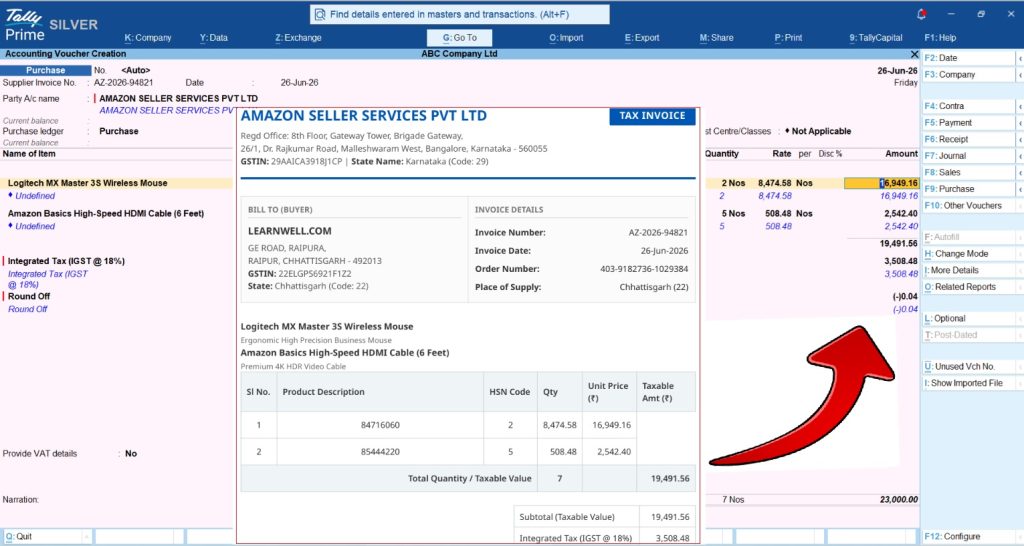
- Multi-Channel Document Capture: Capture incoming bills instantly by taking photos via the mobile app, uploading files on desktop, or receiving PDFs, JPEGs, JPGs, or ZIP files directly through WhatsApp.
- Automated Data Extraction: AI instantly reads scanned documents and extracts the Party Name, Invoice Number, Invoice Date, Tax amounts, and Line Items reducing manual typing by up to 80%.
- Smart Auto-Mapping & Duplicate Detection: Automatically maps vendor and inventory details to your cleaned masters, detects duplicate invoices to prevent double payments, and suggests new master creations when scanning new suppliers.
- Proactive Exception Highlighting: Automatically flags missing GSTINs, rate mismatches, or incomplete details before posting, directing your attention only to items requiring human review.
- Draft Voucher Creation: Converts incoming documents into accounting-ready draft vouchers inside TallyPrime for final verification.
Human Control & Privacy at Every Step: AI in TallyPrime operates under total user oversight. Transactions are never posted autonomously; every document becomes a draft voucher that requires human review and approval. Furthermore, your business data and documents are processed strictly for your operations and are never shared or used to train public AI models.
Practical Framework: The SME Owner's Pre-Automation Readiness Checklist
|
Focus Area |
Housekeeping Action Item |
AI Automation Benefit |
|
Party Ledgers |
Consolidate duplicate party accounts; verify legal party names. |
Seamless auto-mapping of vendor/customer names on scanned bills. |
|
GST Details |
Validate GSTINs via built-in tools; set correct Type of Supply for HSNs. |
Error-free draft tax vouchers ready for instant GSTR filing. |
|
Stock Masters |
Standardize item names and configure UQC/unit conversion rates. |
Accurate line-item extraction without manual inventory re-keying. |
|
Opening Balances |
Eliminate Trial Balance differences via Master Alteration. |
Dependable financial reports and accurate running balance tracking. |
Conclusion & Actionable Takeaways
Preparing your business for artificial intelligence is not a daunting technical leap. It is simply a natural extension of disciplined daily accounting practices. By consolidating duplicate ledgers, verifying GST master details, standardizing stock units, and resolving opening balance differences, you eliminate the underlying friction that causes automation initiatives to fail.
When clean master data is paired with human-in-the-loop AI tools, invoice processing becomes fast, effortless, and precise. Whether your team operates locally on desktop or utilizes secure TallyPrime Cloud access across multiple branches, establishing structured masters today empowers your organization to cut manual data entry by up to 80% while maintaining absolute financial control.
"AI doesn't replace the need for clean books, it rewards it. When your master data is structured, AI turns hours of manual entry into a quick review."














