










The SME Cash Flow Trap
In my 20 years working with business owners across manufacturing, retail, construction, auto, and e-commerce, I have seen healthy, growing companies close their doors for one primary reason: running out of actual cash.
A business can easily show strong accounting profitability on an accrual basis while quietly sliding into an acute liquidity crisis. Profit on paper does not help when you cannot meet Friday's payroll or clear a critical supplier payment.
Why do so many SMEs run into these sudden cash shortages?
It is because traditional cash flow management is inherently reactive, relying on outdated spreadsheets rather than live ledger data.
Market data shows that roughly 60% of SMEs regularly struggle with cash flow management and forecasting. In my experience, real-time accuracy is what transforms standard financial reports into genuine early warning systems.
Why Are SME Cash Flow Reports Always Lagging? (The Manual Ingestion Drag)
In my two decades of advisory work with auto component, construction, and retail clients, I have found that manual data entry is where cash flow visibility goes to die. When a finance department relies on manual document transfer, information moves at a crawl while business operations move at full speed.
Consider the hard numbers behind this operational drag:
- 72% of SMEs still rely on manual spreadsheets for cash flow projections.
- 76% of data entry staff spend up to 3 hours every day manually transferring transaction records across spreadsheets and accounting systems.
This reliance on manual entry creates days or even weeks of data latency. When management reports reflect the state of a business as it existed two weeks ago, executive decisions are made on outdated assumptions.
Furthermore, manual bookkeeping introduces persistent human errors that directly distort financial statements:
- Mistyped figures and transposed numbers on high-value invoice amounts.
- Duplicate vouchers created from uncoordinated email and paper uploads.
- Misclassified expense categories distorting actual operating margins.
- Omitted tax lines interrupting multi-tier tax credit reconciliations.
- Unallocated customer receipts leaving paid bills marked as outstanding.
To understand how manual bookkeeping undermines cash visibility compared to automated ingestion, consider the workflow comparison below:
|
Processing Dimension |
Traditional Manual Spreadsheet Workflow |
AI-Driven Real-Time Ingestion Workflow |
|
Primary Data Source |
Paper invoices, physical receipts, email attachments |
Invoices and supported PDF bank statements processed through Docs by Ira |
|
Ingestion Mechanism |
Batched manual keying into spreadsheets |
AI-powered invoice processing and supported PDF bank statement import, with intelligent mapping and bulk voucher creation |
|
Data Processing Latency |
Days to weeks behind operational reality |
AI-powered extraction and processing to prepare accounting entries for review and approval |
|
Ledger State |
Static, historical, and prone to entry errors |
Updated accounting records after extracted transactions are reviewed, approved, and posted |
|
Executive Impact |
Reactive firefighting during unexpected cash crises |
Proactive risk mitigation weeks before shortfalls occur |
How Does AI Clean Up the Data Pipeline?
When business owners ask me if they need fancy machine learning algorithms or speculative prediction engines to fix their cash flow, I give them a blunt answer: No.
In standard SME accounting, deterministic calculations, adding up known accounts receivable, scheduled payables, bank balances, and fixed overheads are mathematically sufficient to project future liquidity. The primary barrier to reliable forecasting is not mathematical complexity; it is the speed, quality, and completeness of the underlying data.
AI's core value in accounting is not replacing deterministic logic with speculative guessing, but securing the data entry pipeline at the source. This is where AI comes in.
The Ingestion Mechanism: Docs by Ira
To reduce manual data entry bottlenecks, TallyIra brings AI-powered invoice processing and supported PDF bank statement import directly into TallyPrime through Docs by Ira. This capability helps businesses turn information from invoices and bank statements into structured data that can move into the accounting workflow, reducing repetitive entry and improving the timeliness of financial records.
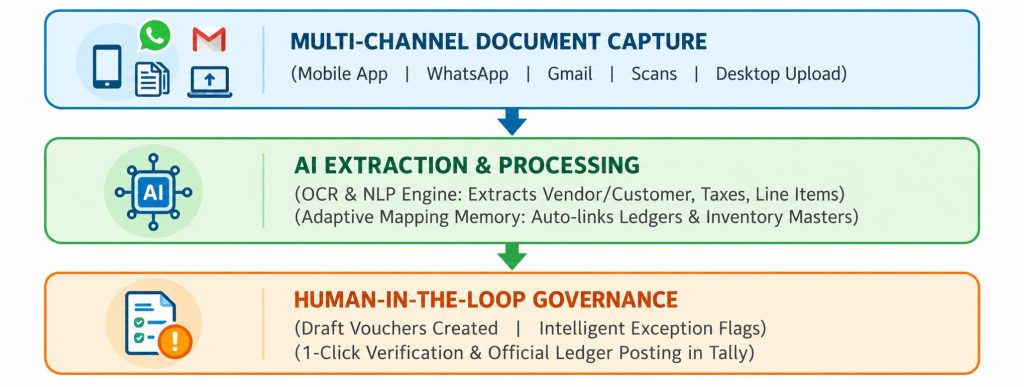
Docs by Ira simplifies everyday accounting through the following capabilities:
- AI-Powered Invoice Processing: Extracts information from invoices and helps convert it into structured information for creating accounting entries, reducing the need for repetitive manual typing.
- PDF Bank Statement Import: Enables businesses to import transactions from supported PDF bank statements and use TallyPrime's existing reconciliation features to match them against their books.
- Intelligent Mapping and Bulk Voucher Creation: Uses intelligent mapping to simplify transaction creation, while bulk voucher creation helps accountants process multiple transactions more efficiently.
- Exception Highlighting and Human Review: Highlights exceptions and information requiring attention, allowing accountants to review, verify, and approve entries before they are posted to the books.
The key advantage is that AI assists with extraction and transaction preparation, while the accountant remains in control of the final accounting entries.
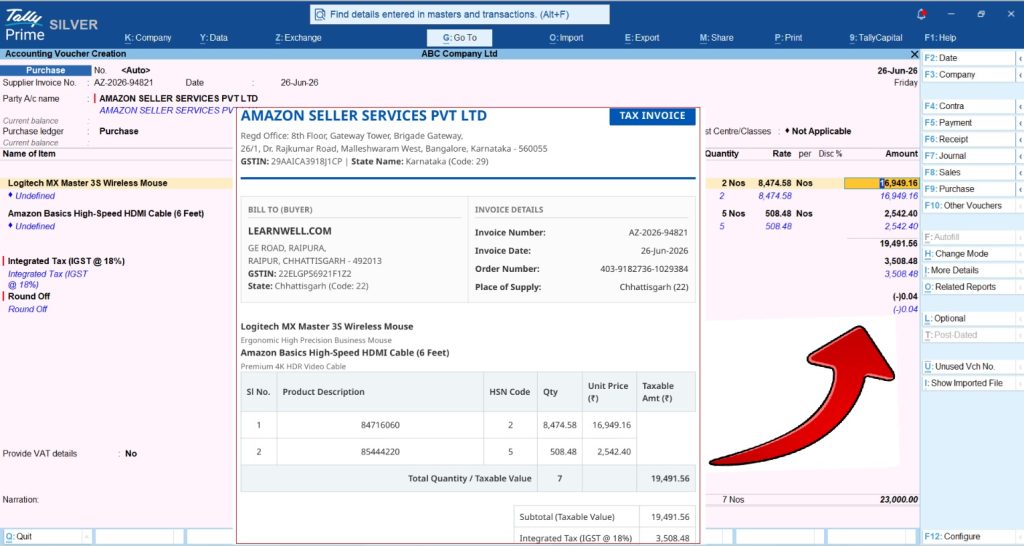
Learn how to configure your document capture pipeline step-by-step in our TallyIra Workflow Setup Guide
"The true power of AI in accounting isn't a complex prediction engine, it's ensuring the everyday transaction data feeding your core reports is fast, accurate, and trustworthy enough to act on."
How Do Live Invoices Turn into Early Warning Indicators in TallyPrime?
In my advisory practice, once we improve the data entry pipeline, I show executive teams how TallyPrime transforms from a passive recording system into an active command center. With Docs by Ira supporting AI-powered invoice processing and supported PDF bank statement import, businesses can reduce manual entry and prepare accounting transactions more efficiently. Once these entries are reviewed, approved, and posted, the updated ledger data feeds into TallyPrime's reporting and analytical tools, helping business owners identify potential liquidity risks before they disrupt operations.
Dynamic Dashboards
TallyPrime provides visual dashboard tiles that aggregate live ledger data. Business owners can review net bank availability, daily sales trends, accounts receivable age, stock summary, immediate payables and more, knowing every metric reflects live voucher postings.
Cash Flow Projections (Ctrl+B)
The Cash Flow Projection report models expected incoming and outgoing funds across daily, weekly, or monthly intervals. Managers can tailor projections to real-world conditions using the Basis of Values configuration (Ctrl+B):
- Bank Overdraft (OD) Limits (Alt+S): Incorporate sanctioned credit lines into baseline liquidity calculations (Alt+S). This avoids false alarms while establishing exact liquidity floors.
- Overdue Bill Integration: Toggle past-due receivables and payables into short-term projections to measure the immediate impact if delayed customer payments settle suddenly.
- Provisional Scenarios: Include optional vouchers, memorandum entries, or reversing journals to model unbilled purchase orders, expected sales, or upcoming tax liabilities.
To optimize these parameters for your business, explore our Cash Flow Projection Configuration walkthrough.
Bill-by-Bill Ageing Analysis
Controlling accounts receivable is essential for maintaining liquidity. TallyPrime tracks balances on a bill-by-bill basis, categorizing unpaid invoices into custom age buckets (0–30, 31–60, 61–90, and 90+ days). The system tracks payment history to calculate average customer payment performance, while credit control functions trigger warnings during sales order creation if a buyer has overdue bills or exceeds assigned credit limits.
MSME Section 43B(h) Compliance
Regulatory compliance directly impacts cash outlays. Under Section 43B(h) of the Income Tax Act in India, payments to registered Micro and Small Enterprises (MSEs) must be settled within written agreement terms (capped at a maximum of 45 days) or within 15 days without a contract. Beyond these deadlines, the purchase expense is disallowed from taxable income deductions for that fiscal year directly inflating your income tax outgo alongside mandatory statutory interest penalties. TallyPrime categorizes vendors by UDYAM registration and tracks deadlines against statutory 15-day and 45-day thresholds.
AI-powered invoice processing through Docs by Ira can help reduce delays in recording supplier invoices. Once the extracted details are reviewed, approved, and posted in TallyPrime, the updated accounting records can support better visibility into upcoming MSME payment obligations.
For full details on compliance setup, read our guide on Section 43B(h) MSME Compliance Rules.
Scenario: How Apex Industrial Solutions Averted a ₹4 Lakh Shortfall
Let me walk you through a real-world scenario from my SME financial advisory practice involving Apex Industrial Solutions, an industrial equipment distributor.
The Financial Profile
- Annual Revenue: ₹18 Crore
- Bank Balance: ₹12 Lakhs
- Sanctioned Bank OD Limit: ₹10 Lakhs
- Total Available Liquidity Ceiling: ₹22 Lakhs
- Fixed Commitments: ₹14 Lakhs payroll (due on the 25th) + ₹12 Lakhs Section 43B(h) MSME payables (due on the 28th) = ₹26 Lakhs Total Commitment
- Baseline Deficit: ₹4 Lakhs shortfall above total available liquidity unless collections arrive as scheduled.
Outcome A: Traditional Lagging Bookkeeping
Invoices sit in physical transit or binders during the first three weeks of the month. On Day 12, customer Beta Manufacturing fails to settle a ₹15 Lakhs invoice due on Day 10. Because books are updated manually at month-end, the owner assumes liquidity is adequate. The accountant enters batch records on Day 23, just 48 hours before payroll, revealing that Beta's bill is 13 days overdue and ₹12 Lakhs in MSME payables are due in 5 days. Caught with a ₹4 Lakhs cash deficit and no lead time, Apex breaches its OD limit, incurs late fees, delays vendor payments, and faces an operational crisis.
Outcome B: AI-Assisted Accounting and Timely Cash Flow Visibility (Docs by Ira + TallyPrime)
On Days 1 to 3, the accounting team processes incoming invoices using Docs by Ira's AI-powered extraction and intelligent mapping capabilities. Supported PDF bank statements can also be imported, with TallyPrime's existing bank reconciliation features helping match bank transactions against the books. The accountant reviews highlighted exceptions, verifies the extracted details, and approves the accounting entries before posting.
On Day 05, the owner reviews the updated financial reports in TallyPrime and runs a Cash Flow Projection with overdues and OD limits enabled (Ctrl+B).
With the relevant invoices and transactions reviewed and posted, the ledger reflects updated receivables and payables, helping the owner identify Beta Manufacturing's overdue bill and assess the projected ₹4 Lakhs cash shortfall on Day 25.
Positioned 20 days ahead of the deadline, the owner acts:
- Generates an automated outstanding statement with an embedded Razorpay payment link directly to Beta's finance director.
- TallyPrime automatically halts further credit sales to Beta.
- Beta agrees to a partial payment of ₹10 Lakhs, which clears on Day 15.
- Payroll is met smoothly on Day 25, and MSME vendor obligations are fully cleared on Day 28.
|
Scenario Stage |
Traditional Lagging Workflow |
Real-Time AI Ingestion Workflow |
|
Invoice Registration |
Delayed until Day 22 via manual month-end batch entry |
Invoices processed using Docs by Ira's AI-powered extraction, intelligent mapping, and exception highlighting, with entries reviewed and approved before posting on Days 01–03 |
|
Overdue Identification |
Discovered on Day 23 after manual posting |
Detected on Day 05 via dynamic Cash Flow Projection |
|
Shortfall Prediction |
Surfaced 48 hours before payroll deadline |
Surfaced 20 days before payroll deadline |
|
Collection Action |
Emergency phone calls; hostile payment chasing |
Automated payment links (Razorpay QR) & credit holds |
|
Financial Outcome |
Overdraft breach, late fees, delayed vendor pay |
Liquidity secured Day 15; payroll & MSME bills met |
Why Does Cloud Access Matter for Cash Flow Visibility?
I always tell my executive clients that an early warning system sitting on an office desktop in an empty building is completely useless when you're traveling or managing job sites. Executive responsiveness requires access to live records wherever decisions happen.
TallyPrime Cloud Access extends desktop accounting capabilities into a flexible cloud environment. Business leaders and external advisors can access TallyPrime via web browsers on macOS, Linux, or Windows PCs, or through virtual clients. This enables remote decision-makers to review ageing reports, run cash flow projections, and access updated accounting information after invoice and bank transactions processed with Docs by Ira have been reviewed, approved, and posted in TallyPrime.
Governance and security are maintained through a dual-layer security model:
- Authentication: Tally.NET user credentials, mandatory Secure PINs, and Two-Factor Authentication (2FA).
- Access Permissions: Configured via a Self-Service Portal (SSP) with rights set to Allowed (full edit permissions), Disallowed (restricted access), or Allowed in TallyPrime (restricting users to read-only application access while strictly blocking raw data file downloads, safeguarding proprietary ledgers).
- Automated Backups: System connections trigger automated, encrypted backups stored in isolated cloud storage to safeguard against local hardware failure or malware.

Conclusion & Actionable SME Cash Flow Checklist
Achieving reliable cash flow visibility depends on eliminating processing latency at the point of document receipt, ensuring your accounting ledgers reflect live operational reality before you attempt long-term forecasting. By automating data ingestion, you give your management team the trustworthy lead time required to protect liquidity and sustain growth.
In my experience, moving from reactive firefighting to proactive cash management requires following this practical step-by-step framework:
-
Eliminate Document Processing Delays: Use Docs by Ira's AI-powered invoice processing and supported PDF bank statement import to reduce repetitive manual entry. Leverage intelligent mapping, exception highlighting, and bulk voucher creation to simplify transaction processing, while ensuring that accountants review, verify, and approve entries before posting.
-
Enforce Bill-by-Bill Ledger Tracking: Ensure Maintain Bill-by-Bill is enabled for all debtor and creditor ledgers, assigning explicit credit periods and credit limits to every customer account.
-
Configure Dynamic Projections: Routinely run TallyPrime Cash Flow Projections (Ctrl+B), factoring in sanctioned Bank Overdraft limits (Alt+S), overdue bills, and memorandum vouchers.
-
Monitor MSME Payment Deadlines: Track vendor UDYAM registration statuses and set payment alerts for statutory 15-day and 45-day limits to maintain Section 43B(h) tax compliance.
- Enable Remote Executive Access: Deploy TallyPrime Cloud Access so business leaders can review ageing reports and approve draft vouchers from anywhere.














