










A business needs multi-company consolidation the moment it operates more than one legal entity - a branch, a subsidiary, or an associate company, and someone, whether an owner, an auditor, a lender, or an investor, needs to see the group's financial position as a whole rather than as separate sets of books. This need shows up through signals like: intercompany transactions becoming frequent, external stakeholders asking for group-level numbers, statutory filings requiring consolidated figures, or manual Excel-based roll-ups starting to take days instead of hours.
For a single-entity business, closing the books each month is fairly simple: reconcile accounts, review the trial balance, and prepare the financial statements. But when a business adds another entity, a branch, sister concern, or subsidiary, the process becomes more complex, with multiple sets of books that need to work together.
Group structures are increasingly common. A manufacturing business might set up a separate trading arm. A services company might incorporate a subsidiary to enter a new geography. A family-run enterprise might operate three or four legal entities across generations, each with its own GST registration, bank accounts, and statutory obligations.
This blog breaks down these signals in more detail, what complex consolidation involves, and why the right accounting software makes this transition far less seamless.
What is multi-company consolidation?
Multi-company consolidation is the process of combining the financial data of two or more related entities into a unified set of financial statements. It typically involves:
- Aggregating: revenue, expenses, assets, and liabilities across entities
- Eliminating: intercompany transactions (e.g., one group company selling to another) so the group's numbers aren't inflated
- Adjusting: for differences in accounting periods, currencies, or minority interests where applicable
- Presenting: a consolidated balance sheet, profit & loss statement, and cash flow statement that reflect the group as a single economic entity
Consolidation is different from simply adding up numbers across companies. It requires structure - a consistent chart of accounts, standardised reporting periods, and a reliable way to identify and net off intercompany balances.
Watch this video to understand how to manage multiple companies in TallyPrime
When does a business first needs to consider consolidation
1. You've registered a second legal entity
The most direct signal is when you have a second legal entity. Whether it's a branch office, a subsidiary, or a separate company for a new product line, the moment a second entity exists, someone will eventually ask: "What does the group look like together?"
2. Investors, lenders, or boards are asking group-level questions
Once external stakeholders enter the picture, banks assessing group creditworthiness, investors reviewing overall performance, or a board wanting a consolidated P&L, entity-by-entity reports aren’t sufficient. Group-level financial statements become a baseline expectation.
3. Intercompany transactions are becoming frequent
If entities within the group regularly buy from, sell to, or lend money to each other, tracking and eliminating these transactions manually gets error-prone fast. This is one of the clearest operational signals that structured consolidation is a necessity.
4. Statutory or regulatory filings require group figures
Certain regulatory, tax, or compliance filings require consolidated figures rather than standalone entity numbers. When this requirement appears, ad hoc spreadsheet consolidation becomes a compliance risk rather than just an inconvenience.
5. Multiple currencies or locations enter the picture
A group with entities operating in different states or countries introduces currency conversion, differing statutory formats, and location-specific reporting. All of this adds real complexity to a simple roll-up.
Why spreadsheet-based consolidation breaks down
Many growing businesses start consolidation the same way: someone exports trial balances from each entity into Excel and manually combines them. This works fine for two entities with low transaction volume. But, it becomes unsustainable when:
- The number of entities grows: each additional company adds exponential complexity to manual elimination entries
- Reporting frequency increases: monthly or quarterly consolidation is far more demanding than an annual exercise
- Chart of accounts drift: entities that evolved separately often end up with slightly different account structures, making a clean roll-up difficult
- Audit trail expectations rise: auditors and regulators increasingly expect traceable, system-generated consolidation, not manually adjusted spreadsheets
- Human error compounds: a single formula mistake in a multi-entity spreadsheet can misstate group-level numbers without anyone noticing until much later
This doesn’t mean a business has done anything wrong by starting with spreadsheets. It's a natural first step. The signal to move on is simply when the effort of manual consolidation starts outweighing the time saved by not adopting a system built for it.
What complex consolidation looks like in practice
Complexity in group consolidation usually comes from a combination of the following, not any single factor alone:
- Entity count: Three or more companies materially increases coordination effort
- Ownership structure: Wholly owned subsidiaries vs. partially owned associate companies require different treatment
- Intercompany elimination: Sales, loans, or transfers between group companies need to be identified and netted off accurately
- Currency differences: Group entities transacting in different currencies need consistent conversion for a true consolidated view
- Reporting cadence: Monthly management consolidation vs. annual statutory consolidation have very different turnaround expectations
A business doesn't need to hit every one of these to benefit from structured consolidation. Even one or two of these factors is usually enough to justify moving away from manual methods.
How TallyPrime supports complex financial consolidation for groups
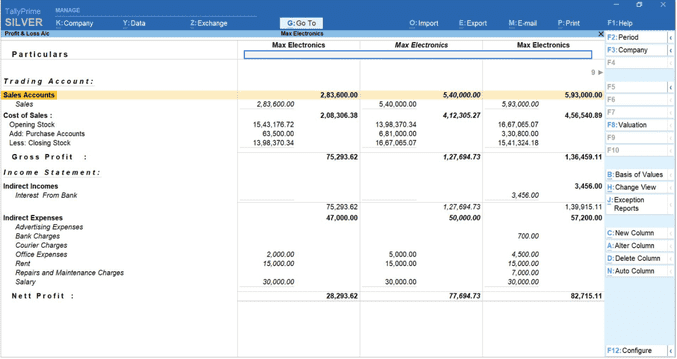
TallyPrime is built to handle this kind of group-level complexity, without asking finance teams to abandon the accuracy and control they expect from managing each entity independently. With TallyPrime, businesses can:
- Consolidate financial statements across multiple companies: Combining ledgers, trial balances, and final accounts of group entities into a unified view, while each entity's own books remain fully intact and independently accurate
- Handle multi-currency consolidation: Group companies transacting in different currencies are consolidated with consistent conversion, so the group-level picture is coherent
- Maintain entity-level integrity: Consolidation doesn't mean merging companies into one data set. In TallyPrime, each entity keeps its own vouchers, ledgers, and statutory reports, with consolidation happening as a reporting layer on top
- Scale as the group grows: Whether it's two related companies or a larger group structure, the consolidation process works the same way, so businesses don't need to re-architect their accounting setup as they add entities
- Generate consolidated reports on demand: Rather than waiting for a manual monthly roll-up, group-level P&L and balance sheet views can be pulled whenever they're needed
For a business that has grown from a single entity into a group, through expansion, diversification, or restructuring, this means the accounting system grows with the structure. The finance team doesn’t have to build a separate consolidation process.
Read more on how to activate multi-currency in TallyPrime
Signs to move to a structured consolidation
A business should seriously consider structured, system-based consolidation when most of the following are true:
- More than one legal entity exists under common ownership or management
- Consolidated reports are requested more than once or twice a year
- Intercompany transactions occur regularly
- Any entity operates in a different state, region, or currency
- Manual consolidation is taking days rather than hours each reporting cycle
- Auditors have raised questions about consolidation methodology or traceability
- The group is preparing for external funding, a loan application, or a statutory filing that requires group-level figures
If three or more of these apply, manual consolidation has likely already become a bottleneck, even if it hasn't caused a visible problem yet.
Conclusion
Multi-company consolidation isn't a milestone reserved for large enterprises, it's a natural next step for any business that has grown into a group structure. The earlier a business moves from manual roll-ups to a system that consolidates accurately and consistently, the less disruptive the transition tends to be.
With TallyPrime's support for complex financial consolidation, groups can get a reliable, group-wide financial picture without compromising the accuracy of each entity's own books.














