










Many business owners still make critical decisions using outdated spreadsheets, month-end reports or assumptions about what is selling well. The challenge is that retail, D2C and wholesale businesses move quickly, making delayed information far less useful.
A pricing issue, a slow-moving product category or a customer delaying payments can affect cash flow long before monthly financial statements are reviewed. TallyPrime helps founders track inventory, profitability, sales performance and cash flow through real-time business reports, enabling decisions based on current numbers rather than estimates.
How founders use TallyPrime reports to make decisions
Faster access to information becomes valuable only when it leads to action. Here are some of the ways founders use TallyPrime business reports to make day-to-day business decisions.
Tracking category-wise margins instead of relying on total sales
Revenue growth does not always mean profit growth. A business may see rising sales while margins continue shrinking because high-volume products are generating lower returns.
TallyPrime provides item-wise profitability and stock-related reports that help businesses analyse profitability at a product level. This helps businesses compare revenue performance with actual profitability across product categories.
Example
Suppose a D2C skincare brand has the following sales figures:
- Face wash: ₹12 lakh monthly revenue
- Serums: ₹8 lakh monthly revenue
- Sunscreens: ₹6 lakh monthly revenue
At first glance, face wash appears to be the strongest category. However, profitability reports may reveal something different. For example:
|
Product category |
Revenue |
Margin |
|
Face wash |
₹12 lakh |
12% |
|
Serums |
₹8 lakh |
28% |
|
Sunscreens |
₹6 lakh |
24% |
Instead of increasing marketing spend on the highest-selling category, ie, face wash, the founder may decide to focus customer acquisition efforts on serums because they contribute more profit per sale.
Identifying slow-moving stock before it affects working capital
Excess inventory uses up cash that could otherwise be used for purchasing fast-selling products, marketing campaigns or business expansion.
TallyPrime includes inventory reports such as stock summary, movement analysis, inventory reorder status and stock ageing analysis. These reports help businesses identify slow-moving stock, ageing inventory and products approaching expiry.
Example
Let’s assume a wholesale distributor stocks 2,000 units of a product. Monthly sales data shows:
- First quarter: 500 units sold per month
- Current quarter: 120 units sold per month
Without inventory analysis, the business may continue ordering the same quantity.
By reviewing stock movement and ageing reports, the founder can reduce future purchases, clear old inventory through promotions and avoid further accumulation of unsold inventory.
Learn how to manage your stock efficiently with TallyPrime.
Understanding which customers are actually profitable
Big organisations are not always the most valuable customers. Some customers place frequent orders but negotiate lower margins, require higher servicing costs or take significantly longer to make payments. Looking only at sales volume can create a misleading picture of business performance.
TallyPrime allows businesses to analyse sales, profitability, receivables and customer-level transactions through reports such as sales register, bills receivables and profitability analysis.
Example
Say, a wholesale business serves two major customers with the following data:
|
Customer |
Annual sales |
Gross margin |
Average payment cycle |
|
Customer A |
₹1 crore |
8% |
90 days |
|
Customer B |
₹70 lakh |
18% |
30 days |
Clearly, Customer A generates higher revenue. However, Customer B contributes stronger margins and faster collections, improving both profitability and cash flow efficiency.
This type of visibility helps founders decide where to focus sales efforts and credit limits.
Monitoring cash conversion instead of waiting for month-end reports
Many businesses face financial pressure despite reporting healthy sales numbers. The issue is often cash conversion. Revenue may increase while cash remains stuck in inventory or outstanding receivables.
TallyPrime provides cash flow statements, cash flow projection reports and receivables tracking that help businesses monitor incoming and outgoing funds throughout the reporting period.
Example
Assume a retailer generates ₹30 lakh in monthly sales. At the same time:
- ₹12 lakh remains stuck in receivables.
- ₹18 lakh is tied up in inventory.
- Supplier payments are due within 30 days.
Sales appear healthy, but working capital pressure is increasing.
Cash flow and receivables reports help identify these issues earlier, allowing founders to follow up on collections, adjust purchasing plans or manage payment schedules before cash shortages become serious.
Making inventory and purchasing decisions using live business data
Retail and wholesale businesses often lose money through over-ordering or under-ordering inventory. Ordering too much increases storage costs and working capital requirements. Ordering too little can result in lost sales and stock-outs.
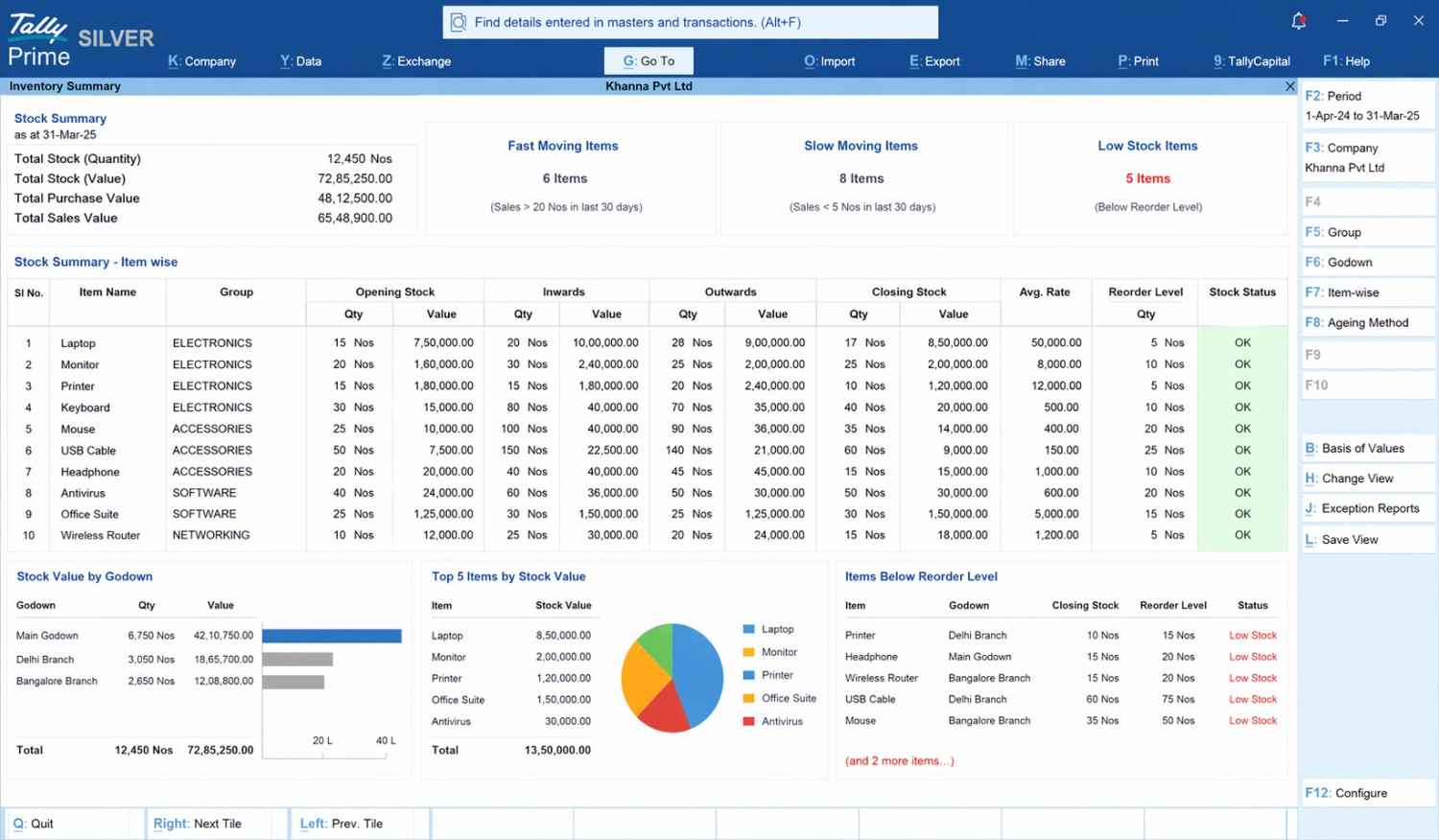
TallyPrime's inventory reports help businesses review current stock availability, reorder requirements, inventory valuation and location-wise inventory levels before making purchasing decisions.
What questions can founders answer quickly using TallyPrime?
Founders can use TallyPrime features and reports to quickly answer operational questions such as:
- Which products generate the highest margins?
- Which SKUs are moving slowly?
- Which customers contribute the most profit?
- Which invoices remain unpaid?
- How much cash is expected to come in this month?
- Which inventory categories require replenishment?
Having access to these answers earlier often leads to better pricing, purchasing and sales decisions.
Conclusion
For retail, D2C and wholesale businesses, decision-making often depends on how quickly operational issues become visible. Delayed visibility into inventory movement, customer payments, product profitability or cash flow can lead to missed opportunities and unnecessary working capital pressure.
TallyPrime helps businesses bring accounting, inventory, sales and receivables data into a single system, making it easier to track performance and act on emerging issues without waiting for month-end reviews. As transaction volumes grow, having faster access to business information can help founders make more informed decisions across pricing, purchasing, collections and inventory planning.














