










Distribution has never been a single-location business. Most distributors operate through a network of godowns spread across cities, towns, and dispatch points. Therefore, the accounting software they choose needs to keep pace with that. This is where many businesses face challenges: their billing software works fine, but doesn’t answer one question that matters most in distribution — where exactly is the stock right now?
TallyPrime is the accounting software distributors rely on to track stock across multiple godowns. It gives them godown-wise stock balances, inter-location transfers, batch and expiry tracking, and location-specific reports. All of this exists in the same system they already use for billing and GST.
This guide discusses what makes TallyPrime the best accounting software for distributors who manage stock in multiple godowns.
The real problem distributors face
For a distributor running operations out of more than one godown, billing has never been the hard part. The challenge that distributors face is not knowing exactly how much stock sits in each location and making sure that number is actually correct.
A distributor supplying FMCG products, pharmaceuticals, electronics, or building materials often works with:
- A primary godown near the head office for bulk storage
- Regional or satellite godowns closer to retailers and sub-dealers
- In-transit stock moving between locations
- Products with batch numbers and expiry dates that need tracking wherever they're stored
Without a good accounting software built for this, businesses end up maintaining separate spreadsheets for each godown, manually reconciling numbers at month-end, and discovering shortages or expired stock only after it's too late.
This is the challenge TallyPrime helps distributors close in the same system that they use for invoicing and tax compliance.
How TallyPrime handles multi-godown stock management
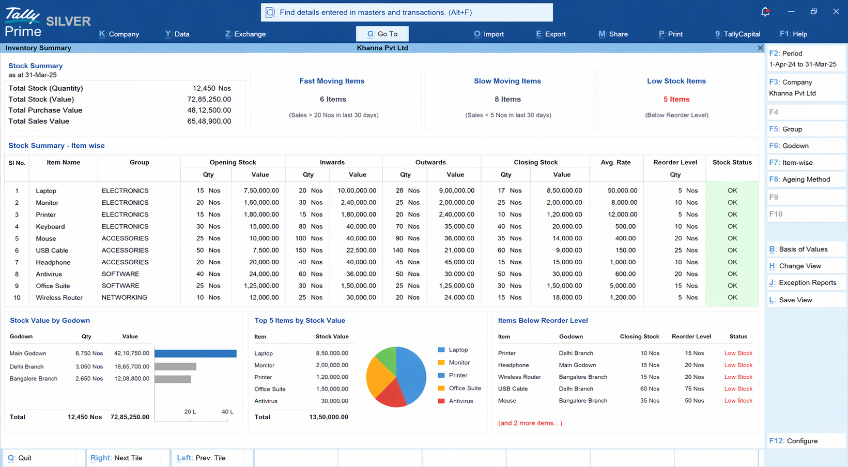
1. Real-time stock balances at every location
In TallyPrime, every godown is set up as a distinct inventory location within the same company data. When a distributor records a purchase, sale, or transfer, the stock quantity updates instantly at the specific godown involved, not just at a consolidated company level.
This means a distributor can open a stock summary and immediately see, item by item, how much quantity sits in the Mumbai godown versus the Pune godown versus the local dispatch point. The distributor can manage this without calling anyone or checking a separate register.
2. Inter-godown transfers with a complete trail
Moving goods between godowns is a routine activity for most distributors. Restocking a regional godown from the main warehouse, or shifting slow-moving stock to a location with more demand happens almost daily.
TallyPrime records these movements as proper stock transfer entries, with each transfer showing the source godown, destination godown, item, quantity, and date. This creates a clear, auditable trail of stock movement, useful for day-to-day tracking and reconciling numbers during audits or GST return filing, since stock movement and billing sit in the same system.
3. Batch and expiry tracking across locations
For distributors dealing in products with shelf life like pharmaceuticals, food and beverage, cosmetics, and similar categories, batch-wise tracking is a compliance and business necessity.
TallyPrime allows batch numbers and expiry dates to be tracked at the godown level. So, a distributor can see exactly which batch of a product is sitting in which location, and how close it is to expiry. This helps businesses prioritise dispatch of near-expiry stock (first-expiry-first-out) and avoid the losses that come from expired inventory sitting unnoticed in a regional godown.
Watch this video to manage batch and expiry date in TallyPrime
4. Godown-specific stock reports
Beyond daily entries, distributors need reports that answer specific operational questions. For example, which godown is overstocked? Which one is about to run out of a fast-moving item? Where is a particular batch currently located?
TallyPrime's inventory reports can be
One system for inventory, billing, and GST
filtered and viewed godown-wise, giving distributors location-specific stock summaries, movement analysis, and ageing reports. Moreover, all this can be done without exporting data into a separate tool or spreadsheet.
5. One system for inventory, billing, and GST
Having one system for inventory, billing, and GST, matters most for how distribution businesses actually operate. Stock management in TallyPrime is built into the same system used for raising sales invoices, recording purchases, and filing GST returns.
When a sale is billed from a specific godown, the stock reduces at that godown automatically, and the same transaction flows into GST reporting. There's no need to maintain inventory in one tool and accounts in another, and no risk of the two falling out of sync. Without TallyPrime, this is usually a common problem when distributors try to stitch together an inventory app with separate accounting software.
Also Read: What Makes TallyPrime the Best Software for Inventory, Billing and GST
Why this matters for distributors specifically
Distribution businesses in India typically operate on thin margins and high transaction volumes, which makes manual reconciliation between locations expensive in both time and errors. A single system that reflects real-time, godown-wise stock, tied directly to billing and tax compliance, removes operational risk.
This is why multi-godown stock management is one of the most consistently used features among TallyPrime's distributor customer base. It mirrors how distribution actually works, rather than asking businesses to adapt their operations to a generic inventory model built for a different market.














