










The Real Story Behind SME Tech Adoption
In my 20 years of accounting across factories, pharmacies, and dealerships in India’s industrial heartland, I have seen dozens of technology trends presented as revolutionary tools. But the reality on the ground is far simpler. For businesses in Tier 2 and Tier 3 India, AI often does not look like a separate high-tech system or a large IT investment. It looks like practical assistance built into the software they already use, helping capture data from bills and documents, reduce repetitive entry, identify errors, and make everyday accounting work faster. For a smaller Indian business, that is what useful AI looks like: subtle, familiar, and focused on solving daily operational problems.
In Tier 2 and Tier 3 cities, AI adoption is still very practical and need-based. Most small business owners are not looking for complex AI systems; they want tools that can save time, reduce repetitive work, and fit into the software and processes they already use.
AI is increasingly helping with tasks such as capturing information from bills and documents, reducing manual data entry, checking details, and supporting faster day-to-day accounting work. However, adoption is not always easy. Business owners may worry about accuracy, cost, data security, employee training, or whether AI will actually work reliably for their business. There is also a perception that AI is meant mainly for large companies or technically advanced teams.
For Tier 2 and Tier 3 businesses, successful AI adoption therefore depends less on advanced technology and more on simple, trustworthy tools that solve clear everyday problems.
What Do Tier 2 and Tier 3 SMEs Need From AI?
For businesses in Tier 2 and Tier 3 cities, the value of AI is not in having the most advanced technology. It is in making everyday work simpler. SMEs need AI that fits naturally into their existing workflows, reduces repetitive tasks, improves accuracy, and does not require a separate technical team to manage it.
In my work across Tier 2 and Tier 3 towns, I have seen business owners and managers handle several responsibilities at the same time from customer support and working capital to vendor follow-ups and day-to-day accounting. In such an environment, AI is most useful when it works quietly in the background and removes routine administrative effort instead of adding another system to learn.
Digital maturity across Tier 2 and Tier 3 businesses varies widely. Many SMEs already use accounting software while still receiving invoices, purchase bills, receipts, and other business documents through paper, PDFs, email, or WhatsApp. Their priority is not to replace these familiar workflows overnight, but to make them faster and more accurate. This is where built-in AI becomes valuable: it can work with the documents businesses already handle, reduce repetitive effort, and deliver immediate time savings without disrupting day-to-day operations.
What Tier 2 and Tier 3 SMEs Need And How Built-In AI Delivers It
|
What SMEs Need |
How Built-In AI Delivers It |
|
Works with real-world documents |
AI can process information from paper bills, PDFs, scanned documents, and images instead of requiring perfectly structured data. |
|
Fits lean teams |
Automation reduces repetitive work for accountants and business owners without requiring a separate IT or data team. |
|
Easy to adopt |
AI built into familiar business software reduces the need to learn new platforms or manage separate analytics tools. |
|
Minimal disruption |
Businesses can continue with their existing workflows while AI assists with routine activities in the background. |
|
Faster everyday operations |
Tasks such as document capture, data extraction, checking details, and preparing entries can be completed with less manual effort. |
|
Human control and reliability |
Users can review and validate AI-assisted information before finalising transactions, combining automation with human judgement. |
What Does "Invisible AI" Look Like on the Shop Floor?
"Invisible AI" is technology that solves acute operational bottlenecks without forcing business owners to learn artificial intelligence jargon or alter their core operational habits. It operates silently in the background of familiar, trusted software.
When I walk the shop floor of a brass components manufacturer in Rajkot, a textile trading firm in Coimbatore, or a wholesale distributor in Gadag, the owner tells me the same thing: software is only useful if it saves time today. AI is completely impractical if an accountant must log into a separate browser application every afternoon to upload files. Whether software is accessed locally or deployed via TallyPrime Cloud Access across multiple business locations, invisible AI transforms raw document chaos into structured financial data directly inside the primary accounting screen.
For these businesses, invisible AI works by silently running in the background of familiar software to automate routine data entry. It processes raw documents—like scanned paper bills or digital invoices—and instantly turns them into structured accounting records. It does all this without requiring the user to learn complex technical jargon or navigate separate AI platforms. A prime, real-world example of this technology in action is TallyPrime's Docs by Ira.
How Does TallyPrime’s 'Docs by Ira' Fix Daily Invoicing Chaos?
A prime, real-world example of "Invisible AI" in action is Docs by Ira in TallyPrime. Manual document entry is historically the most repetitive, error-prone bottleneck in SME finance departments. When I demonstrate Docs by Ira to client finance teams, the capability that wins them over is how effortlessly it helps convert raw paper and digital invoices into clean accounting entries through a simple five-step workflow:
- Capture: Invoices are captured effortlessly by scanning via the mobile app, importing files on desktop, or forwarding directly from WhatsApp.
- Extract: Built-in AI automatically scans and reads essential line items, party names, GSTINs, invoice dates, purchase amounts, and tax breakdowns.
- Draft: The system automatically generates GST-ready draft vouchers in TallyPrime, cutting manual typing effort by up to 80%.
- Flag: Intelligent exception highlighting automatically identifies missing GST numbers, mismatched values, duplicate invoice numbers or incomplete fields before entries reach the ledger.
- Learn: Smart mapping intelligently aligns parties and inventory items to existing masters, creates missing masters when prompted, and remembers manual user corrections for future invoices.
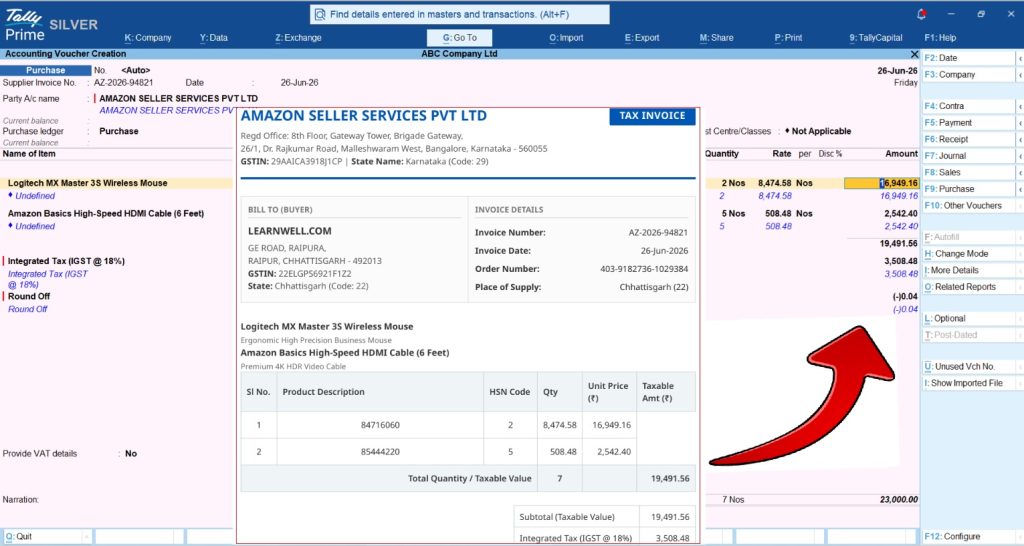
|
Daily Accounting Pain Point |
How Docs by Ira Solves It |
|
Hours spent manually typing line-by-line vendor invoice data |
Automatically extracts line items, GSTIN, and dates to generate accounting-ready draft vouchers. |
|
Unnoticed invoice errors, mismatched totals, or missing vendor GSTINs |
Proactively highlights exceptions and flags compliance errors before entries post to books. |
|
Month-end accounting backlog due to physical invoice pile-ups |
Supports bulk invoice uploads (PDF, JPEG, JPG, ZIP) to process hundreds of bills in minutes. |
|
Repetitive ledger and stock mapping for recurring suppliers |
Uses smart mapping to remember vendor and inventory ledger corrections automatically for next time. |
Where Does AI Help Most in an SME’s Accounting Workflow?
In a typical SME accounting day, a large amount of time goes into routine work rather than complex accounting decisions. Purchase bills need to be read, details entered into vouchers, parties and accounting information checked, GST-related details reviewed, and entries verified before the books are finalised.
This is where built-in AI can be most useful. For example, Docs by Ira in TallyPrime can help capture information from business documents and convert it into structured data for accounting. Instead of entering every detail manually, the accountant can review the extracted information and prepare the transaction within the familiar TallyPrime workflow. TallyPrime can also support checks around GST-related information and help identify details that may require attention before filing.
The important difference is that AI assists with the repetitive part of the process, while the accountant continues to review, correct, and approve the final accounting entry.
What Does a Day Look Like For a Business Before and After AI?
Consider a small business processing around 200 purchase bills in a month.
Before AI assistance: The accountant may need to open every invoice, read supplier and invoice details, enter amounts and tax information, check the entry, and correct mistakes manually. When similar work is repeated across hundreds of documents, even small errors can take additional time to trace and correct before GST filing or month-end closing.
With built-in AI assistance: Invoice information can be captured and presented in a structured form for review. Instead of typing every field from scratch, the accountant focuses more on checking the details, making necessary corrections, and finalising the voucher. This can reduce repetitive data-entry effort, help catch issues earlier, and make it easier to keep the books updated throughout the month rather than dealing with a large backlog at closing time.
Why is Human Control the Key to SME AI Trust?
For accounting teams, automation is useful only when they remain confident about what finally enters the books. A wrong party, tax treatment, amount, or ledger selection can affect reporting and compliance, so AI should assist the accountant rather than remove them from the process.
That is why human review is an important part of built-in AI workflows. With Docs by Ira in TallyPrime, information is not only captured but mismatches and exceptions are highlighted for review before the accounting entry is finalised. The accountant can check the extracted details, make corrections where required, and confirm the transaction before it becomes part of the books.
This approach gives SMEs the benefit of faster, less repetitive work without giving up control over financial data. AI handles much of the preparation; the accountant remains responsible for the final decision.
For CAs and Tax Professionals managing client compliance, unverified automation represents a liability. Docs by Ira earns long-term trust through three non-negotiable principles:
- Drafts over final postings: AI never makes autonomous posting decisions. It generates draft vouchers; the human accountant or business owner inspects, validates exception flags, and approves every entry.
- Data privacy & statutory compliance: Business documents and accounting ledgers remain strictly private. In alignment with India's Digital Personal Data Protection (DPDP) Act 2023, client data operates under rigorous local data protection standards and is never used to train public global AI models.
- Automation with accountability: AI assumes the tedious 80% of the workload (reading documents, extracting text, mapping line items), while human expertise retains the critical 20% (reviewing exceptions, verifying tax rates, and authorizing transactions).
Practical Framework: How Tier 2/3 SMEs Can Benefit From AI Today
- Audit Your Operational Bottlenecks: Identify specific workflow friction points where manual typing creates backlogs, such as daily vendor bill processing or purchase reconciliation.
- Upgrade Existing Infrastructure: Check if your primary accounting system already offers embedded AI upgrades like Docs by Ira. Rather than buying disjointed software, contact your service provider to upgrade your Tally license to TallyPrime to unlock native document processing.
- Maintain Human Oversight: Establish a 10-minute daily review routine for your accountant to inspect exception flags and approve draft vouchers, replacing hours of manual entry.
- Protect Your Business Data: Verify that all digital tools adhere to strict privacy controls and the DPDP Act 2023, ensuring that sensitive financial ledgers remain confidential and local.
Conclusion: The Future of SME Technology is Already Built In
True digital transformation across India’s heartland does not arrive with noisy product launches or complex enterprise software packages. It happens quietly on the shop floor when routine administrative burdens vanish into the background. Solutions like TallyPrime and Docs by Ira prove that practical AI is at its best when it adapts to how smaller businesses naturally operate.
After two decades advising Indian MSMEs, my recommendation to business owners is straightforward: stop chasing over-hyped technology trends. Invest in invisible, built-in automation that respects your privacy, drastically cuts manual typing, and leaves you in total control of your financial books.
"Tier 2 and Tier 3 Indian SMEs don't need enterprise-first AI initiatives; they need silent assistants built right inside the accounting software they already trust."














