










What is an audit?
An audit is an investigation and assessment that ensures the accuracy of information presented by a business. Auditors objectively determine whether the information provided is error-free or not. The information being assessed can differ according to the type of audit being conducted. In the case of a financial audit, the financial report is checked by auditors. This report contains an income statement, balance sheet, cash flow statement, and statement of equity changes. An audit report may contain notes as well. Auditing standards and procedures must be followed during an audit. An audit generally takes place once a year. It can be conducted internally or externally.
12 different types of audit
The major types of audits include internal, external, financial, statutory, tax, operational, compliance, information system, payroll, forensic, cost and management audits.
These audits are not all classified in the same way. An audit can be classified by who performs it, whether it is legally required, what it examines, or the purpose for which it is conducted. As a result, some audit categories overlap. For example, a statutory audit is normally external, while a financial audit can also be statutory when the law requires it.
Below are the different types of audit:
1. External audit
The external audit is performed by people who are not associated with your business in any way. An external audit can be done by financial institutions or government agencies. Auditors must follow the GAAS, or the Generally Accepted Auditing Standards. The outcome of an external audit is an audit report that outlines whether the financial information given by your business is accurate or not. When compared to an internal audit, they are more professional and stricter because they determine whether the details you shared with auditors are reliable or not. Lenders can ask for an external audit to be performed.
| Statutory Audit & Reporting: Definition and Example | Audit Report: Definition, Types, Format, Tools and Sample |
2. Internal audit
An internal audit is performed by an in-house team or an individual who works in your business. Internal audits enable you to understand how well your business is doing and whether it is legally compliant or not. It sheds light on whether the current business processes are efficient, the state of policy compliance, and assessments of the various controls in the business. The audit report is reviewed by management, which then goes on to make the required changes as necessary. Your business might have an audit committee that reviews the audit reports internally.
3. Financial audit
Financial audits are one of the common types of audits. All businesses that are publicly held must get a financial audit conducted. A financial audit is performed to ensure that the information revealed in the financial statements is correct. Auditors verify the business’ financial details pertaining to revenue, assets, and expenses. It investigates whether recording and reporting have been done appropriately. Financial audits are generally of value to shareholders and investors who can base their decisions on the final outcome of a financial audit report. CPA firms conduct financial audits as these audits must be conducted by people outside of the business.
4. Financial audit
A financial audit examines an organisation's financial statements and the underlying accounting information to determine whether they are prepared in accordance with the applicable financial reporting framework.
The auditor gathers and evaluates evidence relating to balances, transactions, disclosures and accounting records before expressing an opinion on the financial statements.
The primary objective is to give users of the financial statements greater confidence that the information is presented appropriately and is free from material misstatement due to fraud or error. India's CAG uses the same fundamental principle when defining financial audit in the public-sector context.
5. Statutory audit
A statutory audit is required by law. For companies in India, the Companies Act, 2013 contains requirements relating to the appointment of statutory auditors and the audit of company financial statements. A statutory auditor independently examines the company's financial records and statements and reports the findings to the company's members.
The purpose of a statutory audit is to provide independent assurance on the financial statements and support compliance with the applicable legal and financial-reporting framework.
6. Operational audit
Operational audits are performed to analyse the effectiveness of the operating processes of a business. They are generally conducted by an internal team, but some businesses can choose an external team of auditors. An operational audit can help uncover inefficiencies and wastage in a business. It determines the efficient use of resources to meet business goals and can identify how business operations can improve. Procurement can be subject to an operational audit whereby procurement processes are thoroughly examined and investigated. An operational audit can be conducted to determine the culture and policies of a business. An operational audit can result in cost reduction.
7. Compliance audit
A compliance audit is one of the types of audits that is conducted by educational institutions and industries where regulation is vital. It checks whether your business is complying with internal and external regulations. A compliance audit can be conducted department-wise. Compliance audits reveal if the business is complying with regulations such as those for safe working conditions. It takes into account the laws, local regulations, and the standards set by the business. For instance, a manager can ask for a compliance audit to be conducted to ensure workers are adhering to safety guidelines when they are working in a factory.
8. Information system audit
An information system audit is performed to verify that your business is using the best security practices so that no external entity, such as a hacker, can get access to the business data. It involves checking if the best practices are being utilised by the business to ensure the proper functioning of the IT systems in the business. Information system audits help in the proper evaluation of data processes and checks that determine the accuracy of data from these systems. Information system audits can reveal improvements such as new software recommendations that can drive the business to do better and excel. It also takes into account backup plans.
9. Payroll audit
A payroll audit is one of the types of audits that are usually conducted by internal teams. The HR team may perform a payroll audit. The payroll audit examines and investigates the accuracy of the information in relation to payroll processing. This includes wages, employee-related information, tax data, and pay rates. It is a specific type of compliance audit that focuses on payroll. A payroll audit helps businesses spot internal human errors that exist. A regular payroll audit can prevent costly mistakes from taking place before other types of audits take place, such as an IRS tax audit. A payroll audit ensures compliance with employment laws.
10. Forensic audit
A forensic audit investigates suspected fraud, financial misconduct, misappropriation or other serious irregularities. Unlike a routine audit, a forensic audit focuses on investigation. The auditor examines transactions, documents, digital records and other evidence to determine what happened, assess the financial impact and identify the parties or activities involved.
Businesses and authorities can use forensic audits to investigate suspected fraud, diversion of funds, manipulation of financial records, asset misappropriation and other financial irregularities.
Because the findings can support disciplinary, regulatory or legal action, forensic auditors also focus closely on collecting and documenting evidence.
11. Cost audit
A cost audit examines a company's cost records and related information to verify whether the organisation maintains them correctly and accurately records the cost of producing goods or providing services.
In India, the Companies Act, 2013 gives cost audit a specific statutory context. Prescribed classes of companies engaged in specified goods or services can fall under cost-audit requirements.
The cost auditor reviews areas such as cost records, allocation of expenses, production costs and cost-accounting information. A cost audit differs from a financial audit because a financial audit examines the financial statements as a whole, while a cost audit focuses specifically on cost records and cost reporting.
12. Management audit
A management audit evaluates how effectively management plans, organises, directs and controls an organisation's activities and resources. The auditor reviews areas such as decision-making, organisational policies, management systems, allocation of responsibilities and the use of resources.
The findings help identify weaknesses in management practices and highlight opportunities to improve organisational performance. A management audit overlaps with an operational audit in some areas, but the emphasis differs. An operational audit focuses mainly on processes and efficiency, while a management audit focuses more directly on managerial effectiveness and decision-making.
How are audits classified?
Businesses classify audits according to who conducts them, whether the law requires them and what they examine.
The main classifications include:
- By auditor: Internal auditors perform internal audits, while independent external auditors perform external audits.
- By legal requirement: The law requires statutory audits, while organisations undertake voluntary audits without a specific statutory requirement.
- By subject or purpose: Financial audits examine financial statements, operational audits examine processes and efficiency, compliance audits check adherence to requirements, and information system audits examine technology and information controls.
- By specific regulatory requirement: Tax audits and cost audits apply under their respective legal and regulatory frameworks.
These classifications can overlap. For example, an audit of company financial statements can qualify as a financial audit, a statutory audit and an external audit at the same time.
Internal vs external audit: what is the difference?
The main difference between internal and external audit lies in their purpose and the relationship of the auditor to the organisation. Internal audit helps management evaluate and improve controls, risks and processes. External audit gives intended users independent assurance. Both types of audit strengthen accountability, but they serve different purposes.
| Basis | Internal audit | External audit |
|---|---|---|
| Primary purpose | Improves controls, risk management and business processes | Provides independent assurance or an opinion |
| Auditor | Internal audit function or appointed professional | Independent auditor outside the organisation |
| Scope | Management and applicable requirements determine the scope | The engagement and applicable requirements determine the scope |
| Independence | Operates independently within the organisation's governance structure | Operates independently of the organisation |
| Main users | Management, audit committee and those charged with governance | Shareholders, regulators, lenders or other intended users |
| Frequency | Takes place continuously or periodically | Usually covers a defined reporting period or engagement |
Statutory vs internal audit: what is the difference?
A statutory audit takes place because the law requires it. An internal audit helps the organisation evaluate and improve controls, risks, processes and governance.
Statutory and internal audits complement each other. Internal audit helps strengthen controls throughout the year, while the statutory auditor independently performs the audit that the law requires.
| Basis | Statutory audit | Internal audit |
|---|---|---|
| Requirement | Applicable law requires it | Prescribed entities must conduct it, while others use it as part of internal governance |
| Main purpose | Provides independent assurance under the applicable statutory requirement | Evaluates and improves controls, risks and processes |
| Auditor | Independent statutory auditor | Internal auditor or eligible professional appointed for the role |
| Main focus | Matters defined by the applicable statute and audit engagement | Controls, risks, operations, processes and governance |
| Main recipient | Members and other users specified by law | Management, audit committee or board |
| Independence | Independent of the company | Works independently from the activities under review |
How does accounting software help businesses be ready for audit?
An audit can be beneficial to a business, whether done internally or externally. It can uncover inconsistencies, inefficiencies, and errors found within the business. An accounting software solution can make a business audit-ready by ensuring all the financial transactions are stored in an easy-to-find manner. Accounting software that comes with an audit trail can ensure compliance, transparency, and integrity.
Accounting software helps businesses:
- Maintain complete and organised books of accounts
- Access ledgers, vouchers and reports from one system
- Trace transactions back to accounting entries
- Maintain consistent records across accounting periods
- Identify unusual or incorrect entries for investigation
- Control user access to financial information
- Maintain a record of changes where audit-trail functionality applies
- Generate financial and statutory reports required during an audit
Businesses that use accounting software conduct audits much faster compared to businesses that use manual methods. Robust accounting software solutions such as TallyPrime make auditing simpler for all businesses, so no business has to fail when the time for audit arrives.
How can TallyPrime help?
Tally makes life easier for your accountants, auditors and other users. Auditors will find their work easier with inbuilt audit/verification tools available in TallyPrime. The data analysis tools facilitate in conducting internal analysis and verification of the company's financial data. Thus, helping in identifying exceptional areas and thereby easing the process of verification.
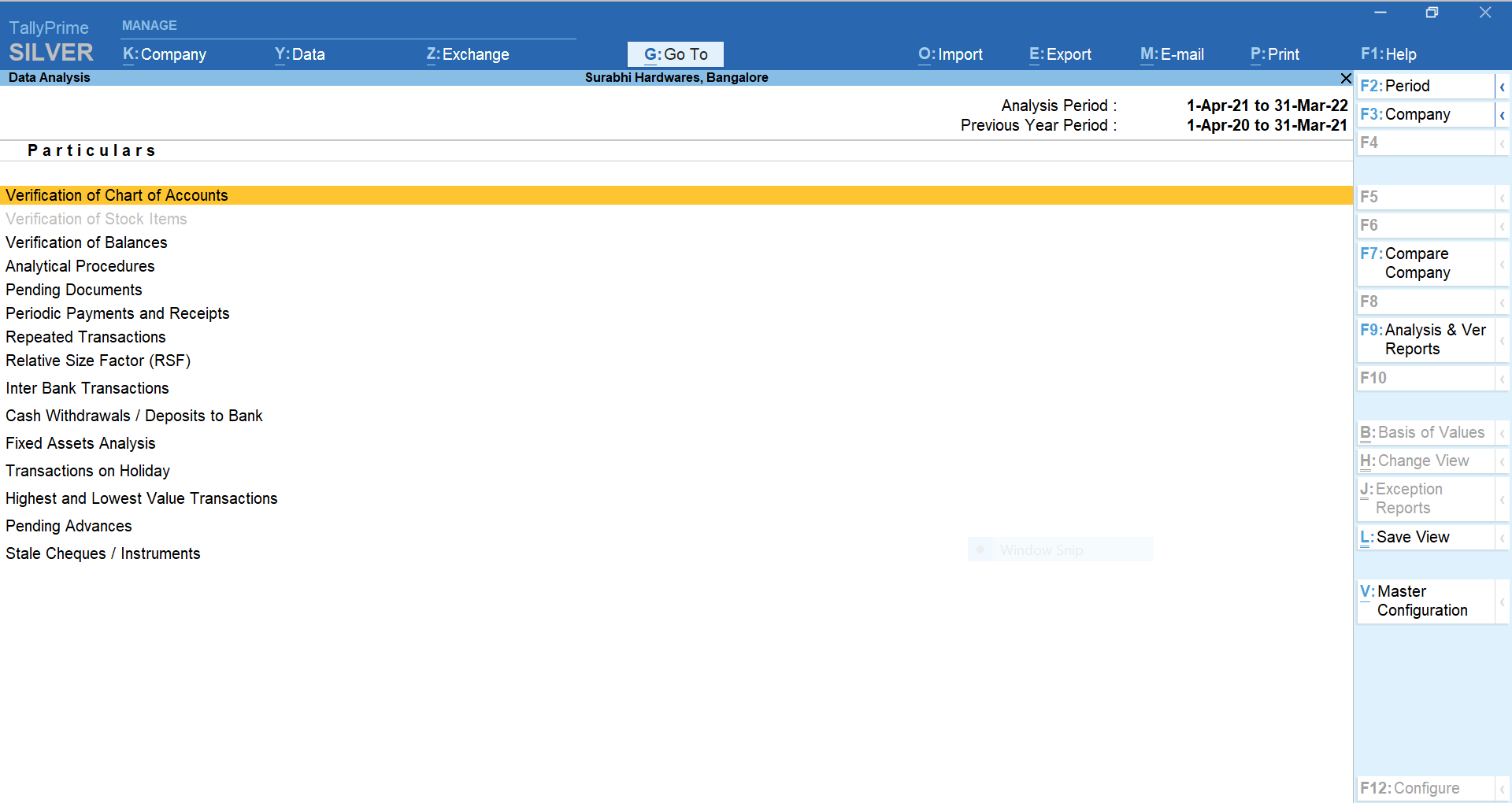
TallyPrime also comes with a voucher verification tool that helps you verify all the transactions or apply the required sampling method and verify only the sampled transactions to form the auditor's opinion. The same process can be applied for forex vouchers as well.
Conclusion
Different types of audits serve different purposes. Some examine financial statements, while others focus on tax compliance, operations, information systems, payroll, cost records, management practices or suspected fraud.
The right audit depends on what the organisation needs to examine, who needs assurance and whether the law imposes a specific requirement.
Understanding how internal, external, statutory, financial, tax and other audits differ helps businesses maintain the right records, appoint the appropriate professionals and strengthen financial and operational controls.
Read more:














