










Preparing financial statements is a crucial part of a Chartered Accountant’s work, but it often involves much more than simply generating reports. From reviewing the Trial Balance to ensuring Schedule III compliance, CAs frequently spend hours classifying accounts, verifying balances, reconciling discrepancies, and compiling supporting schedules. When much of this work happens across multiple spreadsheets, the process can become time-consuming and prone to errors.
The good news is that it doesn't have to be this way. With TallyPrime, CAs can simplify the journey from Trial Balance to Schedule III financial statements by working with structured financial data and connected reports. Instead of spending valuable time gathering and reorganising information, they can focus on reviewing, analysing, and delivering better insights to clients.
In this article, we'll explore how TallyPrime helps streamline financial statement preparation, common challenges CAs face during year-end finalisation, and practical ways to make the entire process faster and more efficient.
Tired of spreadsheet chaos? TallyPrime to go from Trial Balance to Schedule III automatically can be done
Every financial year-end, I see the same stressful routine in Chartered Accountancy firms. The team gets the Trial Balance, exports it to Excel, and begins the painful, manual process of re-grouping accounts to fit the strict statutory formats required by Schedule III.
You can automate this entire process. TallyPrime eliminates the need for external spreadsheets by allowing you to map your Trial Balance directly to Schedule III formats right inside the software. This update transforms a compliance bottleneck into a smooth, push-button task.
The Real Challenge: Why Does Financial Statement Preparation Take So Much Time?
If you've worked on year-end financials, you've probably faced situations like these:
- Trial balance is ready, but classifications need correction.
- Multiple ledgers need regrouping.
- Supporting schedules are scattered across worksheets.
- Adjustments are tracked in separate Excel files.
- Last-minute changes require revisiting multiple reports.
I've seen many firms spend days reconciling figures before they can even begin preparing final financial statements.
The problem is rarely the accounting data itself.
The real challenge is converting that accounting data into a structured Schedule III format efficiently.
What does "from Trial Balance to Schedule III" really mean?
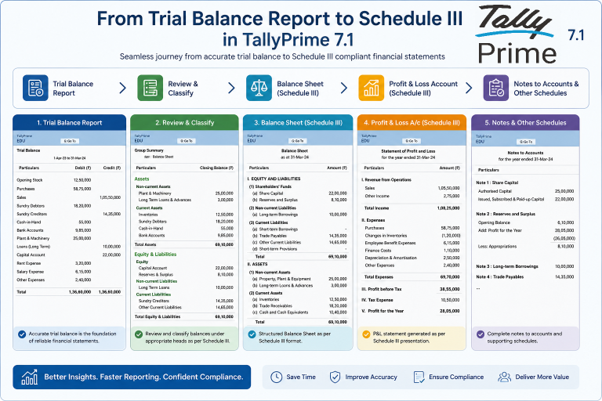
The journey typically looks like this:
- Finalize accounting entries
- Verify Trial Balance
- Classify balances correctly
- Prepare Balance Sheet
- Prepare Profit & Loss Statement
- Create Notes to Accounts
- Generate supporting schedules
- Review and finalize disclosures
Traditionally, much of this work happens outside the accounting system.
Lastest TallyPrime helps reduce this dependency by making financial reporting more structured and accessible directly within the system.
Why is accurate classification so important?
A financial statement is only as good as its classification.
For example:
A client once classified a long-term loan under current liabilities.
The Trial Balance matched perfectly.
However, the Balance Sheet presentation became incorrect.
Finding such issues during audit review creates unnecessary delays.
With proper ledger grouping and reporting visibility in TallyPrime, these errors become easier to identify before finalization.
How does TallyPrime help CAs prepare financial statements faster?
One of the biggest advantages is that financial information remains connected to the source transactions.
Instead of manually collecting figures from different reports, CAs can work directly from:
- Trial Balance
- Balance Sheet
- Profit & Loss Account
- Ledger Reports
- Group Summaries
- Supporting Schedules
This creates a smoother workflow from accounting records to financial statements.
Can CAs reduce spreadsheet dependency?
Absolutely.
While Excel will always remain useful, many firms still maintain multiple versions of financial statement worksheets.
This creates challenges:
- Version control issues
- Formula errors
- Missing adjustments
- Duplicate work
In my experience, firms that rely more on system-generated reports spend less time validating numbers and more time interpreting them.
That's where TallyPrime creates value.
Since reports are generated directly from accounting data, there is less manual compilation involved.
How does drill-down reporting improve accuracy?
One feature CAs appreciate is report drill-down capability.
Suppose you notice an unexpected increase in expenses.
Instead of searching through multiple files, you can move from:
Financial Statement → Group Balance → Ledger → Voucher
This traceability helps answer questions quickly during:
- Audit reviews
- Partner reviews
- Client discussions
- Tax assessments
What makes Schedule III preparation easier?
Schedule III compliance requires proper presentation rather than simply accurate accounting.
This means:
- Current vs Non-current classification
- Asset categorisation
- Liability grouping
- Disclosure-ready schedules
- Consistent presentation
When books are maintained with proper grouping throughout the year, preparing Schedule III statements becomes significantly easier at year-end.
Many accountants wait until finalisation to reorganise data.
I've found that maintaining clean ledger structures from day one reduces year-end workload dramatically.
A practical example from a growing business
A medium-sized trading company approached us during year-end closing.
Their Trial Balance was technically correct.
However:
- Advances were mixed with receivables.
- Deposits were grouped incorrectly.
- Some liabilities appeared under the wrong heads.
Earlier, the team used multiple spreadsheets to prepare financial statements.
After restructuring their accounting groups and reviewing reports directly through TallyPrime, financial statement preparation became much faster.
The biggest benefit wasn't automation.
It was clear.
Everyone worked with the same set of numbers.
How can CAs deliver more value beyond compliance?
Clients increasingly expect guidance, not just reports.
When less time is spent compiling statements, more time becomes available for:
- Financial analysis
- Profitability reviews
- Cash flow discussions
- Risk identification
- Business advisory services
This is where modern accounting workflows make a real difference.
Technology should reduce repetitive work so professionals can focus on decision-making.
Conclusion
Financial statement preparation should not feel like assembling a puzzle every year.
The smoother the journey from Trial Balance to Schedule III, the more productive and accurate the process becomes.
TallyPrime 7.1 helps CAs simplify reporting by keeping financial data connected, organised, and easy to verify.
Frequently asked questions (FAQs)
1. Can Lastest TallyPrime help in Schedule III financial statement preparation?
Yes. Properly maintained accounting data and structured reporting make Schedule III presentation easier and more efficient.
2. Why is ledger grouping important for financial statements?
Incorrect grouping can result in wrong classifications in Balance Sheet and Profit & Loss statements even when accounting entries are correct.
3. Can CAs verify balances directly from reports?
Yes. Drill-down functionality allows users to move from summary reports to ledgers and vouchers for verification.
4. Does TallyPrime reduce spreadsheet dependency?
Many financial reviews and validations can be performed directly within the system, reducing manual spreadsheet work.
5. How can firms improve year-end finalisation speed?
Maintaining clean ledger structures, reviewing classifications regularly, and validating reports throughout the year significantly improves efficiency.
6. What is the biggest benefit of moving from Trial Balance to Schedule III within a connected workflow?
It improves accuracy, reduces duplication of work, and allows CAs to focus more on analysis and client advisory services.







