










8 practical checks that can reveal GST mistakes, missing entries and reconciliation issues before return-filing day.
GST return filing should ideally be the last step of accounting, not the beginning of a detective investigation.
But in many offices, GST filing starts with:
“Where is this purchase invoice?”
“Why is this sale showing as B2C?”
“E-way bill is there, but invoice is missing!”
“RCM was applicable? Nobody checked it!”
Suddenly, the accountant becomes an accountant + detective + GST investigator.
The objective should be simple:
If your GST return had to be prepared today, your books should already be ready.
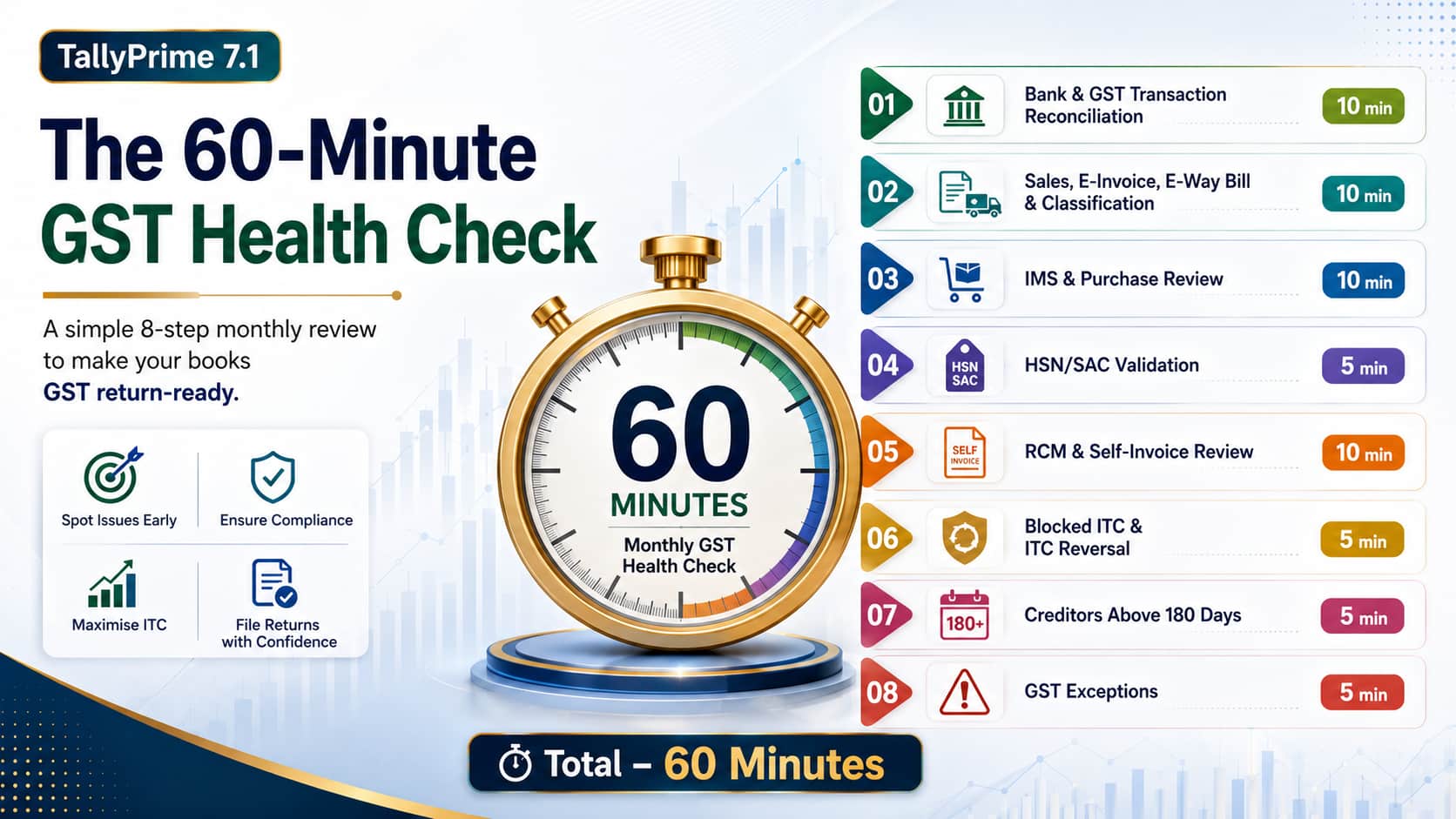
Here is a practical 8-step monthly GST health check that can be completed in around 60 minutes using TallyPrime.
Step 1: Start With the Bank — Because the Bank Rarely Lies
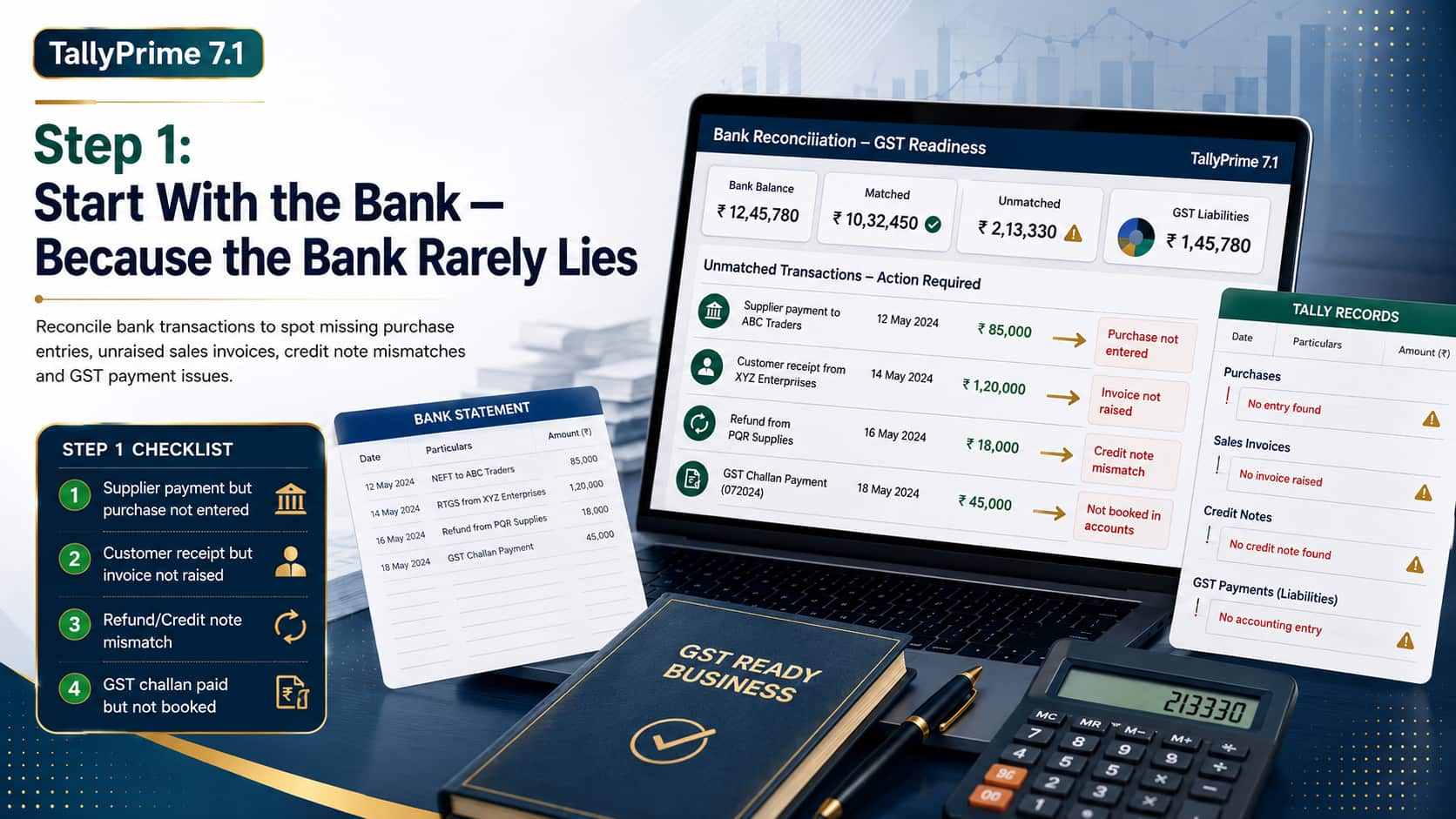
Bank reconciliation is not merely about matching balances.
Use it to identify transactions that have happened financially but have not been correctly accounted for under GST.
Check for:
- Payment made to a supplier but inward supply/purchase invoice not entered
- Payment received from a customer but sales invoice not raised or recorded
- Supplier payment recorded but invoice booked under the wrong GSTIN
- Customer receipt adjusted against the wrong invoice
- Refund received from a supplier but corresponding credit note not accounted for
- Refund paid to a customer but sales return/credit note not recorded
- GST challan payment appearing in the bank but not properly accounted for
- Bank transactions temporarily parked in suspense or miscellaneous ledgers
Example
Bank statement shows:
Payment to ABC Supplier – ₹1,18,000
But there is no corresponding purchase invoice in Tally.
This could mean:
Purchase missing → ITC missing → IMS mismatch → Supplier balance wrong.
Or the bank shows:
Customer receipt – ₹2,36,000
but no sales invoice has been raised.
Now the issue is not merely reconciliation. There may also be an unrecorded outward supply and GST liability.
Bank: “The money has already moved.”
Tally: “I have no record of it.”
GST: “Interesting. Shall we investigate?”
Step 2: Put Your Sales Under the GST Scanner
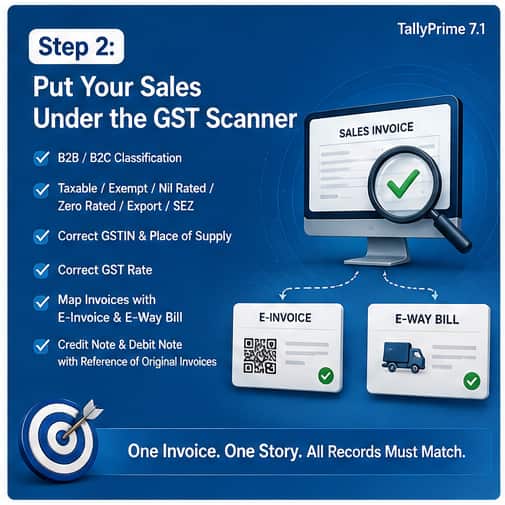
Now review your entire outward-supply side.
Don't simply ask:
“Is the sales invoice entered?”
Ask:
“Is it entered and classified correctly for GST?”
Check:
- B2B sales
- B2C sales
- Taxable / Exempted / Nil-Rated / Zero Rated supplies
- Correct GSTIN
- Correct place of supply
- Intra-State vs Inter-State classification
- Correct GST rate
- E-invoice generated wherever applicable
- E-way bill generated wherever applicable
Most importantly, map:
Tally Invoice → E-Invoice → E-Way Bill → GSTR-1
Invoice number, date, GSTIN, taxable value and tax should agree wherever applicable.
Don't Forget Credit Notes & Debit Notes
Review whether:
- Credit notes are correctly accounted for
- Debit notes are correctly accounted for
- GST impact has been properly considered
- Credit notes clearly reference the original invoice
- Original invoice number/date can be traced
- Credit/debit notes appearing in GST records agree with Tally
GSTR-1 specifically captures credit/debit-note details, making this an important part of outward-supply reconciliation.
Example
Tally Invoice: ₹5,00,000
E-Invoice: ₹5,00,000
E-Way Bill: ₹4,50,000
Something needs checking.
“Three documents. One transaction. Three different numbers. That is not a plot twist we want in GST.”
Step 3: IMS — Find Out What Your Suppliers Have Reported
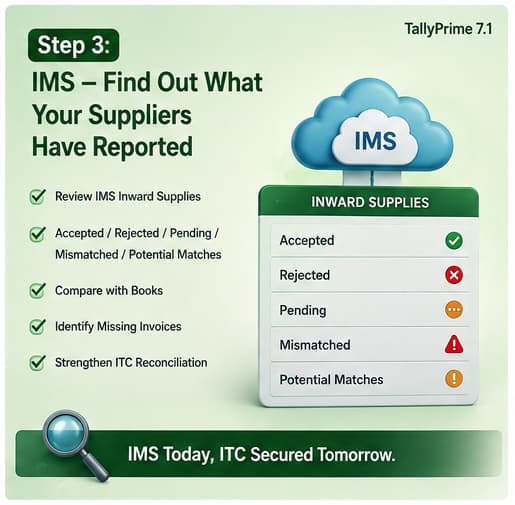
Now move to purchases and Input Tax Credit.
Compare inward supplies recorded in Tally with invoices available through IMS/GST records.
Review:
- Accepted
- Rejected
- Pending
- No Action
- Mismatched
- Potential Matches
Example
Supplier reports an invoice of ₹1,18,000, but it is missing from Tally.
Before asking:
“Can we claim ITC?”
First ask:
“Where is the purchase entry?”
Supplier: “I reported the invoice.”
Accounts: “We don't have it.”
GST Consultant: “Perfect. We have found today's mystery.”
IMS reconciliation can therefore discover accounting problems before they become return-filing problems.
Step 4: HSN/SAC — One Digit Can Change the Whole Story
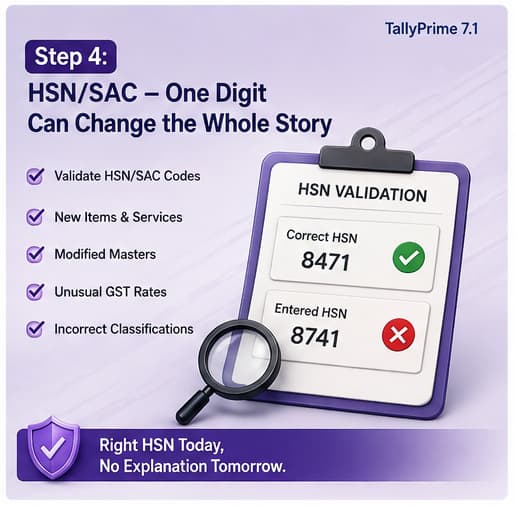
Validate HSN/SAC particularly for:
- New stock items
- New services
- Recently modified masters
- Items with unusual GST rates
- Incorrect classifications
Example
Correct HSN: 8471
Entered HSN: 8741
It looks like a minor typing error.
GST may see a completely different classification.
“One wrong digit can turn a simple invoice into the opening scene of a compliance thriller.”
Step 5: RCM — The Silent Character Who Appears at the Climax
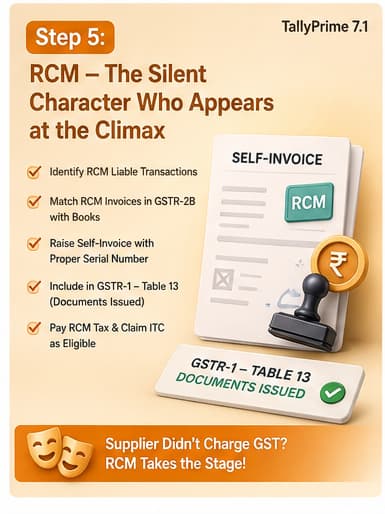
RCM deserves its own monthly review.
Check:
- Expenses liable to RCM
- Purchases liable to RCM
- RCM invoices appearing in GSTR-2B
- RCM invoices appearing in GSTR-2B but missing from Tally
- RCM identified in Tally but missing from the return working
- Correct taxable value and GST rate
- Correct IGST / CGST / SGST treatment
- RCM liability properly paid
- ITC claimed only after satisfying applicable conditions
GSTR-2B separately identifies inward supplies liable to reverse charge and feeds relevant values into GSTR-3B.
Self-Invoice Check
Where a self-invoice is required under the RCM provisions, ensure:
- Self-invoice has actually been raised
- Proper serial number is allotted
- Invoice series is controlled
- Taxable value and GST are correctly mentioned
- Self-invoice is properly recorded in Tally
- Relevant document-series details are included in Table 13 – Documents Issued of GSTR-1, as applicable
The GST Portal provides Table 13 specifically for reporting documents issued during the tax period.
Maintain this documentary trail carefully before claiming eligible RCM ITC.
Accounts: “The supplier didn't charge GST.”
GST Consultant: “Correct. That doesn't mean the story ends there. RCM just entered the scene.”
Step 6: Blocked ITC & ITC Reversal — Not Every GST Amount Is Yours to Keep
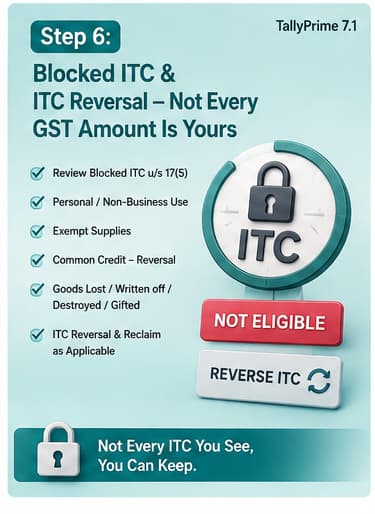
Just because GST appears on an invoice does not automatically mean it is eligible ITC.
Run a monthly check for blocked or reversible ITC.
Review areas such as:
- Credits blocked under applicable GST provisions
- Personal/non-business expenses
- Ineligible motor-vehicle related credits, where applicable
- Food, beverages, club or membership expenses where restricted
- Goods/services used for exempt supplies
- Common ITC requiring proportionate reversal
- Goods lost, stolen, destroyed, written off or given as gifts/free samples, where applicable
- Any ITC identified as ineligible during IMS/GSTR-2B review
Example
Accounts sees GST of ₹18,000 and says:
“Great, ₹18,000 ITC available.”
GST law may reply:
“You may want to read the eligibility conditions before celebrating.”
“Every GST invoice is an entry ticket. Not every ticket gives you access to the ITC lounge.”
Step 7: Creditors Ageing — Has the Supplier Been Unpaid for More Than 180 Days?
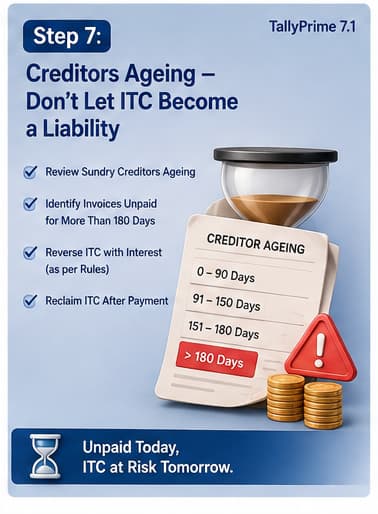
Your creditors ageing report is not only a payment-management report.
It can also become an important GST ITC control report.
Identify supplier invoices where:
Payment of value plus tax has remained outstanding beyond 180 days from the invoice date.
Under the applicable GST provisions, ITC relating to such unpaid consideration may require reversal/payment along with applicable interest, subject to statutory exceptions; credit can generally be re-availed after payment to the supplier. (CBIC GST)
Monthly Check
Create ageing buckets:
0–90 Days | 91–150 Days | 151–180 Days | Above 180 Days
The 151–180 day bucket is your warning list.
The Above 180 Days bucket requires immediate GST review.
Example
Purchase Invoice:
₹10,00,000 + GST ₹1,80,000
Supplier remains unpaid beyond the prescribed period.
The outstanding amount is no longer merely a creditor issue.
It can also become an ITC reversal and interest issue.
Accounts: “The supplier can wait.”
GST: “Maybe. But your ITC may not.”
Step 8: Clear GST Exceptions — Don't Leave Them for the Sequel
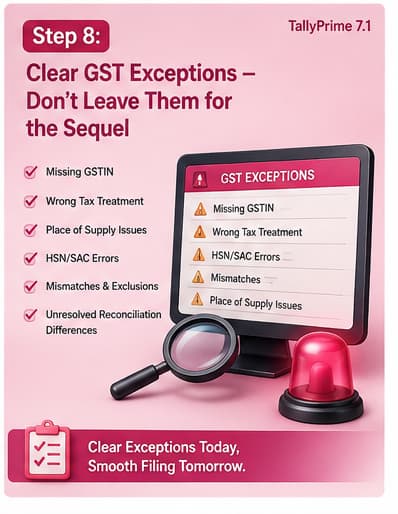
Finally, review all GST exceptions.
Look for:
- Missing GSTIN
- Wrong tax treatment
- Wrong place of supply
- HSN/SAC errors
- Uncertain transactions
- Return exclusions
- Reconciliation mismatches
- Unresolved ITC differences
- RCM differences
- Incorrect tax rates
Your target should be:
Exceptions reduce every month—not become permanent residents of Tally.
“Today's ignored exception is tomorrow's GST_FINAL_REVISED_FINAL_V9.xlsx.”
The 60-Minute GST Health Check
|
Check |
Time |
|
Bank & GST Transaction Reconciliation |
10 min |
|
Sales, E-Invoice, E-Way Bill & Classification |
10 min |
|
IMS & Purchase Review |
10 min |
|
HSN/SAC Validation |
5 min |
|
RCM & Self-Invoice Review |
10 min |
|
Blocked ITC & ITC Reversal |
5 min |
|
Creditors Above 180 Days |
5 min |
|
GST Exceptions |
5 min |
|
Total |
60 Minutes |
|
|
|
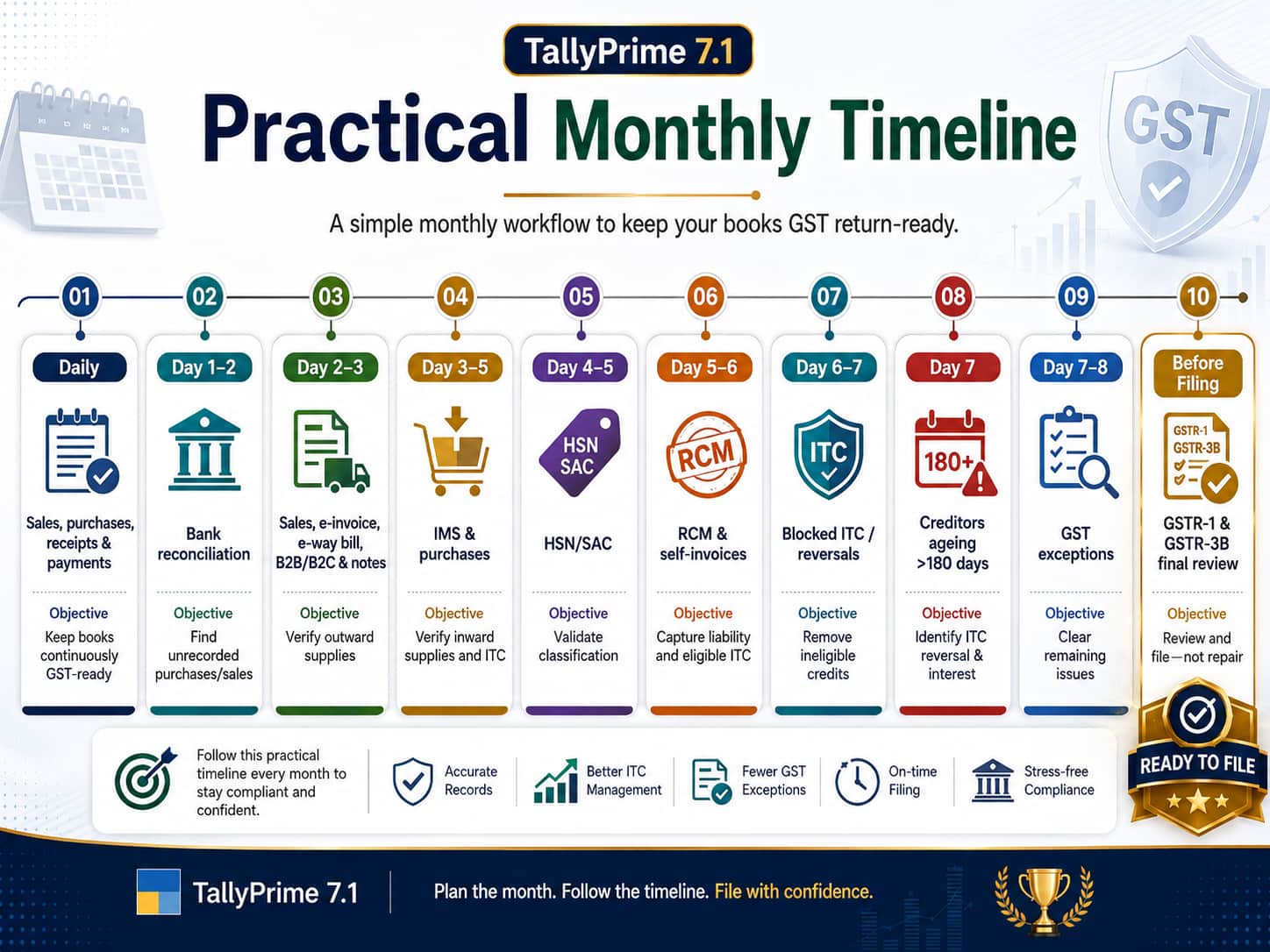
Practical Monthly Timeline
|
Timeline |
Review |
Objective |
|
Daily |
Sales, purchases, receipts & payments |
Keep books continuously GST-ready |
|
Day 1–2 |
Bank reconciliation |
Find unrecorded purchases/sales |
|
Day 2–3 |
Sales, e-invoice, e-way bill, B2B/B2C & notes |
Verify outward supplies |
|
Day 3–5 |
IMS & purchases |
Verify inward supplies and ITC |
|
Day 4–5 |
HSN/SAC |
Validate classification |
|
Day 5–6 |
RCM & self-invoices |
Capture liability and eligible ITC |
|
Day 6–7 |
Blocked ITC / reversals |
Remove ineligible credits |
|
Day 7 |
Creditors ageing >180 days |
Identify ITC reversal & interest |
|
Day 7–8 |
GST exceptions |
Clear remaining issues |
|
Before Filing |
GSTR-1 & GSTR-3B final review |
Review and file—not repair |
Final Thought
The objective of TallyPrime 7.1 should not merely be:
“Can I generate my GST return?”
A better question is:
“Can I file my GST return today without first cleaning up my books?”
If the answer is yes, your accounts are truly GST Return-Ready.
“The best GST month-end has no suspense, no villain and definitely no last-minute climax.”







