






A Goods and Services Tax (GST) audit is a detailed examination of a taxpayer's financial records. It helps authorities assess if all the tax filings are consistent with business records.
When a taxpayer cannot determine the correct tax rate or the taxable value, the law permits a provisional assessment. This allows tax payment on a temporary basis until the final resolution is determined.
What is a GST audit?
In a GST audit, the taxpayer’s books of account are checked to ensure that they are in compliance with the rules under the Central Goods and Services Tax (CGST) Act, 2017.
This helps authorities to verify the correctness of the turnover declared, payment of GST, claiming of input tax credit (ITC) as per the law and validity of the refund claims and exemptions.
An audit does not necessarily mean anything is wrong. It is used to confirm that tax returns have been correctly filed.
Key steps involved in a GST audit
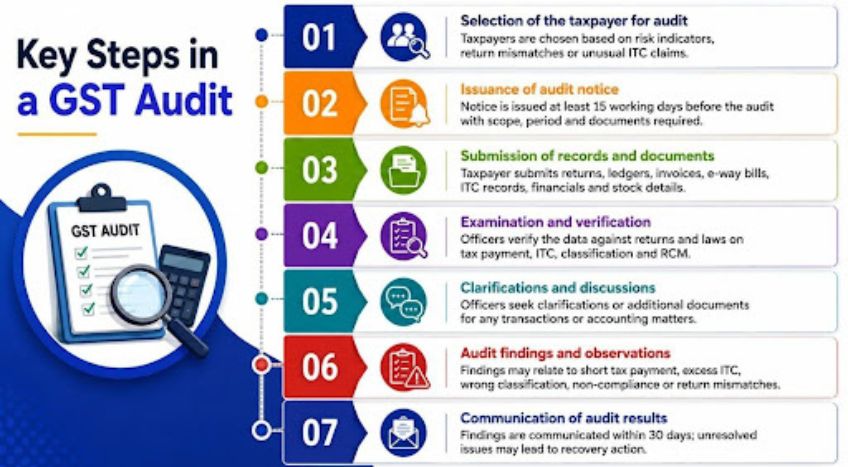
The GST audit process has a set structure which will always be followed, irrespective of the type and size of business.
Step 1: Selection of the taxpayer for audit
The process begins with the choice of a registered taxpayer to audit. The selection may be on account of risk parameters, inconsistencies in returns, unusual ITC claims, sector-specific concerns or any other compliance indicators.
Step 2: Issuance of audit notice
The taxpayer shall be served notice at least fifteen working days prior to the commencement of the audit. It specifies the scope of the examination, period under review, the documents required and the date it will commence.
Pre-notification provides a business with the time to gather the records and documentation.
Step 3: Submission of records and documents
Documents such as the following have to be submitted by the taxpayer:
- Returns of GST (such as GSTR-1, GSTR-3B and annual returns where applicable)
- Purchases and sales ledger
- Tax invoices
- E-way bills
- Financial statements
- ITC records
- Stock ledgers
Organised records can help speed up the audit process.
Step 4: Examination and verification
Information submitted by taxpayers will be reviewed in relation to GST returns and other statutory documents. Turnover claims, payment of taxes, categorisation of goods and services and availing of ITC will be examined by the officers.
Step 5: Clarifications and discussions
In case a transaction requires clarification or the method used in the accounts is found to be doubtful, tax officers may call for an explanation from the business. Documents will also have to be provided to substantiate the position. Swift action can help resolve issues that may lead to litigation.
Step 6: Audit findings and observations
After verification, the authorities prepare their findings. Their observations may include:
- Short payment of tax
- Excess ITC claims
- Incorrect tax classification
- Procedural non-compliance
- Return mismatches
The taxpayer is given an opportunity to present explanations before final conclusions are reached.
Step 7: Communication of audit results
The findings are communicated to the taxpayer within thirty days of the audit completion. If the discrepancies remain unresolved, recovery proceedings may be initiated.
What is a provisional assessment under GST?
Provisional assessment allows a taxpayer to pay GST temporarily when they cannot determine the correct value or the applicable tax rate.
The taxpayer can request permission to pay tax provisionally until the final liability is established. This provision is governed by Section 60 of the CGST Act, 2017.
How a provisional assessment is handled
This is a formal safeguard and must be initiated by the taxpayer.
Application by the taxpayer
The taxpayer sends an application explaining why they can't figure out their exact tax amount. They also need to include any supporting papers that back this up.
Review by the tax authority
This involves a review of the application, and the officer can call for further details where necessary. The issue to be considered is whether the circumstances warrant issuance of the provisional assessment.
When satisfied, the officer will authorise the payment of tax on a provisional basis. The order provides the basis upon which tax will be charged pending the final assessment.
Execution of bond and security
The taxpayer is supposed to sign the bond with security as provided under the provisions. This ensures that any extra tax that arises during the final assessment will not jeopardise the revenue of the government.
Final assessment
This entails consideration of all the relevant matters and the issuance of a final assessment order. Tax payable for the transactions in question is determined by the final order.
The officer is generally required to finalise the assessment within six months from the date of the provisional assessment order.
Adjustment of tax liability
Where the final liability exceeds what was paid provisionally, the shortfall becomes payable along with applicable interest. An overpayment, on the other hand, entitles the taxpayer to claim a refund under the relevant GST provisions.
Common compliance considerations
Businesses can reduce audit-related issues and provisional assessment disputes by:
- Maintaining accurate books of account
- Regular reconciling returns
- Regularly reviewing ITC claims
- Keeping supporting documents
- Monitoring classification and valuation
- Replying promptly to department notices
It is often cheaper to identify discrepancies early than to fix issues after an audit has been initiated.
Conclusion
GST audit and provisional assessment are done to ensure that a business is paying the right taxes. One is a review of whether the past transactions were reported correctly, while the other gives a business a legal way forward where the right liability is not yet clear.
TallyPrime makes GST compliance easier for businesses with high volumes of transactions by consolidating all GST data, accounting records and documentation in one place.