






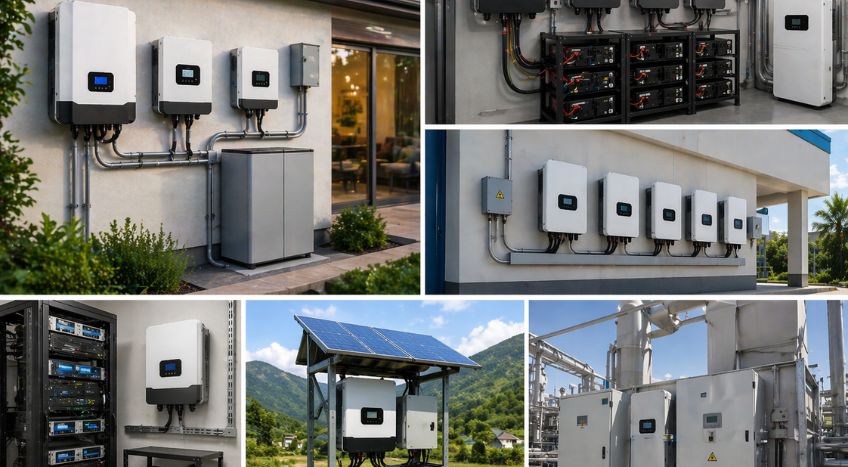
Inverters fall under Section XVI (Machinery and Mechanical Appliances; Electrical Equipment) of the Harmonised System of Nomenclature (HSN) classification system. Within this section, they are classified under Chapter 85, which covers electrical machinery and equipment. More specifically, inverters are categorised under electrical transformers, static converters and inductors.
This classification is based on the core function of an inverter, which converts electrical energy (usually DC to AC), placing it under the category of static converters.
What is the inverter HSN code?
After the Goods and Services Tax (GST) rate rationalisation announced during the 56th GST Council Meeting held in September 2025, the GST structure was simplified mainly into 5%, 18% and 40% slabs. Standard electronic and electrical equipment, including conventional inverters, continues to attract 18% GST from 22 September 2025 unless specifically exempted or notified otherwise.
The table below outlines the relevant HSN codes and their descriptions for inverters and related components commonly used in power systems:
|
Category |
HSN Code / Number |
Description |
|
Electrical transformers, static converters and inductors |
8504 |
Covers electrical transformers, static converters (e.g., rectifiers, inverters) and inductors. It applies to various power management devices, including voltage stabilisers, battery chargers and ballast for lamps, with many components categorised by their power-handling. |
|
Static converters (including inverters, rectifiers and battery chargers) |
8504 40 |
Common items include electric inverters, voltage stabilisers and AC/DC power adapters. |
|
Parts of transformers & static converters |
8504 90 |
Covers parts used in transformers and static converters, including inverter components like PCBs, control units and housings. |
|
Electric inverters |
8504 40 10 |
It applies to solar inverters, home inverters and UPS systems. |
|
Solar inverters (when supplied as part of a solar power system) |
8504 40 10 |
Solar inverters used within a solar power generating system (not sold separately but as part of a system supply). |
|
Other Static Converters |
8504 40 90 |
Includes devices like rectifiers, inverters and certain UPS units. |
What is the GST treatment for solar inverters?
Standalone solar inverters are generally taxed at 18% GST because they are classified as static converters under HSN 8504. However, GST treatment may differ when solar inverters are supplied as part of a Solar Power Generating System (SPGS) or a renewable energy project.
Under Notification No. 24/2018-Central Tax (Rate), renewable energy EPC contracts are subject to a deemed valuation mechanism for tax purposes. Under this mechanism:
- 70% of the gross contract value is treated as the value of goods
- 30% of the gross contract value is treated as the value of services
The goods portion is taxed at the GST rate applicable to renewable energy devices, while the service portion is generally taxed at 18% GST.
This concessional structure usually applies when solar panels, solar inverters, mounting structures, cables and other components are supplied together under a single renewable energy system contract.
What is composite vs mixed supply in inverter sales?
GST treatment of inverters can change depending on how they are supplied along with other components.
- Composite supply
When an inverter is supplied along with batteries, wiring or solar panels as part of a naturally bundled system (for example, a solar power setup), it may qualify as a composite supply. Tax rate is based on the principal supply. It’s often relevant in solar EPC or system contracts.
- Mixed supply
If an inverter and a battery are sold together but not naturally bundled (for example, in promotional combos), they may be treated as a mixed supply. The highest applicable GST rate in the bundle applies.
For example, if a retailer offers a festive combo deal:
- Inverter (HSN 8504) - ₹10,000 (18% GST)
- Battery (HSN 8507) - ₹8,000 (18% GST)
Instead of invoicing them separately, the seller bundles both items into a single combo pack for ₹16,000, without indicating separate values. Since the inverter and battery are not naturally bundled (they can be sold independently and are not always supplied together in the ordinary course of business), this qualifies as a mixed supply.
Common mistakes in inverter HSN classification
Even though inverter classification appears straightforward, businesses often make these avoidable errors that should be watched carefully:
- Confusing HSN 8504 with 8507
A frequent error is mixing up inverters with batteries. Inverters are classified under HSN 8504 (static converters), while batteries fall under HSN 8507 (electric accumulators). Treating both under the same code can result in incorrect reporting and tax treatment.
- Treating solar inverters as standalone products
Solar inverters are sometimes incorrectly classified as regular inverters. While this is correct when sold independently, they may qualify for concessional GST when supplied as part of a complete solar power generating system. Ignoring this distinction can lead to wrong tax applications.
- Not separating the inverter and battery in invoices
Many businesses bundle inverters and batteries into a single line item. Since both fall under different HSN codes, they should ideally be invoiced separately to ensure accurate classification, GST calculation and input tax credit claims.
- Applying the wrong GST rate
Another common issue is applying a uniform GST rate without accounting for the nature of the supply. While most inverters attract 18% GST, solar-related supplies or system-based contracts may be eligible for concessional rates. Misapplication can lead to underpayment or excess tax liability.
Conclusion
Understanding inverter classification goes beyond simply applying HSN 8504 and an 18% GST rate. Businesses must also assess whether the inverter is supplied as a standalone product or as part of a bundled system, especially in solar projects where concessional GST treatment and valuation rules may apply.
Correct classification is not just a compliance step but a cost and credit decision. A small error in identifying the nature of supply can directly impact GST liability and input tax credit eligibility.
Maintaining accurate invoicing, clearly separating components and correctly mapping HSN codes helps prevent disputes and tax mismatches. Using reliable accounting software like TallyPrime can further simplify HSN classification, automate GST calculations and support consistent, compliant invoicing in day-to-day operations.