










Accounting principles are the standardised rules that guide how businesses record, summarise, and present financial transactions. They ensure financial statements are comparable, reliable, and understandable across companies and borders.
Recording every transaction under these rules helps determine the financial performance of the business. The resulting financial statements are used by internal stakeholders and external ones such as investors, tax authorities, regulators, and banks.
Imagine if every business prepared financial statements in its own way. There would be thousands of formats conveying the same information, making it impossible to compare one company with another.
The financial data would become unusable. Accounting principles bridge this gap and bring uniformity to financial reporting.
What is an Accounting Principle?
An accounting principle is a fundamental guideline—such as the revenue recognition or matching principle—that dictates how specific transactions are treated in the books. These principles form the backbone of the Generally Accepted Accounting Principles (GAAP) and International Financial Reporting Standards (IFRS).
These principles are commonly referred to as Generally Accepted Accounting Principles (GAAP). They act as the common rulebook for recording transactions and preparing financial statements.
Accounting principles bring uniformity to accounting and are followed worldwide. Each country's regulators may have their own version, such as UK GAAP, US GAAP, or IFRS. At the core, the fundamentals and objectives remain the same.
Why are accounting principles important?=
Accounting principles ensure consistency in financial records around the world. They define standards that companies must follow, making statements and reports more accurate and easier to read.
Conditions of accounting principles
Accounting principles are the body of rules behind accounting theory, procedure, and financial reporting. Your accountant may choose one method to prepare the financial statements while another accountant chooses a different one. Both are correct only if the principles applied are acceptable, and to be acceptable, a principle must satisfy these conditions:
- Accounting principles should be based on realistic assumptions.
- Accounting principles must be simple, understandable and explanatory.
- Accounting principles should be followed consistently
- Accounting principles should be able to reflect future predictions
- Accounting principles should be informative for the users.
Accounting principles spectrum - A diagrammatic representation
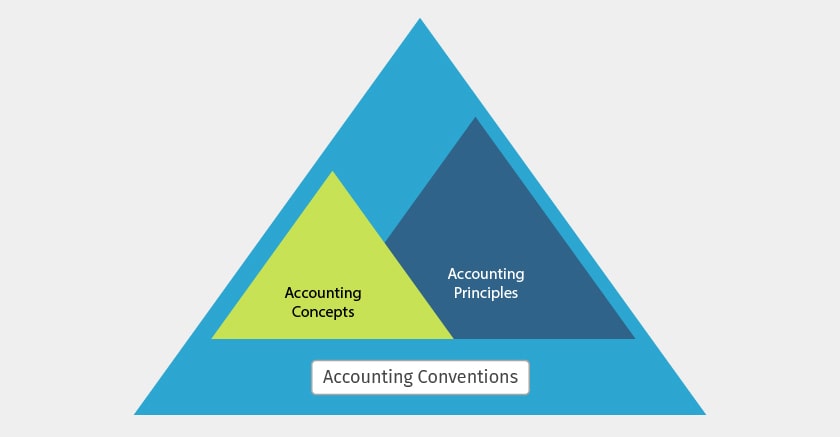
Types of accounting principles
Accounting principles consist of accounting concepts and accounting conventions. To understand the principles, you need to know both.
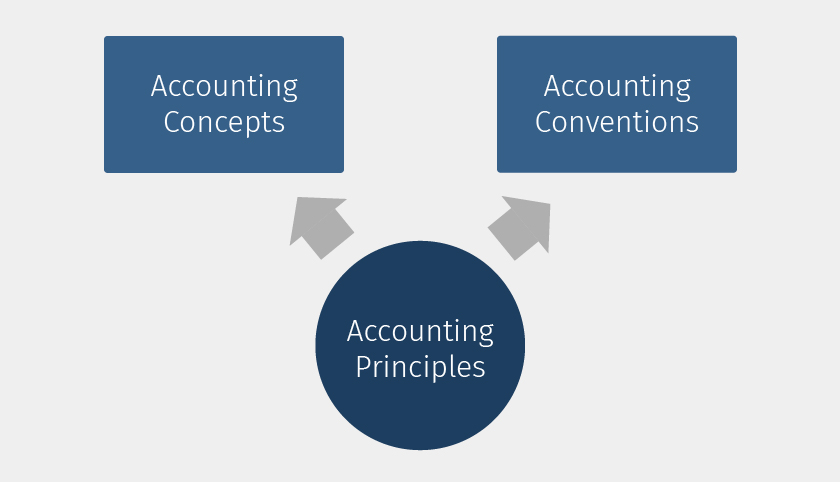
Let us start with the accounting concepts. Among the many concepts, these are the most important:
- Money measurement principle: All business transactions are measured in money as the common unit. You record only those transactions or events that can be expressed in monetary terms.
- Business entity concept: This concept treats the business and its owner as separate for financial transactions. Legally, your business exists independently of you and can sue or be sued in its own name.
- Going-concern principle: Transactions are recorded on the assumption that the business will continue operating for the foreseeable future. It is expected to meet its obligations as planned.
- Cost principle: This principle sets the rules for accounting fixed assets. Fixed assets are recorded at their original purchase price. Each year, their value is depreciated based on usage, wear and tear, and the passage of time.
- Dual-aspect concept: This accounting principle states that for every debit, a corresponding credit is made. This is the foundation on which the accounting system is carried out. This is important for you to understand in detail. Read our article ‘ Accounting – The Language of Business’ to know more about it.
- Accounting year concept: This implies that each business chooses a specific time period to complete the accounting cycle and financial reporting. In short, this principle talks about the periodicity of accounting. The period can be monthly, quarterly or annually.
- Matching concept: When revenue is recognised, the expenses incurred to earn that revenue must also be recognised. This gives a true picture of profit for the accounting period.
- Realisation concept: Revenue is reported when it is earned, regardless of when payment is received. No amount received is treated as profit until the goods or services are delivered to the buyer.
Core accounting principles
1. Revenue Recognition Principle – Record revenue when earned, not when cash is received.
2. Matching Principle – Align expenses with the revenues they help generate.
3. Historical Cost Principle– Report assets at their original purchase price.
4. Full Disclosure Principle – Reveal all material information in the notes to the financial statements.
5. Conservatism Principle – When in doubt, choose the more cautious estimate.
Why are accounting principles important?
Accounting principles assure that a business's financial statements are thorough, uniform, and comparable, thus making it simpler to analyze and derive information from the financial statements, over a period of time.
How does IFRS differ from GAAP?
Here are the major differences between IFRS and GAAP:
| IFRS | GAAP |
| IFRS is used in more than 110 countries around the world, including the EU and many Asian and South American countries. | GAAP, on the other hand, is only used in the United States |
| Principle-based | Rules-based |
| Allows revaluation of the following assets to fair value if fair value can be measured reliably: inventories, property, plant & equipment, intangible assets, and investments in marketable securities | Revaluation is prohibited except for marketable securities |
| Allows impairment losses to be reversed for all types of assets except goodwill | Prohibits reversals of impairment losses for all types of assets |
| Long-lived assets are initially valued at cost, but can later be revalued up or down to market value | Long-lived assets, such as buildings, furniture and equipment, are valued at historic cost and depreciated appropriately |
Accounting conventions
Accounting conventions are the second part of accounting principles. They are customs and traditions, derived from usage and practice, that guide how accounting statements are prepared. There are four accounting conventions:
- Consistency: Consistency is a fundamental assumption that states accounting practices and policies are consistent from one period to another.
- Full disclosure: This convention, as part of accounting principles, implies that the accounts should be prepared in a manner that all material information is clearly disclosed.
- Conservatism: This convention takes into consideration all prospective losses and leaves all prospective profits until they are earned.
- Materiality: In the materiality principle, all the items having a significant economic effect on the business should be disclosed in the financial statement. All unimportant items are either ignored or merged with other items.
Examples of Accounting Principles
Let's consider the matching concept. It requires businesses to record revenues and expenses in the period they occur, whether or not cash has changed hands. For example, if you make a credit sale on 27th March and receive the cash on 15th April, the revenue is recorded on 27th March.
International Financial Reporting Standards (IFRS)
International Financial Reporting Standards (IFRS) are common rules that ensure consistency, transparency, and comparability in financial statements worldwide. IFRS specifies how companies must maintain and report their accounts, and defines the types of transactions and events with financial impact.
Conclusion
The aim of accounting is to keep systematic records that show an entity's financial performance and position. This information is then communicated to the user groups who need it.
Financial statements are how management communicates this information publicly. ERP systems such as TallyPrime maintain these records automatically, following the accounting principles laid down by statutory bodies, so your books stay accurate and compliant.














