






Every business that processes vendor invoices at scale eventually runs into the same problem: a GST number gets mistyped, an invoice gets entered twice, or a rate gets applied incorrectly. None of it is obvious until weeks later, when it shows up as a mismatch during reconciliation or, worse, a notice from the GST department.
TallyPrime helps businesses identify potential accounting discrepancies at two important stages: during invoice processing through Docs by Ira, and later through its GST reconciliation and return-checking features. Together, these workflows help accountants review information earlier and reduce the risk of errors reaching their books or GST returns.
The first checkpoint is at entry. When an invoice is processed through Docs by Ira, its AI-powered extraction and intelligent mapping capabilities help prepare accounting information for review. Exception highlighting brings potentially incorrect or incomplete details to the accountant's attention, while duplicate detection helps identify invoices that may already have been processed. Users can verify the information, make corrections, and approve entries before posting them to the books.
The second checkpoint comes later, right before you file GST. TallyPrime compares your books against your GST returns, GSTR-2A/2B, and GSTR-1 against GSTR-3B, so any gap between what you've recorded and what's been reported shows up while you can still correct it, not after you've already filed.
When do small errors usually creep into your books?
Most bookkeeping errors aren't the result of carelessness. They're just what happens when a business is moving fast:
- a bookkeeper is entering invoices from three different vendors in one sitting
- an accounts team member is filling in for someone on leave
- or an invoice arrives twice because two people in the supply chain both forwarded it.
On their own, these look like small slips. But if you add them up across a filing period, they turn into input tax credit mismatches, return discrepancies, and hours spent during month-end reconciliation trying to figure out where things went sideways.
The old way of dealing with this was to catch errors during reconciliation, or to find out about them only when a GST notice landed.
Docs by Ira helps move error identification earlier in the accounting process. With AI-powered extraction, intelligent mapping, duplicate detection, and exception highlighting, accountants can identify information requiring attention while preparing invoice entries. They can then review and verify the details before approving transactions for posting, reducing the risk of incorrect information entering the books.
How does TallyPrime’s AI-assisted invoice processing validate data at entry?
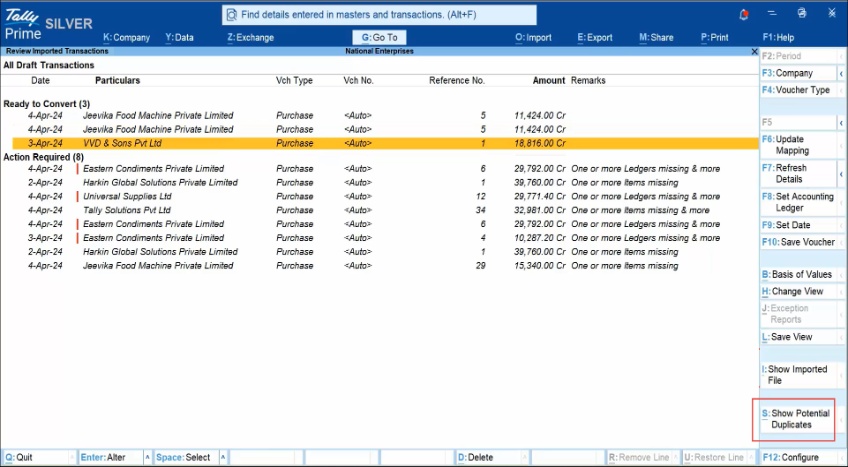
Think of Docs by Ira as an AI-powered assistant that helps accountants process invoices while identifying information that needs attention. It uses AI-powered extraction and intelligent mapping to prepare accounting entries, highlights exceptions for review, and supports duplicate detection. It also automatically creates new masters when needed and remembers manual mapping corrections for future invoices. Importantly, accountants review, verify, and approve entries before posting them to the books.
A GST field doesn't add up
If a vendor invoice contains GST-related information that is incomplete, inconsistent, or requires verification, Docs by Ira's exception highlighting capability can bring the relevant details to the accountant's attention during invoice processing. The accountant can review the extracted information, verify the tax-related details, and make corrections where necessary before approving the entry for posting. This early review helps reduce the risk of incorrect invoice information affecting subsequent accounting and GST workflows.
The invoice number has already been used
This happens more often than businesses expect. An invoice may be processed by the person who receives it and then submitted again by someone in finance. Docs by Ira's duplicate detection capability helps identify invoices that may already have been processed, allowing accountants to review the potential duplicate before approving it for posting. This helps reduce the risk of recording the same expense or payable more than once.
In both cases, Docs by Ira assists with identifying information that requires attention rather than making the final accounting decision. Accountants can review highlighted exceptions, verify invoice details, correct mappings where needed, and approve entries before posting. This combination of AI-powered assistance and human verification helps businesses maintain control over their accounting records.
Intelligent Mapping Helps Prevent Repetitive Errors
When invoice information is mapped to the wrong party or item, it can create inconsistencies in accounting records. Docs by Ira's intelligent mapping helps match extracted invoice details with existing masters and automatically creates new masters when needed. If an accountant manually corrects a mapping, Docs by Ira remembers that correction for future invoices. This reduces repetitive adjustments and helps maintain more consistent transaction processing, while users continue to verify the mapped details before posting.
Read more about Tally Ira’s AI-Powered Invoice Processor That Keeps You in Control
How TallyPrime catches mismatches between books and GST returns before filing
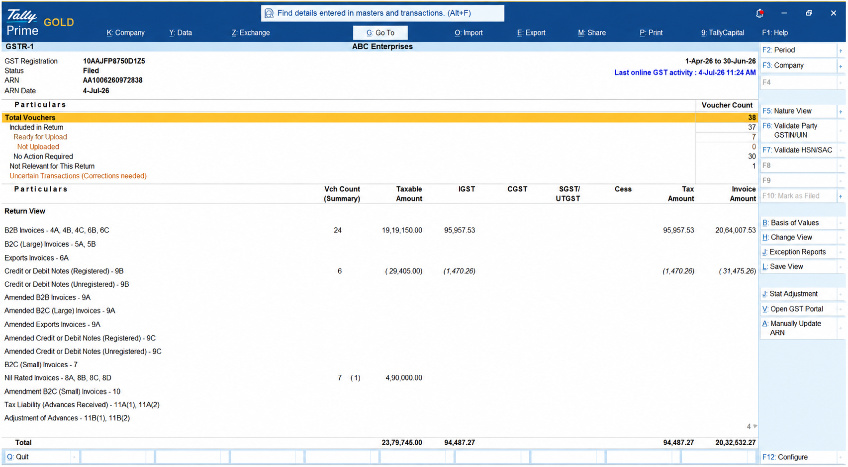
Getting the entry right is only half the job. The other half shows up at filing time, when your books need to line up with what's actually been reported by your vendors, and by you in earlier returns. This is where TallyPrime's second layer of checks comes in, and it works in two directions:
Against your vendors' filings
TallyPrime reconciles your purchase entries with GSTR-2A and GSTR-2B — the data auto-populated from what your vendors have filed. If a vendor hasn't filed yet, has reported different figures, or the tax amounts simply don't match, TallyPrime flags it so you can chase it up or correct your own entry before it affects your input tax credit claim.
Between your own returns
TallyPrime also checks that your GSTR-1 (what you've reported as outward supplies) is consistent with your GSTR-3B (your summary return). A gap between the two is one of the more common reasons businesses end up fielding questions from the GST department, and catching it before filing means it gets fixed quietly instead of being explained later.
While Docs by Ira helps identify exceptions during invoice processing, these pre-filing checks are performed through TallyPrime's existing GST reconciliation and return-related features. Together, they support review at different stages of the accounting and compliance workflow.
Read more on How to Fix a Mismatch Between GSTR-1 and GSTR-3B
Why Does Catching Errors at Both Stages Matter?
TallyPrime catches errors in two places rather than just one, because each stage is solving a different problem.
- Entry-stage review: Docs by Ira uses AI-powered extraction, intelligent mapping, duplicate detection, and exception highlighting to help identify potential issues before invoice entries are approved and posted. Accountants can verify the information and correct errors at an early stage.
- Pre-filing reconciliation: TallyPrime's existing GST reconciliation and return-checking features help identify discrepancies between accounting records and relevant GST return information, including differences that may only become visible after supplier return data is available.
Together, these two stages give businesses opportunities to identify and resolve discrepancies before they affect accounting records or GST filings. Early invoice verification helps reduce incorrect entries, while pre-filing reconciliation provides an additional opportunity to review differences that emerge later in the compliance process.
What's the Payoff of Catching Errors Early?
When invoices are processed using Docs by Ira, AI-powered extraction, intelligent mapping, duplicate detection, and exception highlighting help accountants identify details that may require attention before posting. Later, TallyPrime's GST reconciliation features support another round of checks against relevant return information. This can reduce the time spent tracing discrepancies during month-end finalisation, GST filing, and audits.
When invoices are checked as they're entered and books are checked against returns before submission, most of the "finding the error" work has already happened in the background, long before anyone sits down to reconcile.
For a business handling a steady stream of vendor invoices, that's real time back — time that would otherwise go into tracing a mismatched GST number through weeks of entries, or explaining a GSTR-1/GSTR-3B gap after the fact. TallyPrime helps businesses identify potential issues earlier through AI-assisted invoice processing and subsequent GST reconciliation, reducing avoidable correction work.
The Bottom Line
Catching an error is often a question of timing. Identifying an incorrect invoice detail before posting can be much simpler than tracing the same discrepancy during reconciliation or after a GST return has been filed.
Docs by Ira helps businesses identify potential issues during invoice processing through AI-powered extraction, intelligent mapping, duplicate detection, and exception highlighting. Automatic master creation and the ability to remember manual mapping corrections further simplify repetitive accounting work. Accountants remain responsible for reviewing, verifying, and approving entries before posting.
TallyPrime's GST reconciliation and return-checking features provide an additional opportunity to identify discrepancies before filing. Together, these capabilities help businesses reduce repetitive correction work and maintain better control over accounting and compliance processes.