










Companies need to calculate their financial health to control capital and make the right investments. Ratio analysis acts like a financial detective. It uncovers hidden signs and gives a clear picture of a company's financial health.
This guide explores ratio analysis and its critical role in determining a company's financial viability.
Ratio analysis works like a financial magnifying glass. It zooms in on a company's financial statements and extracts relevant insights.
Ratio analysis studies the correlations between different financial numbers. These correlations help you conclude a company's performance and stability.
These ratios provide context and perspective in addition to raw information.
|
“Ratio analysis is the financial magnifying glass that reveals a company's true health – from liquidity to profitability, it's the key to informed decisions. Discover its power and how TallyPrime simplifies the journey.” |
Why should businesses use or look at ratios?
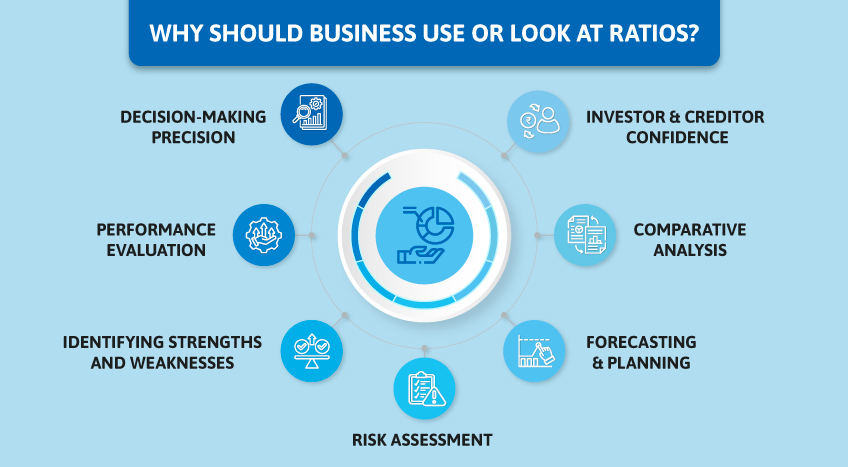
In business, decisions can make or break an enterprise. Understanding and using ratios is important for informed decisions and sustainable growth.
Here's why businesses should use them.
-
Decision-making precision
Ratios give decision-makers a concise snapshot of a company's financial performance. They cover profitability, liquidity, efficiency, and solvency, giving a well-rounded view that supports precise decisions. -
Performance evaluation
Businesses use ratios as a yardstick to measure success over time. Comparing current ratios with historical data or industry benchmarks helps companies track progress and spot areas needing improvement. -
Identifying strengths and weaknesses
Ratios reveal both the strengths and weaknesses of a business. They pinpoint areas of operational excellence and areas that need corrective measures, so businesses can focus their efforts effectively. -
Risk assessment
Every business faces risks. Ratios help assess risk by showing whether a company can meet its financial obligations and handle unexpected challenges. This matters most to lenders and investors seeking assurance of financial stability.
-
Forecasting and planning
Successful businesses are forward-looking, and ratios assist in crafting accurate forecasts and plans. By analysing trends in ratios, companies can anticipate future financial scenarios, align their strategies, and allocate resources accordingly.
-
Comparative analysis
Ratios enable businesses to compare their financial performance with that of competitors or industry standards. This benchmarking aids in identifying areas where the company outperforms or lags behind, offering insights for strategic differentiation. -
Investor and creditor confidence
For businesses seeking external funding, ratios serve as a language that investors and creditors understand. A healthy set of ratios signifies stability and competence, fostering investor confidence and improving creditworthiness.
Key ratios that matter to businesses
Key ratios show performance and flag areas that need attention. These ratios fall into distinct groups, each offering insights into a different aspect of a company's financial health.
-
Liquidity ratios
Liquidity ratios measure a company's ability to meet short-term obligations. The Current Ratio (current assets divided by current liabilities) and the Quick Ratio (liquid assets divided by current liabilities) show how well a company can cover its immediate debts. -
Profitability ratios
Profitability ratios show a company's ability to generate profit relative to its revenue, assets, or equity. The Gross Profit Margin (gross profit divided by revenue) and the Net Profit Margin (net profit divided by revenue) reveal how efficiently a company manages costs and generates profit. -
Solvency ratios
Solvency ratios measure a company’s long-term financial health and ability to repay debt. Key measures include the Debt-to-Equity Ratio, indicating reliance on borrowed funds, and the Interest Coverage Ratio, showing its ability to meet interest payments. -
Efficiency ratios
Efficiency ratios assess how effectively a company manages operations and assets. The Inventory Turnover Ratio measures inventory use, while the Accounts Receivable Turnover Ratio evaluates how efficiently the company collects customer payments and manages credit.
-
Market ratios
Market ratios show a company's market value and investor perceptions. The Price-to-Earnings Ratio (stock price divided by earnings per share) and the Price-to-Book Ratio (stock price divided by book value per share) reveal how the market values the company's earnings and assets.
How can TallyPrime help you?
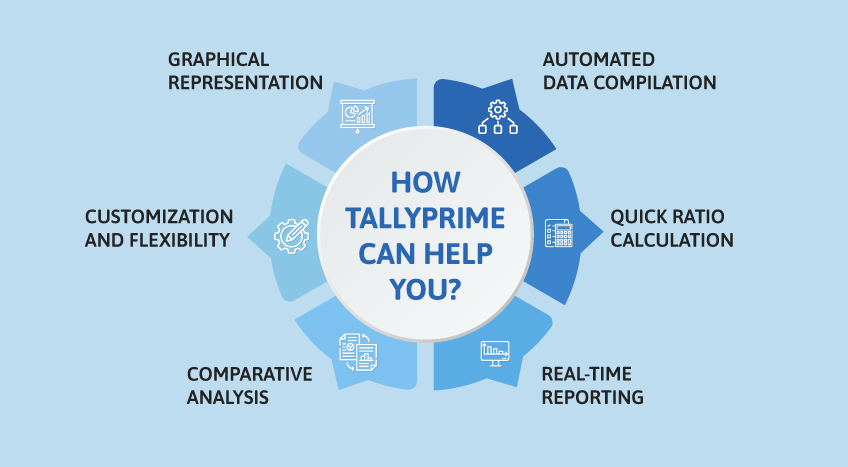
TallyPrime, a versatile business management software, can streamline and enhance ratio analysis, making it more efficient and insightful.
Here's how TallyPrime can assist you in conducting ratio analysis:
Automated data compilation
TallyPrime automates the process of gathering financial data from various sources, including balance sheets, income statements, and cash flow statements. This eliminates manual data entry errors and ensures accurate and up-to-date information for ratio calculations.
Quick ratio calculation
TallyPrime allows you to calculate various ratios using its built-in features effortlessly. With a few clicks, you can generate liquidity ratios like the Current Ratio and Quick Ratio, providing instant insights into your company's short-term financial health.
Real-time reporting
Through TallyPrime's real-time reporting capabilities, you can access dynamic and interactive financial reports. This enables you to monitor key ratios and financial indicators as they evolve over time, aiding in proactive decision-making.
Comparative analysis
TallyPrime enables easy comparison of ratios across different periods, helping you identify trends and changes in your company's financial performance. This feature is invaluable for tracking improvements or identifying areas that need attention.
Customisation and flexibility
The software allows you to customise reports and dashboards, tailoring them to your specific needs and preferences. This flexibility empowers you to focus on the ratios that matter most to your business and industry.
Graphical representation
TallyPrime can transform complex numerical data into visually engaging graphs and charts. This visual representation of ratios enhances your ability to communicate financial insights to stakeholders who may not be well-versed in financial terminology.
Wrapping up
Financial metrics reflect a company's performance, stability, and growth potential. Whether you're evaluating liquidity, profitability, or efficiency, ratios point the way forward.
Ratio analysis can get complex, but TallyPrime simplifies it. With automated data compilation, real-time reporting, and a user-friendly interface, TallyPrime makes ratio analysis a seamless process.
It helps businesses make sense of their financial data and enables confident, strategic decisions. Use ratio analysis with TallyPrime to unlock insights that shape your business's direction, whether you're a startup or an established enterprise.














