










Credit lending is how businesses borrow funds from banks or NBFCs to manage cash flow, fund operations or invest in growth, making it a critical tool for sustaining and scaling operations. For Indian MSMEs, accessing credit effectively depends on selecting the right facility, maintaining clean, reliable financial records and using options such as collateral-free government schemes to secure funds at competitive rates without straining working capital.
What are the primary types of credit lending for businesses?
Securing capital is effective only when the loan type matches the business’s operational needs and repayment capacity.
-
Working capital and cash credit
Working capital (WC) loans and cash credit (CC) are short-term facilities.
Best used for: Funding day-to-day operations such as payroll, rent and inventory.
-
Term loans
Term loans are medium- to long-term facilities with fixed or floating monthly instalments over a defined tenure.
Best used for: Capital expenditure such as purchasing machinery, equipment or real estate.
-
Invoice discounting and TReDS
Delayed receivables can significantly strain cash flow.
Solution: Through the Trade Receivables Discounting System (TReDS), businesses can access funds against unpaid invoices instead of taking on traditional debt.
-
Overcoming the collateral hurdle
Many MSMEs lack physical assets to pledge for secured loans.
Solution: Eligible businesses can use the Credit Guarantee Fund Trust for Micro and Small Enterprises (CGTMSE) scheme to secure collateral-free credit from partner lenders, subject to eligibility and lending norms.
Where should MSMEs apply?
Choosing the right financial partner is as important as selecting the right loan product.
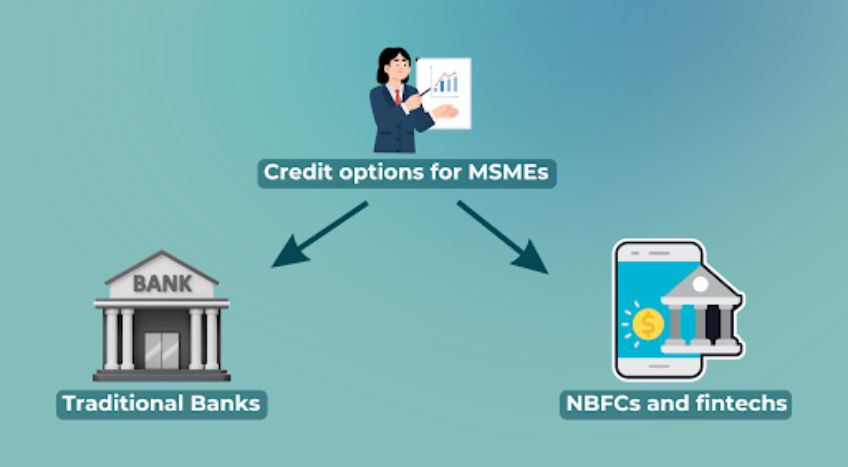
Choosing the right financial partner is as important as selecting the right loan product.
-
Traditional banks
Traditional banks are suitable for established businesses seeking lower interest rates. However, lenders may require 1 to 3 years of operating history, depending on the product, turnover, repayment profile and collateral availability.
They may also ask for CMA data (Credit Monitoring Arrangement reports), financial statements, collateral in some cases and typically have longer processing timelines.
-
NBFCs and fintechs
Digital lenders and NBFCs are better suited for businesses needing faster, unsecured capital. They assess applications primarily based on cash flow and Goods and Services Tax (GST) returns, offering quicker approvals but usually at slightly higher interest rates.
How do lenders evaluate a business credit application?
Before approving a loan, lenders assess the borrower’s financial discipline and repayment capacity.
-
Commercial credit scores
Lenders rely on commercial credit scores, such as the CIBIL MSME Rank, to evaluate past repayment behaviour and creditworthiness.
-
Debt Service Coverage Ratio (DSCR)
This metric indicates whether the business generates sufficient income to meet its loan obligations comfortably.
- DSCR = Net Operating Income (NOI) / Total Debt Service
Net Operating Income (NOI): Typically measured as EBITDA, reflecting the core operating cash generated by the business.
Total Debt Service: Includes all principal and interest payments due within the period, across both short- and long-term debt.
-
Digital underwriting and account aggregators
Lenders increasingly use the Account Aggregator (AA) framework to securely access verified financial data, such as bank statements, with user consent. Open Credit Enablement Network (OCEN)-based lending models are also expanding across select platforms and lenders.
What are the hidden costs in commercial credit lending?
Evaluating a loan only on the advertised interest rate can lead businesses to underestimate the true cost of borrowing.
-
Interest calculation methods
There is a significant difference between flat interest rates, where interest is charged on the full principal throughout the tenure and reducing balance rates, where interest is charged only on the outstanding balance. This directly affects the total interest paid over time.
-
Fixed vs floating rates
Most bank term loans are linked to external benchmarks such as the Reserve Bank of India (RBI) repo rate. If the repo rate increases, the MSME’s floating interest rate and monthly instalment also rise, impacting future cash flow.
-
Upfront costs
Borrowers should account for additional charges such as processing fees, legal and valuation costs for collateral, and applicable stamp duty, which vary by state.
-
Operational costs
Lenders may charge penalty interest for delays in submitting required documents, such as monthly stock statements. Some also impose foreclosure charges if a term loan is repaid before the agreed tenure.
How to prepare your records for faster loan approval?
Financial institutions often reject applications when there is a mismatch between reported income and official records.
-
The Udyam registration baseline
A Udyam Registration Certificate is the baseline requirement for recognition as an MSME and for accessing priority sector lending (PSL) benefits and government-backed schemes.
-
The standard document checklist
Lenders typically require a consistent set of documents before starting the underwriting process:
- 1 to 3 years of financial statements (audited where applicable)
- 6 to 12 months of bank statements
- Latest GST returns (GSTR-1 and GSTR-3B), where applicable
- Income tax returns
- KYC documents of directors, partners or proprietors
- Existing loan statements, if any
-
Aligning financial documents
It is essential to align income tax returns, GST filings and bank statements. If revenue reported under GST does not match actual bank deposits, it raises concerns during underwriting.
-
Arranging margin money
Banks typically do not finance the full project cost. Borrowers are required to contribute a portion of the loan amount as margin money, which varies based on the lender, borrower profile, asset type and the applicable scheme.
-
Statutory filings
Ensure that annual returns and filings are completed accurately and on time with the Ministry of Corporate Affairs (MCA), as delays or inconsistencies can impact loan approval.
Conclusion
Securing and maintaining business credit depends on one core factor: consistent, accurate financial data that lenders can trust at every stage. Delays in stock statements, record mismatches or incomplete reporting can disrupt credit lines and directly affect daily operations.
TallyPrime helps businesses stay continuously prepared by generating real-time balance sheets, stock summaries and ageing reports with accuracy and speed. This ensures financial records remain aligned, audit-ready and easy to present to lenders, enabling smoother approvals and uninterrupted access to credit when it matters most.














