










- Definition
- Source of Cost of Capital
- Components of Cost of Capital
- Cost of Capital Formula
- How to Calculate Cost of Capital
- Example of Cost of Capital Calculation
What is Cost of Capital?
Cost of capital is the minimum rate of return a business must earn on its investments to satisfy the providers of capital, such as lenders, shareholders, and investors. In financial management, it is used as a benchmark to decide whether a project, investment, or expansion plan is financially worthwhile.

|
Question |
Simple Answer |
|
Meaning |
Minimum return expected by capital providers |
|
Used in |
Investment decisions, project evaluation, business valuation |
|
Includes |
Cost of debt, equity, preference shares, and retained earnings |
|
Common method |
Weighted Average Cost of Capital |
|
Simple example |
If cost of capital is 12%, the business should earn more than 12% from an investment |
Cost of Capital in Financial Management
Cost of capital plays an important role in financial management because it helps businesses evaluate whether an investment or project is financially worthwhile. It represents the minimum return a company should aim to earn on the funds invested in its business. Financial managers use the cost of capital while making decisions related to new projects, expansion, financing, and allocation of funds. Comparing the expected return of an investment with its cost of capital can help a business make more informed financial decisions.
Why Cost of Capital is Important
Understanding the cost of capital helps businesses make better investment and financing decisions. It provides a benchmark for evaluating potential projects and determining whether they are likely to create value for the business. It can also help management choose an appropriate mix of debt and equity financing, assess financial performance, and plan for long-term growth. A clear understanding of the cost of capital therefore supports more disciplined use of funds and better financial decision-making.
Source of Cost of Capital
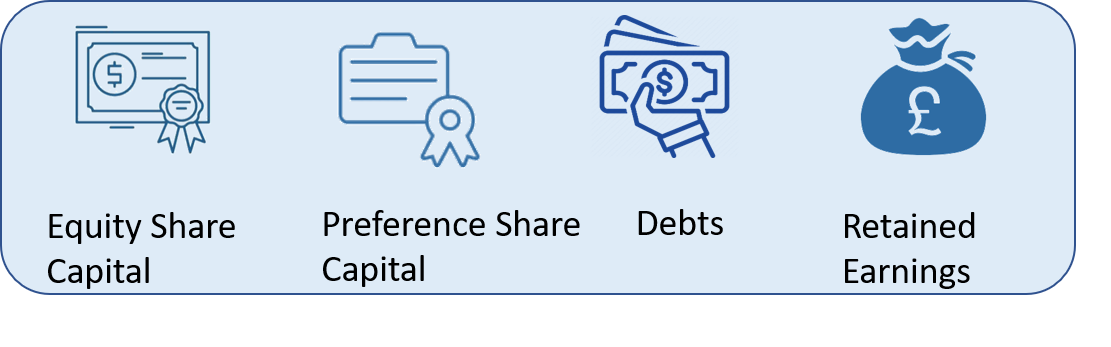
The source of capital employed by the firm is usually in the following form:
Components of Cost of Capital: Zero Risk, Business Risk & Financial Risk
There are three factors to the cost of capital explained below:
Zero Risk Return
It talks about the expected rate of return when a project involves no financial or business risks.
Premium for the Business Risk
Business risk is determined by the capital budgeting decisions that a firm takes for its investment proposals. So, if a firm selects a project that has more than normal risk, then it is obvious that the providers of capital would require or demand a higher rate of return than the normal rate.
Thus the premium factor plays an important role here as it increases the Cost of Capital. But how much premium? it’s up to the firm’s project selection decision which alienates with the firm’s goal and objectives and how badly they want the project to increase their market value.
Premium for the Financial Risk
Financial risk is associated with the capital structure pattern of the firm. Here, the premium finds its way to the picture depending on the volume of debts the firm owes. The higher the debt capital, the more is the risk compared to a firm that has relatively low debts.
Computation of Cost of Capital
The cost of capital can be computed in two ways:
|
Method / Technique |
Meaning |
When Used |
|
Specific cost of capital |
Cost of each individual source of finance |
To calculate cost of debt, equity, preference shares, or retained earnings separately |
|
Composite cost of capital / WACC |
Weighted average cost of all sources of finance |
To calculate overall cost of capital of the business |
Techniques of Cost of Capital
|
Technique |
Formula / Basis |
|
Cost of debt |
Interest cost adjusted for tax |
|
Cost of preference shares |
Dividend on preference shares divided by net proceeds |
|
Cost of equity |
Expected return required by equity shareholders |
|
Cost of retained earnings |
Opportunity cost of reinvested profits |
|
WACC |
Weighted average of debt, equity, preference capital, and retained earnings |
Cost of Capital Formula
The three components of cost of capital discussed above can be written in an equation as follows:
K = r₀ + b + f
Where:
- K = Cost of Capital
- r₀ = Return at zero-risk level (risk-free rate of return)
- b = Premium for business risk
- f = Premium for financial risk
In simple terms:
Cost of Capital = Risk-free Return + Business Risk Premium + Financial Risk Premium
This formula provides a conceptual representation of the return expected for providing capital, considering both business and financial risks.
WACC Formula
WACC = (E/V × Ke) + (R/V × Kr) + (P/V × Kp) + (D/V × Kd)
Where:
- E = Equity share capital
- R = Retained earnings
- P = Preference share capital
- D = Debentures
- V = Total capital
- Ke, Kr, Kp, Kd = Cost of each respective source of capital
Cost of Capital Example
Suppose a business borrows ₹10,00,000 at an annual interest rate of 10%. If the applicable tax rate is 30%, the after-tax cost of debt can be calculated as:
After-tax Cost of Debt = Interest Rate × (1 − Tax Rate)
= 10% × (1 − 30%)
= 7%
This means the business effectively pays 7% after considering the tax benefit on interest.
If the business uses other sources of finance, such as equity, their costs would also be considered to determine the overall cost of capital.
Cost of Capital Calculation Example with WACC Formula
Aero Ltd had the following cost capital structure employed for financing its projects and would like to calculate the cost of capital.
|
|
Amount ( Rs. ) |
After-tax Cost % |
|
|
Equity share capital |
8,00,000 |
16% |
0.0225 |
|
Retained earnings |
4,00,000 |
15% |
0.03 |
|
Preference share capital |
6,00,000 |
12% |
0.025 |
|
Debentures |
6,00,000 |
9% |
0.053 |
|
|
|
|
|
|
Total |
24,00,000 |
|
|
Calculation of Cost of capital of Aero Ltd
|
Source |
Amount (Rs. )
(1) |
Weights (Specific Capital/Total cost)
(2) |
After-tax Cost (Cost%/100)
(3) |
Weighted Cost
(4) = (2) *(3) |
|
Equity share capital |
8,00,000 |
0.34 |
0.16 |
0.053 |
|
Retained earnings |
4,00,000 |
0.16 |
0.15 |
0.024 |
|
Preference share capital |
6,00,000 |
0.25 |
0.12 |
0.03 |
|
Debentures |
6,00,000 |
0.25 |
0.09 |
0.023 |
|
|
|
|
|
|
|
Total |
24,00,000 |
|
|
0.13 |
Weight Average Cost of Capital here is 13% (0.13*100). This implies that the overall cost of capital employed by Aero Ltd is 13%. In other words, we can say that the company is paying a premium of 13% to the lenders of capital as a return for their risk.
You can use the formula we discussed, and the result will be similar.
= (6,00,000 / 24,00,000) * 0.09 + (6,00,000 / 24,00,000) * 0.12 + ( 4,00,000 / 24,00,000 ) * 0.15 + ( 8,00,000 / 24,00,000) * 0.16 = 13%
If the company’s WACC is 13%, any project should ideally generate returns higher than 13%. A project earning less than 13% may reduce value, while a project earning more than 13% may create value.
How TallyPrime Helps in Financial Management
TallyPrime makes financial management simpler by helping businesses manage accounting, cash flow, receivables, payables, and financial reports in one place. With easy access to reports such as Balance Sheet, Profit & Loss A/c, and Cash Flow, businesses can better understand their financial position and make informed decisions.














