










The AI industry is growing rapidly, with every product and service incorporating AI features to deliver better, more user-friendly interactions that enhance productivity across various fields. The driving force behind many of these successful AI capabilities is Large Language Models (LLMs). Leveraging the power of LLMs has become a popular approach to boosting productivity, as exemplified by ChatGPT from OpenAI, widely used for its advanced language understanding.
However, despite its benefits, users often face concerns about privacy and data security. Even when AI features guarantee that user data is not used for model training, the lingering question remains: "Is my data safe?" Addressing this trust issue requires innovative solutions that ensure no user data ever leaves the local device.
Model efficiency is crucial in AI deployments, especially when balancing performance with the constraints of device resources and privacy needs. Knowledge Distillation offers a compelling approach to achieve this balance by transferring the knowledge of a large, complex teacher model into a smaller, more efficient student model. This teacher-student paradigm enables the creation of Small Language Models (SLMs) capable of running locally, without internet connectivity, providing users with privacy assurance and maintaining strong language understanding.
In this article, we explore how Knowledge Distillation can be leveraged to train SLMs with comparable comprehension to LLMs while addressing privacy and efficiency challenges in real-world AI applications.
Introducing Knowledge Distillation!
Knowledge Distillation (KD) is a model compression technique where a large, high-capacity teacher model imparts its knowledge to a smaller student model. The core idea is to train the student to mimic the behaviour of the teacher, i.e. to train the student to replicate the teacher’s predictive behaviour with significantly reduced computational and memory requirements, enabling deployment in resource-constrained environments without substantial accuracy loss, as large models have higher number of parameter indicating large layers and neurons for which to generate any response, each performs certain operations which requires more computation resources and more Memory to load for large models.
Before we dive into the Knowledge Distillation workflow, let’s get familiar with a few terminologies.
Teacher and student models
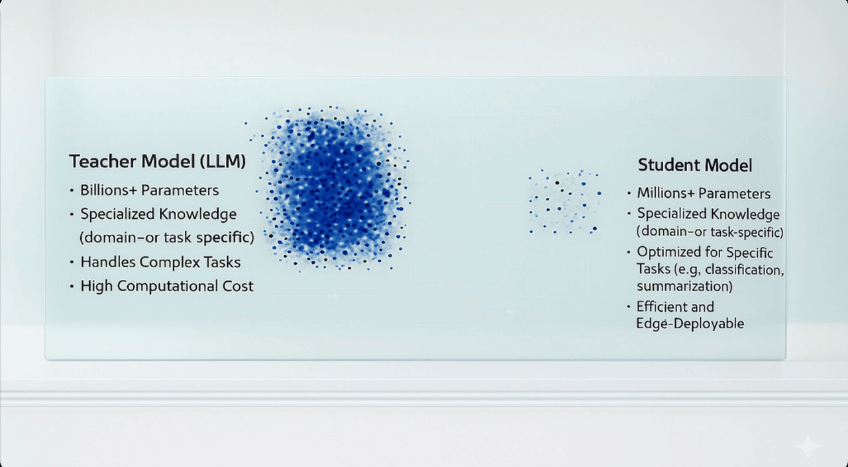
- Teacher model: A well-trained, often large model, with high accuracy but has high resource requirements and complex architecture. This model generally requires a high-end GPU (usually runs on bare metal servers hosted locally or on cloud) for loading and processing.
- Student model: A smaller, lighter model designed to simulate the teacher’s performance with fewer resources and high speed. The purpose of student models is to be able to serve on low spec systems like smartphones, or IoT devices for providing enhanced assistance to the device’s features.
Hard labels vs soft labels
- Hard labels: These consist of one-hot encoded ground-truth classes used in conventional supervised learning
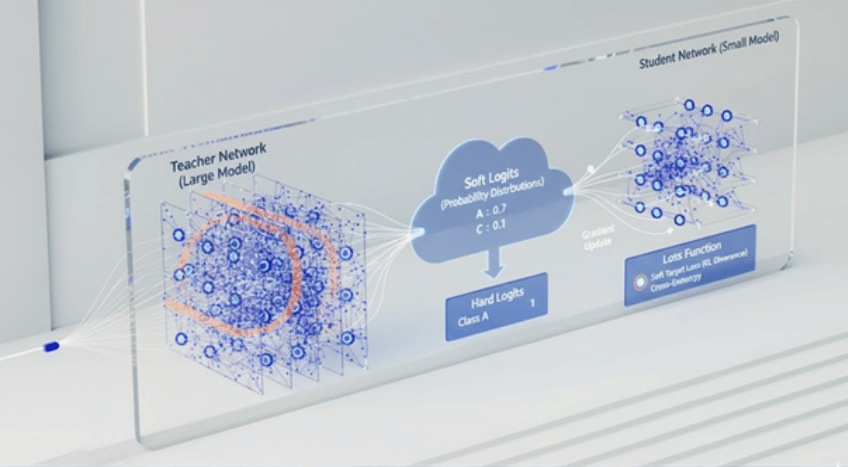
- Soft labels: These are the core of Knowledge Distillation and are the logits or softened probability distributions about inter-class similarities produced by the teacher model, providing richer information about the teacher's confidence. Basically, soft labels are the genes inherited by learning from the teacher model with some variations, providing more generalization to the student model.
Ref: Generated from Gemini 2.5 flash
How is knowledge transferred?
Teacher model training
Teacher model training is the foundational step in the Knowledge Distillation (KD) pipeline. The aim is to build a highly capable teacher model, which later will become a role model or idol to serve as a guide for a smaller student network. Hence, Teacher model works as a performance benchmark. It must capture informative and comprehensive patterns from training dataset and produce fine-tuned probability distribution that signifies inter class relationships. The more generalised and richer these insights are, the more effectively it can teach the student model. This stage determines the quality of information available for distillation and making its design, dataset, and optimization strategies critical.
Importance of teacher selection
Before directly jumping to teacher selection, let us investigate its significance. Selection and tuning of the teacher model are critical in Knowledge Distillation workflows because the quality, diversity, and calibration of the teacher’s knowledge directly determine the upper bound of student performance. The teacher’s output distributions (soft logits) are the primary source for the student, so any weakness - be it in overfitting, bias, poor calibration, or scope, will propagate or even amplify in the distilled student as generalization on top of these small mis-judgements extrapolates to even larger miscalculations.
Now we’ll have a look at factors defining the severity of selection process -
- Generalization power: A student model learns not only what the teacher does well but also its weaknesses. If the teacher is overfitted or unstable, the student will likely repeat those problems, limiting how well it performs outside the training data.
- Calibration: A well calibrated teacher provides “soft” predictions that accurately reflect how confident it is in each class, including any uncertainty between them. If the teacher’s outputs are poorly calibrated, the student may learn misleading confidence patterns, which can reduce the final model’s reliability and robustness.
- Knowledge richness: Teachers that capture deeper patterns and relationships between classes, using methods like self-supervised pretraining or model ensembling or recently proficient training techniques like supervised reinforcement learning (a step wise framework with expert trajectories to teach small language models to reason hard problems), offers more detailed and meaningful “knowledge”. This rich information helps the student learn more effectively during distillation.
- Task alignment: Misalignment in task or domain between teacher and student can introduce knowledge transfer gaps, reducing practical benefit.
Considerations for teacher selection
- Model capacity vs overfitting: Select a model with sufficient capacity suitable and sufficient for the purpose of training to capture complexity but avoid excessive overparameterization, which may lead to noisy, non-generalizable outputs, as true strength lies not in force, but in focus. If we consider a large model with super high parameters for a simple classification task, all it will do is waste resources, when a simple and smaller model can do it proficiently, saving a lot of memory and computational power. Even sometimes, pruning or regularization is also needed post-pretraining.
- Pretraining strategies: Utilizing foundation models pretrained on large, diverse corpus of data often builds teachers with better out-of-distribution generalization and richer soft labels. Fine-tuning on task-specific data is essential for relevance.
- Optimization techniques: Apply loss landscape smoothing (e.g., SAM, an optimization algorithm that acts as a powerful regularizer by guiding models toward flat minima of the loss landscape, which generally leads to better generalization performance on unseen data), or Information bottleneck constraints make the model compress information intelligently, which leads to cleaner features and more general outcomes. This improves how well the model’s knowledge can be transferred or distilled into student models.
- Calibration methods: After or during training, fine tuning the teacher’s output probabilities using methods like temperature or Platt scaling, ensures that the teacher’s confidence is more accurate and well-calibrated, improving student learning from soft labels. How about having dynamic temperature during distillation? Does it ensure better calibration? Answer is not always, in worst case scenario it extrapolates the error patterns, resulting in bad outcomes. However, to compensate this generalization, taking loss of teacher into account can reduce the chance of these error patterns.
- Diversity via ensembles or multi-teacher methods: Use ensemble teachers to blend complementary error patterns or domain knowledge, providing students with a more robust supervisory signal (soft logits). Some methods build explicit multi-teacher assistant networks to smooth knowledge transfer and improve generalization.
Training process (teacher model)
1. Prepare data: Start with a clean and representative dataset. Use data augmentation if the task benefits: this helps the teacher model learn all relevant patterns and reduces overfitting. Data Augmentation techniques can be paraphrasing, noise injection, Synonym Replacement, Random Deletion, Translation, etc.
2. Train with supervised learning: Train the teacher model on the full dataset using standard techniques, such as cross-entropy loss for classification tasks. Monitor validation accuracy and loss to track overfitting or underfitting. Adjust hyperparameters like batch size, learning rate, and optimizer for best results, for which technique like hyperparameter tuning can be used, to get an optimized set of parameters.
3. Calibrate model outputs: Make sure the teacher model’s probability predictions are well-calibrated i.e. when the model is less certain, it shows that uncertainty in its output. “Temperature scaling” can be used to smooth predictions, which later helps the student learn better from soft labels.
4. Evaluate and fine-tune: Check final model accuracy, calibration, and robustness before starting distillation. If needed, fine-tune the teacher on hard examples or relevant sub-tasks to ensure it excels at the purpose of student model.
Distillation process
Once the teacher model is up and running with strong performance and accuracy, just like a teacher who has studied and passed the exam, it is ready to transfer its knowledge to the student model. This is carried out in the following manner:
- Use the trained teacher model
- Start with a teacher model that is well-trained and produces accurate predictions (probability outputs, not just class labels).
- Generate soft labels (knowledge extraction)
- For each example in the training data, pass it through the teacher model and record the output probabilities (soft labels).
- These soft labels are adjusted using a technique called “temperature scaling.” With a higher temperature, the outputs become softer (showing more uncertainty and similarities between classes, providing high level of generalization), giving richer information to the student model.
- Prepare the student model
- Choose a smaller student model architecture designed for fast and efficient inference on target devices (like mobile or edge hardware). These are generally chosen from the same model family having similar architecture ensuring similar pattern recognition abilities.
- Train the student model
- Train the student model using two types of information:
a) Hard labels: The true class labels from the dataset (enhancing accuracy).
b) Soft labels: The probability distributions generated by the teacher model.
- The student’s loss function balances matching the soft labels and correctly predicting hard labels, so the student learns both the correct answer and the reasoning behind it.
- Evaluate and tune
- At the end of training, test the student model’s accuracy, speed, and resource usage. If the results are not satisfactory, adjust hyperparameters, re-run distillation.
Ref: Generated from Gemini 2.5 flash
In this way, Knowledge Distillation transfers not only the teacher model’s final predictions but also the detailed relationships between classes (soft logits). This helps the smaller student model learn more effectively, achieving performance close to the teacher’s accuracy while using much less computing power and memory.
Since we’ve looked at how actually distillation is done, let's have a look at different variations of Knowledge Distillation.
"Experience truly trustworthy AI. With compact models that deliver high performance and unparalleled data security right on your device, boosting strategic success while maintaining complete control. "
Variations of Knowledge Distillation
1. Knowledge types: How information is gathered
These types are based on where the information is derived from the deep teacher model:
- Response-based distillation:
Information is obtained from the output layer of the teacher model. The student model is expected to mimic the teacher's logits (class probabilities). This is the most popular genre of KD. The distillation loss often uses a divergence metric, such as Kullback-Leibler Divergence, to compare the teacher and student logits.
- Feature-based distillation:
Knowledge is derived from the feature maps of the intermediate layers of the teacher network. Each layer of student learns from increasingly abstract feature representations of intermediate outputs. For example, this knowledge can be extracted from the penultimate layer of the teacher model for tasks like image classification.
- Relation-based distillation:
This type explores relationships between different layers or data samples, going beyond the specific layer outputs used in response-based and feature-based methods. An example is the Flow of Solution Process (FSP), which is defined by the Gram matrix and summarizes the relations between pairs of feature maps.
2. Distillation schemes: Training strategy
Distillation schemes classify the training setup based on whether the teacher network is updated simultaneously with the student model:
- Offline distillation:
The teacher network is pre-trained and then frozen (not updated). The student network is trained using the knowledge from the static teacher model. Most conventional KD methods, including the original base paper by Hinton et al., operate in this manner.
- Online distillation:
The teacher and student networks are trained simultaneously. This strategy is necessary when a large pre-trained teacher model is unavailable. It can involve mutual teaching, where sub-networks learn by mutually guiding each other via KD.
- Self-distillation:
The same network acts as both the teacher and the student. This method addresses problems related to selecting an optimal teacher and preventing accuracy degradation in student models. Deeper classifiers (teachers) within the network are used to guide the training of shallower classifiers (students) using divergence and L2 losses. During the inference period, the additional shallow classifiers are dropped.
3. Distillation algorithms: Advanced frameworks
These specialized algorithms are proposed to make the knowledge transfer process more efficient in complex and diverse settings:
- Adversarial distillation:
Applies principles of Adversarial Learning (like GANs). A discriminator measures the similarity between the teacher’s and student’s outputs, and the student acts as a generator attempting to "fool" the discriminator by producing outputs that imitate the teacher.
- Multi-teacher distillation:
Involves distilling knowledge from an ensemble of several heavy teacher architectures to obtain diverse types of knowledge. The soft label outputs of the ensemble are typically averaged to provide supervision to the student.
- Cross-modal distillation:
The process of transferring knowledge between different data modalities (e.g., image to audio). This is used when data or labels for certain modalities are missing, corrupt, or unusable.
- Attention-based distillation:
Leverages attention mechanisms to focus the network on specific input details. Knowledge is transferred by matching the attention maps of intermediate layers between the teacher and student models.
- Quantized distillation:
Aims to train a low-precision student model (e.g., 2-bit or 8-bit integer) from a high-precision teacher network (e.g., 32-bit floating point). This ensures the model is compatible with edge devices that require fixed-point inference for computation and power efficiency.
Practical cases of Knowledge Distillation
Having a look into multiple variations of Knowledge Distillation, let have a look at how Knowledge Distillation is widely used in real-world AI systems where balancing model performance with resource constraints is crucial.
- Mobile and edge AI:
Distilled models run efficiently on smartphones, wearables, and IoT devices, enabling fast, low-power AI for tasks like real time call translation, image processing and predictive typing — all without reliance on cloud connectivity.
- Autonomous vehicles and robotics:
Real-time perception and decision-making in autonomous cars and robots require models that are both accurate and fast. Distillation compresses large perception networks so they can operate within strict latency and hardware limits.
- Healthcare and medical devices:
AI-powered medical diagnostics often need to run on privacy-sensitive devices. Distillation enables lightweight models that keep data local without sacrificing diagnostic performance.
- Natural Language Processing (NLP):
Large pre-trained language models are resource intensive. Distillation lets developers create smaller, efficient language models for chatbots, translation, and sentiment analysis while maintaining quality.
As such Knowledge Distillation offers an effective solution for deploying high-performance AI models on devices with limited resources or strict privacy requirements. By transferring knowledge from a large, well-trained teacher to a compact, efficient student model, organizations can achieve near-state-of-the-art accuracy while drastically reducing computational and memory demands.
Distillation can be performed through multiple variations, giving developers the flexibility to adapt techniques to their use cases and data availability. As AI continues to expand into everyday applications, knowledge distillation enables trustworthy, scalable intelligence for both commercial and edge deployments. Moving forward, ongoing research and practical innovations will further broaden its impact, making intelligent, efficient AI more accessible than ever.














