










In Volume 1, we focused on understanding business problems and selecting the right solution approach. We explored how to evaluate requirements, understand customer workflows, and determine when to use configuration, customisation, integration, or a combination of these approaches.
Choosing the right approach is only the first step.
Many solutions work well when they are first implemented. The real challenge begins later—when business requirements change, data grows, users increase, integrations expand, or upgrades become necessary.
A solution that works today may become difficult to maintain tomorrow.
This is where engineering excellence makes the difference.
Volume 2 focuses on the mindset, principles, and practices required to build solutions that are reliable, maintainable, scalable, and easy to extend. The goal is not just to make solutions work, but to build solutions that continue to deliver value over time.
This volume is not about learning a specific technology or framework. It is about learning how engineers think—how they make decisions, evaluate trade-offs, manage uncertainty, and design solutions for the real world.
To make this journey practical, the playbook is organised into four stages:
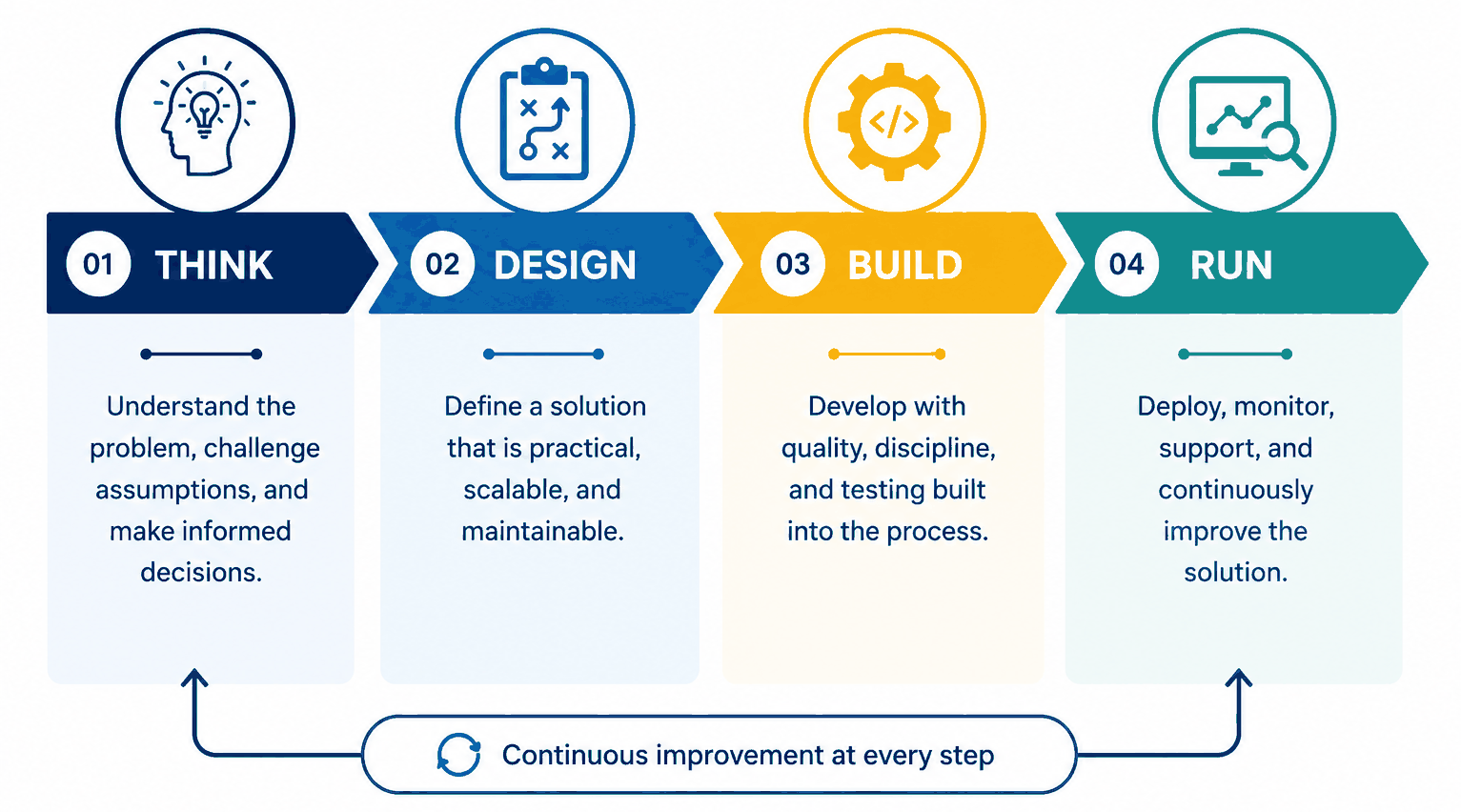
Together, these stages help transform a solution from an idea into a reliable and sustainable outcome.
Who Should Read This Volume
This volume is intended for anyone involved in designing, building, or maintaining solutions in the Tally ecosystem, including:
-
TDL Developers building customisations and extensions.
-
Integration Engineers developing connected solutions and APIs.
-
Technical Architects designing solution architecture and integration strategies.
-
Project Leads responsible for delivery quality and technical decision-making.
-
Enterprise Solution Teams managing large-scale customer implementations.
Whether you are building a small customisation or a complex integration platform, the engineering principles in this volume remain equally relevant.
What Great Engineering Looks Like
The principles in this volume are simple:
-
Build on the Product: Extend TallyPrime's capabilities instead of working against its design.
-
Keep It Simple: Choose the simplest solution that effectively solves the business problem.
-
Design for Real-World Usage: Build solutions around how customers actually work, not how we expect them to work.
-
Make It Easy to Maintain: Create solutions that are easy to understand, support, and enhance.
-
Design for Change: Ensure solutions can adapt to future requirements, upgrades, and business growth.
-
Reduce Operational Effort: Keep solutions easy to deploy, monitor, support, and manage.
Build Right is about creating solutions that are not only functional but also dependable, maintainable, and ready for long-term success.
How to Use This Volume
Use this volume throughout the solution lifecycle:
-
Before development: Validate requirements, evaluate risks, and make better engineering decisions.
-
During design and development: Apply engineering principles to architecture, integrations, coding, testing, and quality.
-
Before deployment: Review readiness, operational considerations, and support requirements.
-
After go-live: Improve monitoring, supportability, maintainability, and long-term sustainability.
The principles in this volume are intended to help you make better engineering decisions—not just build features.
Expected Outcomes
By the end of this volume, you should be able to:
-
Think like an engineer, not just a developer.
-
Make better solution decisions.
-
Design for growth, change, and reliability.
-
Build great solutions with quality and discipline.
-
Deploy and support solutions confidently.
-
Create solutions that continue to deliver value over time.
Part 1 Thinking like an Engineer
Successful solutions are built through good engineering decisions, not just good coding.
This part focuses on understanding problems, choosing the right solution approach, and building solutions that remain reliable, maintainable, and valuable over time.
1.1 Engineering Beyond Coding
Writing code alone does not guarantee a successful solution. Good engineering is about understanding the problem, making the right decisions, and building solutions that continue to perform well as business needs evolve.
In the Tally ecosystem, the goal is not just to make something work today, but to build solutions that are easier to support, extend, and upgrade in the future.
-
Engineering vs Coding: Coding makes a feature work; engineering ensures it continues to work as the solution grows and changes.
-
Think Beyond Implementation: Consider how the solution will behave after deployment, how it will evolve, and how easily it can be supported.
-
Technical Decisions Matter: Shortcuts may save time today but often create more work tomorrow.
-
Build for the Future: Consider future users, data volumes, integrations, and business changes—not just current requirements.
-
Take Ownership: Ownership means caring about quality, handling failures properly, identifying risks early, and thinking beyond assigned tasks.
-
Avoid Quick Fixes: Temporary solutions may solve immediate problems, but often create larger issues later.
Takeaway: Coding solves today's problem. Engineering prepares for tomorrow's challenges.
Example: A developer creates an integration that successfully imports transactions into TallyPrime. The solution works during testing, but it does not handle duplicate requests, network failures, or increasing transaction volumes. As usage grows, duplicate entries and synchronisation issues begin to appear.
The coding was successful because the feature worked. The engineering was incomplete because the solution was not designed for real-world conditions. Good engineering considers reliability, scalability, supportability, and long-term maintenance from the beginning.
1.2 Understanding the Real Problem
Customers often describe the problem they see, not the problem they have. Good engineering focuses on understanding the business workflow, root cause, and operating environment before deciding on a solution. The goal is not to build what was requested—it is to solve what the business actually needs.
-
Understand How the Business Works: Learn current workflows before designing solutions, and improve processes that are inefficient, error-prone, or difficult to scale.
-
Identify the Root Cause: Focus on solving the real cause of the problem, not just the symptoms you can see.
-
Consider Real-World Conditions: Design solutions for real-world usage, including connectivity issues, transaction volumes, user behavior, and multi-user operations.
-
Think Beyond Standard Scenarios: Don't design only for normal cases—consider exceptions, failures, and customer-specific requirements.
-
Understand the Customer Environment: Business size, number of users, operational processes, infrastructure, and deployment models influence solution behavior and scalability.
-
Validate Assumptions: Verify how users, data, and systems actually work instead of relying on assumptions.
-
Challenge Requirements Respectfully: Customers may suggest a solution, but your responsibility is to understand and solve the underlying problem.
Takeaway: The best solution is not always the one the customer asks for. It is the one that solves the real problem.
Example: A customer reports frequent stock mismatches between branches and requests a new stock verification screen before billing. During analysis, the developer discovers that users are already verifying stock before creating invoices. However, stock transfers made in one branch are taking several minutes to appear in other branches because of delayed synchronisation.
The stock mismatch is only a symptom. The real problem is delayed synchronisation, which causes users to work with outdated stock information. Instead of adding another verification screen, the solution focuses on improving synchronisation and providing better visibility into stock update status. The result is fewer stock mismatches without introducing additional screens or user effort.
1.3 Choosing the Right Solution Approach
Not every business problem should be solved in the same way.
The right solution depends on the business requirement, customer environment, operational complexity, and long-term needs. The objective is not to build more functionality, but to choose the approach that solves the problem with the least complexity and effort.
-
Evaluate Before You Build: Before building anything, check whether the requirement can be solved using existing capabilities and choose the simplest approach that works.
-
Explore Configuration First: Before building anything, check whether the requirement can be solved using existing TallyPrime settings and configurations.
-
Customise When It Adds Value: Use customisation only when configuration cannot meet a customer-specific requirement.
-
Integrate When Systems Need to Work Together: Use integration instead of customisation when a requirement involves external systems and data needs to flow between them.
-
Use Each System for What It Does Best: Let each system do what it does best and integrate where information needs to be shared.
-
Avoid Over-Engineering: Choose the simplest solution that effectively solves the problem.
-
Respect TallyPrime Architecture: Build solutions that align with TallyPrime's design to simplify maintenance, support, and upgrades.
-
Think Beyond Today's Requirement: Choose approaches that are easier to support, upgrade, and extend as business needs evolve.
-
Explain Trade-Offs Clearly: Help stakeholders understand the benefits, risks, and long-term impact of each option before making decisions.
Engineering Insight: Good solutions adapt technology to business reality. Before designing a solution, understand how the business works. Build solutions that support and improve existing operations rather than forcing users to change their processes for technical convenience.
Takeaway: Technology should serve the business, not the other way around.
Example: A customer wants different users to have different access levels for creating, modifying, and deleting transactions. Instead of building a custom authorization framework, the developer first evaluates TallyPrime's existing user security and access control capabilities. The requirement is fulfilled through configuration without writing additional code. The simplest solution often provides the best long-term outcome.
1.4 Building Software That Is Easy to Maintain
Good solutions are not only expected to work correctly, but also to remain easy to understand, support, and extend over time. In the Tally ecosystem, solutions often evolve for many years, pass through multiple developers, and adapt to changing business requirements. Poorly structured solutions may work initially but become difficult to maintain later.
-
Write Clean and Readable Code: Write code that someone else can easily understand, maintain, and improve.
-
Organize Projects Properly: Group related components logically so developers can quickly navigate the project and locate required functionality.
-
Design for Reuse: If you are solving the same problem twice, look for a reusable solution.
-
Keep It Simple: A solution does not become better because it is more complex.
-
Build for Future Change: Design for change from the beginning, not after it becomes necessary.
-
Manage Technical Debt: Every shortcut creates future work—make sure it does not become tomorrow's problem.
-
Reduce Dependency on Individuals: Write solutions that others can understand, maintain, and enhance without depending on the original developer.
Takeaway: Good software is not just easy to build—it is easy to maintain, adapt, and grow.
Example: A developer implements approval validation separately across multiple voucher types by copying the same logic into different modules. Initially, the solution works correctly. Later, when approval rules change, the same modification must be applied in several places, increasing effort and the risk of inconsistencies. A better approach is to create a reusable approval validation module that can be used across all voucher types. This keeps the solution simpler, easier to maintain, and adaptable to future business changes.
1.5 Engineering Tradeoffs & Decision Making
There is rarely a perfect solution in engineering. Every decision involves a tradeoff.
Good engineering is about understanding those trade-offs and choosing the approach that delivers the best long-term outcome.
Common Tradeoffs
-
Flexibility vs Simplicity: Every flexibility you add makes the solution more complex to build, test, and maintain.
-
Real-Time vs Batch Processing: Immediate updates provide faster information, while batch processing is often simpler and more reliable.
-
Reusability vs Customer-Specific Development: Building for one customer is faster today, but building for reuse saves effort tomorrow.
-
Delivery Speed vs Maintainability: The fastest solution to build is not always the easiest solution to maintain.
-
Operational Convenience vs Long-Term Stability: What makes life easier today may make the solution harder to manage tomorrow.
Takeaway: Think before you build. The quality of a solution is often determined by the decisions made before development begins. Good engineering is not about choosing what is easy. It is about choosing what is right.
Part 1 Governance Check
Before moving into solution design, ask:
- Have we understood the real business problem?
- Are we solving the root cause rather than the symptom?
- Have we considered workflows, operational realities, and edge cases?
- Have we evaluated configuration, customisation, and integration options?
- Are we choosing the simplest and most sustainable approach?
- Have we considered the long-term impact of our decisions?
Good solutions start with good thinking.
Part 2 Designing Reliable Solutions
Design is the process of making engineering decisions that ensure a solution works correctly, efficiently, and reliably over time while remaining scalable, maintainable, and resilient as requirements and usage grow.
2.1 Understanding TallyPrime Architecture
Building reliable, efficient, and predictable solutions on TallyPrime requires a fundamental understanding of how the platform works internally and behaves in practice.
-
Understand How the Platform Works: Understanding how TallyPrime processes data, executes logic, and manages workflows helps avoid design mistakes.
-
Understand Data Processing: Knowing how information is retrieved, filtered, and processed helps build efficient solutions.
-
Understand Execution Flow: Business logic should execute at the right stage to ensure predictable behavior and avoid unnecessary processing.
-
Design for Multi-User Environments: Consider how the solution behaves when multiple users access or modify data simultaneously.
-
Understand Deployment Models: Consider how the solution behaves in standalone, client-server, and distributed environments.
-
Consider Real-World Operations: Account for branch operations, remote access, network limitations, and operational realities.
-
Work with the Platform: Design solutions that align with TallyPrime's architecture instead of working around it.
Engineering Insight: In TallyPrime, what a solution does is important, but where and when it executes is equally important. Collections, reports, and events execute at different stages of user interaction and transaction processing.
Logic implemented at the wrong stage can lead to unnecessary processing, duplicate execution, incorrect validations, inconsistent results, and performance issues that often appear only as data volumes and usage increase.
A solution that performs well with small data may not perform well at scale.
2.2 Designing Sustainable Architectures
A good architecture meets today's requirements. The best architecture is designed to be easily enhanced, extended, and adapted as business needs change without requiring major effort.
-
Divide Responsibilities Clearly: Clear responsibilities make solutions easier to understand, test, maintain, and enhance.
-
Separate Concerns: Keep business rules, user interface, integrations, and data handling independent so changes in one area have minimal impact on others.
-
Design Information Flow First: Understand how information is created, used, and shared before designing the solution.
-
Define Functional Behavior Clearly: A solution is easier to build when its features, rules, and expected behavior are clear from the start.
-
Design for User Productivity: The best solution is not the one with the most features, but the one that helps users get their work done efficiently.
-
Build for Reuse: If you are solving the same problem more than once, look for a reusable solution.
-
Prefer Configuration Over Hardcoding: Business rules change more often than code, so design solutions that can adapt without modification.
-
Design for Future Upgrades: Solutions that follow platform standards are easier to upgrade and maintain.
-
Design for Extension: If every new requirement requires redesign, the architecture needs attention.
-
Reduce Dependencies: A change in one part of the solution should not require changes everywhere else.
-
Think Beyond Today's Requirement: Design solutions that can accommodate future business growth, changing processes, and evolving customer needs.
Engineering Insight: Customisations that depend directly on specific screens, workflows, or implementation behavior are often more difficult to maintain across releases than solutions built around business concepts and supported extension mechanisms.
Good architecture is not about building for today—it is about building for change.
Example: A developer designs a configuration-driven approval framework instead of creating separate approval logic for each voucher type.
As business requirements evolve, new workflows can be added through configuration rather than code changes, making the solution easier to maintain, extend, and reuse.
2.3 Designing Reliable Integrations
Integrations are a critical part of any solution and must be designed to handle real-world conditions — network issues, system downtime, changing business needs, and growing transaction volumes — ensuring consistent, reliable, and duplicate-free data flow.
-
Choose the Right Integration Approach: Select XML or JSON based on business requirements, ecosystem compatibility, and long-term maintainability rather than personal preference.
-
Choose the Right Data Flow Model: Use push or pull mechanisms based on business needs, system behavior, and operational reliability.
-
Balance Real-Time and Batch Processing: Real-time adds complexity, so use it only when it provides clear business value.
-
Design for Connectivity Challenges: Account for unstable networks, remote locations, and temporary communication failures without losing data.
-
Plan for Failures: Implement retry, recovery, and reconciliation mechanisms to handle failed transactions and maintain data consistency.
-
Validate Every Transaction: Validate requests, responses, and business data to prevent incorrect processing and integration failures.
-
Keep Interfaces Stable: Design APIs and integration interfaces that remain predictable and consistent as systems evolve.
-
Support Backward Compatibility: New capabilities should not break existing solutions.
-
Design for Growth: Ensure integrations can handle increasing transaction volumes, additional systems, and evolving business processes.
-
Maintain Transaction Integrity: Design integrations around complete business transactions rather than individual fields.
Takeaway: A successful integration is not one that works when everything is perfect—it is one that continues to work when things go wrong.
2.4 Data Integrity & Reliability Engineering
A solution is only as reliable as the data it creates, updates, and manages.
Even small data issues can lead to incorrect reports, duplicate transactions, reconciliation problems, and loss of user trust. Good engineering focuses on keeping data accurate, consistent, and dependable throughout its lifecycle.
-
Prevent Duplicate Transactions: Design solutions to identify and prevent duplicate transactions before they are created.
-
Handle Retries Safely: The same request should not create different results when submitted more than once.
-
Maintain Transaction Consistency: Incomplete transactions often create bigger problems than failed transactions.
-
Define Data Ownership Clearly: Every piece of data should have one clear owner which prevents conflicts, duplicates, and synchronisation issues.
-
Design for Prevention, Detection, and Recovery: Problems should be prevented where possible and easy to detect and recover from when they occur.
-
Validate Data Before Processing: Validate data before processing it to prevent incorrect or incomplete information from entering the system.
-
Handle Data Modifications Carefully: Incorrect data changes can create problems far beyond the original transaction.
-
Plan for Recovery and Rollback: A solution is not complete until it can recover safely from failure.
-
Protect Data Throughout Its Lifecycle: Data integrity should be preserved from creation to deletion.
Takeaway: Trust in a solution is built on trust in its data.
Example: A mobile application sends sales vouchers to TallyPrime. Due to a temporary network issue, the application retries the same request multiple times. Without duplicate prevention, multiple vouchers may be created for a single transaction. A better approach is to assign a unique transaction identifier and validate whether the transaction has already been processed before creating a new voucher. This ensures that retries do not result in duplicate entries and data remains consistent.
2.5 Performance & Scalability
A solution that performs well today may not perform well tomorrow.
As businesses grow, data volumes, users, and integrations increase. Good engineering focuses on building solutions that continue to perform efficiently as usage grows.
-
Retrieve Only What You Need: Fetch only the required data to reduce processing time and improve user experience.
-
Avoid Unnecessary Processing: Remove redundant calculations, data access, and operations to improve performance and efficiency.
-
Design for Growth: Build solutions that can scale with increasing data, users, and integrations without compromising performance.
-
Support Multi-User Operations: Design solutions to perform reliably when multiple users access them simultaneously.
-
Manage Long-Running Activities: Design long-running processes to minimize impact on business operations and user productivity.
-
Think Beyond Current Volumes: Design and test solutions for future growth, not just current usage.
Engineering Insight: Performance issues often remain hidden until data volumes grow. When designing a solution, consider how it will behave if transactions increase significantly, more users access it simultaneously, or reports process much larger datasets.
Performance problems are easier to prevent than to fix.
Example: A developer creates a report that scan all vouchers every time it is opened. The report performs well during testing because the data volume is small. As the business grows, the report becomes slow and affects the user experience. The issue is not the report itself. It is a design that assumes current data volumes will remain the same. A better approach is to use efficient collections, appropriate filters, and retrieve only the required data.
2.6 Security, Logging & Traceability
A solution should not only work correctly—it should also be secure, traceable, and easy to support.
As solutions grow, it becomes increasingly important to protect business data, monitor system activity, and diagnose issues quickly when problems occur.
-
Design and Build Security from the Beginning: Design security into the solution to protect data, integrations, and business operations.
-
Protect Sensitive Information: Access, store, and share sensitive data only when necessary to reduce security and compliance risks.
-
Validate All Inputs: Verify data before processing to prevent errors, misuse, and unexpected behavior.
-
Enable Effective Logging and Diagnostics: Provide clear logs and error information to simplify monitoring and troubleshooting.
-
Ensure Auditability and Traceability: Make important actions traceable to improve accountability and issue investigation.
-
Monitor Critical Operations: Visibility into failures, delays, and exceptions helps teams identify issues early and reduce business impact.
-
Design for Supportability: Build solutions that are easy to diagnose, troubleshoot, and maintain.
Takeaway: If a problem cannot be traced, it cannot be resolved efficiently.
Example: A voucher synchronisation between an external application and TallyPrime fails. Without proper logs, the support team knows that the synchronization failed but cannot quickly determine the cause. A better approach is to maintain transaction logs with request details, timestamps, and error information. This helps identify issues faster and reduces business disruption.
Part 2 Governance Check
Before starting development, ask:
- Does the architecture align with TallyPrime principles?
- Is the solution modular, maintainable, and extensible?
- Have we protected data integrity and reliability?
- Can integrations handle failures, retries, and reconciliation?
- Have we considered scalability, performance, and future growth?
- Are security, logging, and traceability adequately addressed?
Reliable solutions are designed intentionally, not achieved accidentally.
Part 3 Building Quality Solutions
A good solution is not just about making it work—it is about making it dependable in real-world use.
Even well-designed solutions can fail because of development mistakes, insufficient testing, or unresolved defects. Quality must be built into the solution from the beginning.
This part covers the practices that help transform good designs into maintainable, well-tested, and supportable solutions through disciplined development, testing, and debugging.
3.1 Building Maintainable TDL Solutions
A TDL solution may start small, but it often grows as new reports, validations, integrations, and business requirements are added.
Good engineering focuses on building TDL solutions that are organized, readable, and easy to maintain throughout their lifecycle.
-
Structure Projects Logically: Organize Reports, Forms, Parts, Fields, Collections, Functions, and Events into logical modules to improve readability and maintainability.
-
Design for Reuse: Write common business logic as reusable functions to reduce duplication and improve consistency.
-
Prefer Configuration Over Hardcoding: Manage business rules and operational settings through configuration to simplify maintenance and adaptation.
-
Build with Runtime Safety in Mind: Avoid inefficient processing and excessive calculations to maintain performance in large-data and multi-user environments.
-
Keep Solutions Easy to Understand: Use clear structure, meaningful naming, and organized logic to make future maintenance and enhancements easier.
Engineering Insight: Business rules such as approval limits, voucher controls, validations, and operational settings change frequently. Managing them through configuration rather than code reduces maintenance effort and makes solutions easier to adapt.
Takeaway: A maintainable TDL solution is easy to understand, easy to change, and easy to support.
Example: A developer hardcodes approval limits and user names directly into voucher validation logic.
The solution works initially, but every business change requires code modification and redeployment.
A better approach is to store approval rules in configurations and access them through reusable functions. This makes the solution easier to maintain, extend, and reuse.
3.2 Writing Quality Code
The quality of a solution depends on the quality of its code.
Good engineering focuses on writing code that is clear, reliable, and easy to maintain throughout its lifecycle.
-
Keep Code Clean and Simple: Avoid unnecessary complexity and keep code easy to understand, debug, and maintain.
-
Use Meaningful Names: Choose clear names for the artefacts like functions, variables, collections, and definitions to improve readability.
-
Write Small, Focused Functions: Design functions with a single responsibility to simplify testing, reuse, and maintenance.
-
Design for Failures: Handle invalid data, missing objects, integration issues, and unexpected conditions gracefully.
-
Provide Meaningful Error Messages: Use clear and actionable messages to help users and developers identify and resolve issues quickly.
-
Enable Traceability: Ensure users can understand how results are produced and navigate to the underlying data when needed.
-
Avoid Fragile Logic: Avoid hardcoded values, hidden assumptions, and scenario-specific logic that can fail as requirements evolve.
-
Write for Future Developers: Structure code so it remains easy to understand, maintain, and enhance over time.
Takeaway: Write code that is easy to read today and easy to maintain tomorrow.
Example: A developer assumes that required ledger data will always be available and does not perform any validation. The solution works during testing but fails when users enter incomplete or unexpected data. A better approach is to validate inputs, handle failures gracefully, and display meaningful error messages.
3.3 Engineering User Experience in TallyPrime
A technically correct solution can still fail if it is difficult to use.
Good engineering focuses on creating experiences that are simple, intuitive, and aligned with how users work. The easier a solution is to adopt, the more value it delivers.
-
Follow TallyPrime's User Experience: Align customisations with TallyPrime's navigation patterns, data entry flows, and system behavior to create a familiar experience.
-
Avoid Operational Disruption: Support business operations without introducing unnecessary screens, steps, or validations that reduce productivity.
-
Guide Users Effectively: Use clear validations, meaningful messages, and guidance mechanisms to help users avoid and resolve issues.
-
Design Intuitive Workflows: Keep workflows simple, consistent, and easy to understand to reduce confusion and errors.
-
Provide Actionable Guidance: Error messages and validations should help users understand what went wrong, why it happened, and how it can be resolved.
-
Minimize User Effort: Design solutions that help users complete tasks efficiently with the fewest possible steps while maintaining accuracy and control.
-
Maintain Consistency: Ensure similar actions behave consistently across the solution to improve usability and reduce learning effort.
Takeaway: The best customisation feels like a natural part of TallyPrime.
Example: A developer creates an approval process using multiple new screens and navigation paths. Although the functionality works, users find it confusing because it behaves differently from standard TallyPrime workflows. A better approach is to integrate approvals into the existing voucher flow using clear validations and status indicators.
3.4 Testing & Validation Discipline
Quality is achieved by finding and preventing issues before they reach customers.
Good engineering treats testing as an essential part of development. Every solution should be validated to ensure it works correctly and behaves as expected in real-world conditions.
-
Validate Business Requirements: Verify features against defined acceptance criteria and expected business outcomes, with test cases prepared before validation begins.
-
Test Individual Components and Integrations: Validate individual functions, business logic, and end-to-end data flows to identify issues early and reduce regression risks.
-
Test Real-World Scenarios: Validate the solution under realistic workloads, multi-user conditions, invalid data, network issues, and other failure scenarios.
-
Prepare for New Releases: Regularly validate customisations and integrations to ensure smooth upgrades to new TallyPrime versions.
-
Take Ownership of Quality: Consider a feature complete only after critical functionality, testing, validation, error handling, documentation, and deployment readiness are verified.
-
Protect Quality Under Pressure: Communicate risks and ensure critical quality practices are not compromised to meet project timelines.
-
Define Completion Clearly: A feature should not be considered complete simply because it works. Completion should include testing, validation, documentation, error handling, deployment readiness, and any agreed quality criteria.
Engineering Insight: Upgrade validation is not a one-time activity. It should become part of the regular maintenance process for every solution.
Takeaway: A solution is truly tested only when it has been tested for failure.
Example: A developer tests a voucher synchronisation feature only under normal conditions. After deployment, network interruptions cause incomplete transactions and duplicate entries. A better approach is to test both success and failure scenarios before release.
3.5 Debugging & Troubleshooting
No matter how well a solution is designed, issues can still occur in real-world environments.
Good engineers focus not only on resolving problems, but also on understanding why they occurred and how to prevent them from happening again.
-
Identify the Root Cause: Focus on understanding the actual cause of the issue rather than fixing only the visible symptom.
-
Debug Systematically: Use a structured approach to analyse solution behavior, diagnose integration, data, performance, and operational issues, and identify where failures occur.
-
Use Logs Effectively: Leverage logs and diagnostic information to trace transactions, understand system behavior, and investigate issues efficiently.
-
Validate Before Fixing: Avoid assumptions and quick fixes. Verify the issue, confirm the cause, and validate the solution before implementing changes.
-
Learn from Failures: Treat every issue as an opportunity to improve the solution, strengthen reliability, and prevent similar problems in the future.
Takeaway: Fixing the symptom solves today's issue. Fixing the root cause prevents tomorrow's issue.
Example: A customer reports that some vouchers are missing after synchronisation between an external application and TallyPrime. Instead of reprocessing the transactions immediately, the developer analyses logs and transaction history. The investigation reveals that requests failed during network interruptions and were not retried. By implementing a retry mechanism, the developer resolves the root cause instead of repeatedly fixing the symptom.
3.6 Development Governance & Standards
Building quality solutions requires discipline, consistency, and a shared way of working.
As solutions grow and multiple developers contribute, common standards help improve quality, reduce errors, and simplify maintenance.
-
Follow Shared Standards: Use consistent coding practices, naming conventions, and development guidelines to improve readability, maintainability, and team-wide consistency.
-
Manage Changes Effectively: Use source control and versioning practices to track changes, preserve history, support collaboration, and identify deployed versions with confidence.
-
Maintain Clear Version History: Use versioning practices that make it easy to identify what changed, when it changed, and which version is deployed at a customer site.
-
Conduct Meaningful Code Reviews: Review code not only for correctness, but also for maintainability, performance, scalability, security, upgrade compatibility, and alignment with engineering standards.
-
Use Reviews for Knowledge Sharing: Share knowledge through reviews to improve engineering judgment, spread expertise, and reduce dependency on individual developers.
-
Follow Controlled Build and Release Practices: Plan, test, and deploy releases in a predictable manner to reduce operational risks and improve delivery quality.
Engineering Insight: The best code reviews do not just find defects. They improve design decisions and spread knowledge across the team.
Takeaway: If changes are not tracked, problems are difficult to trace.
Example: A customisation is deployed without version tracking, code reviews, or release controls. Later, a defect is reported, but the team cannot determine which version is deployed or what changes were made. A better approach is to use source control, versioning, code reviews, and controlled releases.
Part 3 Governance Check
Before releasing the solution, ask:
- Is the code clean, readable, and maintainable?
- Have reusable components been used wherever possible?
- Are business rules configurable instead of hardcoded?
- Have functional, integration, and failure scenarios been tested?
- Are diagnostics, validations, and error handling adequate?
- Can another developer understand and maintain this solution?
Quality is built into the solution; it cannot be added later.
Part 4 Running Stable Solutions
Good engineering extends beyond building. Deploying a solution is not the end of engineering—it is the beginning of its real-world journey.
Once deployed, solutions must continue to operate reliably as users, data volumes, and business needs evolve. Achieving this requires discipline in deployment, operations, monitoring, and support.
This part covers the practices that help keep solutions stable, supportable, and effective over time.
4.1 Engineering-Led Project Execution
Successful projects are driven by sound engineering decisions from the very beginning.
Good engineering focuses on understanding what needs to be built, reducing uncertainty, and choosing an approach that can be delivered successfully.
-
Validate Technical Feasibility Early: Confirm that requirements can be implemented effectively using TallyPrime, TDL, integrations, and the proposed architecture before making commitments.
-
Identify Risks and Unknowns: Recognize assumptions, dependencies, technical risks, and areas of uncertainty early to reduce surprises during implementation and deployment.
-
Estimate Based on Complexity: Consider technical complexity, dependencies, testing effort, and implementation challenges when planning and estimating work.
-
Plan for Phased Delivery: Break large or complex requirements into manageable phases to reduce risk, validate assumptions, and deliver value earlier.
-
Communicate Risks Clearly: Share technical trade-offs, constraints, assumptions, and risks early to support informed decision-making and realistic expectations.
-
Make Engineering-Led Decisions: Base commitments on validated information, technical feasibility, and delivery readiness rather than assumptions or timelines alone.
Engineering Insight: Project risks rarely come from what is known. They often come from assumptions and unknowns that were never identified or validated.
Takeaway: Good project execution starts with reducing uncertainty before making commitments.
Example: A customer requests real-time synchronisation between multiple branch systems and TallyPrime. Before committing, the engineering team validates connectivity, transaction volumes, and operational risks. They discover that some branches have unreliable internet connectivity. The solution is redesigned to include offline handling and retry mechanisms, resulting in a more reliable implementation. Real-time synchronisation is possible, but it increases dependency on network availability and operational complexity. A batch approach may provide better reliability.
4.2 Documentation & Knowledge Continuity
A solution should not depend on the knowledge of a single developer.
As teams change and solutions evolve, clear documentation and shared knowledge help ensure solutions remain maintainable, supportable, and easy to enhance.
-
Document Business Requirements and Workflows: Capture the business problem, solution behavior, and user workflows to maintain a shared understanding throughout the solution lifecycle.
-
Document Architecture and Key Decisions: Record the solution architecture, integrations, data flows, and important design decisions, including the reasoning behind them.
-
Document APIs and Interfaces Clearly: Capture APIs, data formats, request and response structures, and validation rules to simplify integration, troubleshooting, and support.
-
Document Deployment and Operations: Record installation steps, configurations, dependencies, monitoring procedures, and support activities to improve operational readiness and consistency.
-
Write for Future Teams: Assume the reader was not involved in building the solution. Keep documentation clear, simple, and practical so that future developers and support teams can use it effectively.
-
Keep Documentation Current: Ensure documentation evolves along with the solution so it remains accurate, useful, and trustworthy.
-
Share Knowledge Continuously: Use reviews, walkthroughs, and collaborative ownership to spread knowledge across the team and reduce dependency on individuals.
Engineering Insight: The greatest risk is not losing code—it is losing the knowledge needed to understand, support, and evolve it.
Takeaway: Good documentation preserves knowledge long after development is complete.
Example: A developer builds a complex integration with TallyPrime but leaves no documentation. Later, a new developer is asked to enhance the solution. Without information about the data flow, APIs, and deployment process, significant time is spent understanding the system before changes can be made. A better approach is to maintain functional, technical, and operational documentation throughout the project.
4.3 Deployment & Production Readiness
A well-designed solution can still fail if it is not deployed correctly.
Good engineering ensures that deployments are planned, validated, and executed with minimal risk.
-
Verify Deployment Readiness: Confirm the solution is tested, approved, and all dependencies, configurations, and environment-specific settings are in place before deployment.
-
Follow Controlled Deployment Processes: Use a planned, repeatable, and well-documented deployment process. Consistency reduces operational risk and deployment errors.
-
Prepare for Recovery: Maintain backups, rollback plans, and recovery procedures so issues can be resolved quickly if deployment problems occur.
-
Validate After Release: Verify critical business processes, integrations, and workflows after deployment to ensure the solution is functioning as expected.
-
Think Production First: Consider how the solution will behave in real-world environments, including user activity, operational conditions, integrations, and support requirements.
-
Manage Production Changes Carefully: Assess risks, communicate changes, obtain necessary approvals, and maintain a clear history of what changed and why.
Takeaway: A successful deployment is one that can be recovered as easily as it can be released.
Example: A customisation is deployed without validating integration configurations or preparing a rollback plan. After deployment, synchronisation stops working due to an incorrect configuration. Without a rollback option, business operations are affected while the issue is investigated. A better approach is to validate configurations, maintain backups, and prepare a rollback plan before every release.
4.4 Monitoring, Stability & Support
Once a solution is live, the focus shifts to operations, monitoring, and support.
Good engineering ensures that issues can be detected, diagnosed, and resolved quickly to minimize business disruption.
-
Monitor Critical Operations: Track important processes, integrations, and business transactions to identify issues before they affect users.
-
Detect Issues Early: The earlier a problem is identified, the smaller its business impact and the easier it is to resolve.
-
Build for Observability: Provide meaningful logs, diagnostics, metrics, and transaction traceability so teams can understand what happened, why it happened, and how to resolve it.
-
Enable Effective Support: Equip support teams with the tools, documentation, knowledge, and escalation paths needed to handle operational issues efficiently.
-
Build for Operational Resilience: Design solutions to continue functioning reliably despite connectivity issues, processing delays, external system failures, and other operational challenges.
-
Respond and Learn from Incidents: Restore service quickly, communicate clearly, identify root causes, and implement improvements to prevent similar issues in the future.
Takeaway: The faster an issue is detected, the faster it can be resolved.
Example: An integration stops processing transactions because an external API becomes unavailable. Monitoring detects the issue, logs help identify the cause, and the support team follows predefined escalation procedures to restore service quickly.
4.5 Automation & Operational Efficiency
As solutions grow, manual activities become time-consuming, error-prone, and difficult to manage.
Good engineering focuses on automation to improve consistency, reduce operational effort, and minimize human errors.
-
Automate Delivery Processes: Automate build, packaging, and deployment activities to improve consistency, reliability, and release quality.
-
Automate Testing and Validation: Automate critical tests, business validations, and configuration checks to detect issues early and reduce repetitive effort.
-
Automate Deployments: Use deployment automation to make releases faster, safer, and more predictable while reducing deployment errors.
-
Automate Monitoring and Alerting: Continuously monitor critical operations and generate alerts for failures, delays, and unusual behavior to reduce business impact.
-
Reduce Manual Operations: Automate routine activities such as data synchronisation, health checks, notifications, reporting, and recurring validations to improve efficiency and reliability.
-
Focus Human Effort on Value Creation: Use automation to eliminate repetitive tasks so teams can spend more time solving business and technical challenges.
Takeaway: Automate repetitive tasks so people can focus on solving real problems.
Example: A team manually performs deployments, validates integrations, and checks synchronisation logs after every release. As the number of customers grows, these activities become time-consuming and difficult to manage. A better approach is to automate deployment, validation, monitoring, and alerting. This reduces manual effort, improves consistency, and allows the team to focus on higher-value work.
4.6 Engineering for Long-Term Sustainability
Engineering does not end after deployment. Solutions must continue to evolve as businesses grow, requirements change, and TallyPrime advances.
Good engineering focuses on building solutions that remain adaptable, maintainable, and valuable over time.
-
Manage Technical Debt and Continuously Improve: Regularly review, refactor, and improve solutions to maintain quality, reduce future maintenance effort, and prevent temporary shortcuts from becoming long-term problems.
-
Design for Upgrade Compatibility: Build solutions that can adapt to future TallyPrime releases by avoiding version-specific assumptions, isolating version-dependent behavior, and validating customisations and integrations against new releases.
-
Build for Reuse: Create reusable components, frameworks, and patterns that reduce duplication, improve consistency, and accelerate future development.
-
Plan for Growth and Change: Design solutions that can accommodate evolving business requirements, increasing users, transaction volumes, and operational complexity without major redesign.
-
Respect Existing Implementations: Consider the impact of changes on existing customers, customisations, integrations, and business processes to ensure solutions evolve without unnecessary disruption.
Engineering Insight: Sustainable solutions are designed to evolve, not be rebuilt. Solutions that use reusable components, configuration-driven behavior, supported extension mechanisms, and loosely coupled designs are easier to maintain, upgrade, and extend over time.
Takeaway: The easiest upgrade is the one you planned for before the upgrade arrived.
Example: Customisation depends directly on the specific report structure available in a particular TallyPrime release. After an upgrade, changes in the underlying implementation cause the customisation to behave unexpectedly. A better approach is to keep business logic independent of version-specific implementation details and validate the solution against every new release.
4.7 Common Engineering Failures & Lessons
Many solution failures do not appear during development. They emerge later as data volumes grow, users increase, integrations expand, and business requirements evolve.
Learning from common engineering mistakes helps teams build solutions that remain reliable, maintainable, and resilient over time.
-
Avoid Over-Engineering: Unnecessary complexity, excessive flexibility, and complicated workflows often increase maintenance effort without delivering meaningful business value.
-
Think Beyond Initial Success: Design for future scale, evolving requirements, operational realities, and long-term usage—not just successful testing or initial deployment.
-
Build for Change and Compatibility: Avoid fragile designs, hardcoded assumptions, and unsupported behaviors that make solutions difficult to upgrade, maintain, and extend.
-
Design for Reliability and Supportability: Build reliable integrations, meaningful diagnostics, monitoring, documentation, and recovery mechanisms to simplify operations and troubleshooting.
-
Avoid Fragile Design Decisions: Hardcoded logic, duplicate code, tightly coupled components, and ignored edge cases make solutions difficult to maintain and extend.
-
Learn from Past Failures: Treat issues as opportunities to improve engineering practices, strengthen solution design, and prevent similar problems in the future.
Engineering Insight: Most engineering failures are not caused by technology. They are caused by decisions that ignore future growth, operational realities, and long-term maintainability.
Takeaway: Design for tomorrow's scale, not just today's requirements.
Example: A developer builds a synchronisation solution that performs well during testing. Since transaction volumes are low, scalability, monitoring, and recovery mechanisms are not considered. As the business grows, synchronisation starts failing during peak hours and issues become difficult to identify and recover from. A better approach is to design for future growth, implement proper monitoring, and build reliable retry and recovery mechanisms from the beginning.
Part 4 Governance Check
The final check on the solution and process:
- Is the solution ready for deployment and production use?
- Are monitoring, logging, and support processes in place?
- Have backup, recovery, and operational procedures been defined?
- Have repetitive operational activities been automated where possible?
- Is documentation complete and accessible?
- Can the solution evolve with future business growth and TallyPrime upgrades?
Successful solutions are not only built well—they continue to operate, evolve, and deliver value over time.
Appendix A: Common Engineering Anti-Patterns
Engineering failures are often caused by recurring mistakes rather than technology limitations. Recognizing these anti-patterns helps developers avoid common pitfalls and build better solutions.
|
Anti-Pattern |
What it Looks Like |
Result |
Better Approach |
|---|---|---|---|
|
The Symptom Fix |
Solving the visible issue without finding the root cause |
Original problem remains unresolved |
Understand the root cause before designing the solution |
|
The Configuration Blind Spot |
Starting development without evaluating configuration options |
Unnecessary customisation and maintenance effort |
Explore configuration before customisation or integration |
|
The Customisation Hammer |
Using customisation for every requirement |
Increased complexity and support effort |
Choose between configuration, customisation, and integration appropriately |
|
The Hardcoded Business Rule |
Embedding business rules directly in code |
Frequent code changes for business updates |
Use configuration-driven design |
|
The Copied Logic Block |
Duplicating logic across reports, vouchers, or modules |
Inconsistent behavior and maintenance challenges |
Create reusable functions and components |
|
The Voucher Scanner |
Processing all vouchers every time a report runs |
Performance issues as data grows |
Retrieve only required data and filter early |
|
The Collection Explosion |
Fetching and processing more data than required |
Slow performance and poor scalability |
Optimize data retrieval and processing |
|
The Event Trap |
Implementing logic without understanding execution flow |
Unexpected behavior and duplicate processing |
Understand when and where logic executes |
|
The Happy Path Tester |
Testing only successful scenarios |
Production failures during exceptions |
Test both success and failure scenarios |
|
The Real-Time Everything Syndrome |
Making every integration real-time |
Increased dependency on connectivity |
Use real-time only when necessary |
|
The Retry Disaster |
Retrying failed requests without duplicate prevention |
Duplicate transactions and inconsistent data |
Implement idempotency and validation |
|
The No Ownership Problem |
Multiple systems updating the same data |
Conflicts and synchronisation issues |
Define clear data ownership |
|
The Logging Black Hole |
Insufficient logs and diagnostics |
Difficult troubleshooting and support |
Implement meaningful logging and traceability |
|
The Upgrade Surprise |
Depending on version-specific behavior |
Failures after TallyPrime upgrades |
Design and validate for upgrade compatibility |
|
The Documentation Vacuum |
Solution knowledge exists only with the developer |
Difficult maintenance and support |
Maintain functional, technical, and operational documentation |
|
The Deployment Gamble |
Deploying without validation or rollback planning |
Operational disruptions |
Follow controlled deployment practices |
|
The Future Me Problem |
Taking shortcuts expecting to fix them later |
Technical debt and future rework |
Balance delivery speed with long-term maintainability |
Appendix B: Engineering Excellence Checklist
Use this checklist during solution reviews, development, testing, deployment, and support activities.
THINK
Before deciding on a solution, ask:
- Do I understand the real business problem?
- Am I solving the root cause rather than the symptom?
- Have I validated assumptions with actual users, workflows, and business scenarios?
- Have I considered operational realities such as connectivity, transaction volumes, branch operations, and multi-user environments?
- Have I considered customer-specific scenarios such as multiple companies, user-defined voucher types, multi-currency transactions, and customized workflows?
- Have I evaluated configuration, customization, and integration options before deciding the approach?
- Does the proposed solution align with TallyPrime architecture and business workflows?
- Am I choosing the simplest approach that effectively solves the problem?
DESIGN
Before starting development, ask:
- Is the architecture modular, maintainable, and easy to extend?
- Are business rules configurable rather than hardcoded wherever possible?
- Have I clearly defined data ownership and information flow?
- Is data integrity protected throughout the solution?
- Have I considered scalability, performance, and future business growth?
- Have I considered failure scenarios, recovery mechanisms, and reconciliation requirements?
- Can integrations handle failures, retries, duplicate requests, and synchronization issues?
- Have I considered upgrade compatibility and backward compatibility?
- Will the solution remain easy to support and enhance over time?
BUILD
Before releasing the solution, ask:
- Is the code clean, readable, and easy to maintain?
- Have reusable components and common logic been used wherever possible?
- Have I avoided unnecessary complexity and duplication?
- Have I avoided hardcoded business rules where configuration is more appropriate?
- Are validations, error handling, and recovery mechanisms implemented properly?
- Have I tested functional, integration, performance, multi-user, and failure scenarios?
- Have I validated behavior using realistic data volumes and business conditions?
- Does the user experience feel natural and consistent with TallyPrime?
- Are meaningful logs, diagnostics, and traceability available?
- Would another developer be able to understand and maintain this solution?
RUN
Before and after deployment, ask:
- Is deployment readiness validated?
- Is the deployment process documented and repeatable?
- Are backup, rollback, and recovery plans available?
- Have critical workflows, reports, and integrations been validated after deployment?
- Is monitoring available for critical processes and integrations?
- Can issues be diagnosed, traced, and resolved efficiently?
- Is documentation complete, current, and available to support teams?
- Have upgrade, compatibility, and future maintenance considerations been reviewed?
- Is the solution prepared for future business growth and operational change?
- Can the solution be supported, operated, and enhanced over the long term?
FINAL CHECK
Before closing the project, ask:
- If this solution is still being used three years from now, will it remain reliable, maintainable, scalable, and easy to support?
- Have we consciously evaluated the trade-offs made during design and implementation?
- Have we minimized unnecessary complexity?
- Have we designed for growth, failure, change, and long-term sustainability?
Great engineering is not about making a solution work today. It is about ensuring it continues to work tomorrow.
Continue Your Learning
Building Solutions with TallyPrime
TallyPrime provides a powerful platform for both customisation and integration. With TDL, developers can extend TallyPrime naturally to address unique business requirements. Through XML, JSON, ODBC, and other integration capabilities, external applications can connect and exchange data with TallyPrime efficiently.
For more complex business scenarios, organisations can also leverage middleware platforms to orchestrate data flow, manage integrations across multiple systems, and build scalable connected solutions.
Whether you are building a simple customisation, a business-specific workflow, or an enterprise integration, the Tally Developer Ecosystem provides the tools, references, and learning resources needed to get started quickly and build solutions confidently.
To deepen your understanding and apply the concepts covered in this volume, explore the following resources:
-
TallyPrime API Explorer – Explore and test TallyPrime APIs.
-
Developer Reference – Access TDL documentation, object models, collections, functions, and technical references.
-
Integration Learning Resources – Learn XML, JSON, ODBC, integration patterns, and implementation best practices.
Engineering excellence comes from continuously learning, improving, and applying good practices. Build solutions that work today. Engineer solutions that continue to work tomorrow.














