










The billing process is how a business formally requests and collects payment for goods or services delivered. For small businesses in India, the Micro, Small and Medium Enterprises (MSME) 45-day payment rule under Section 43B(h) of the Income Tax Act adds a legal dimension to this cycle that businesses cannot afford to ignore.
It moves through five key stages: quotation, order confirmation, invoicing, payment collection and reconciliation. Managing each stage correctly keeps Goods and Services Tax (GST) compliance intact, reduces payment delays and gives businesses the cash flow visibility they need to make confident decisions.
Step-by-step billing process for small businesses
The billing process for a small business moves through five connected stages, each with its own compliance requirements and cash flow implications, which are as follows:
Stage 1: Sending the quotation
Everything begins with a quotation. This is a formal document sent to a prospective buyer that outlines the price, scope of work or goods, applicable GST rates and validity period. An adequately structured quotation should include:
- Business name and Goods and Services Tax Identification Number (GSTIN)
- Harmonised System of Nomenclature (HSN) or Services Accounting Code (SAC) used for tax classification
- Rate per unit and quantity
- Applicable taxes such as Central Goods and Services Tax (CGST), State Goods and Services Tax (SGST) or Integrated Goods and Services Tax (IGST).
- Payment terms and quotation validity date
One common mistake small businesses make is skipping the quotation validity date. Without it, a client can come back weeks later, citing the old price, especially when raw material costs have moved. Including HSN/SAC codes at the quotation stage is not legally mandatory, but it sets accurate tax expectations early and prevents disputes at the invoice stage.
Importantly, a quotation is not a tax invoice. A buyer cannot claim input tax credit (ITC) on the basis of a quotation alone.
Stage 2: Order confirmation and pro forma invoice
Once the buyer accepts the quote, the seller issues an order confirmation. For businesses that require payment in advance of delivery, a pro forma invoice may also be issued at this stage. It is a preliminary invoice used to collect partial or full payment before the actual supply takes place.
The pro forma invoice follows a similar format to a tax invoice but is clearly marked ‘pro forma invoice.’ This stage helps businesses:
- Confirm pricing and quantities
- Collect partial advance payments
- Reduce order disputes
- Maintain a documented sales trail
Many businesses also convert quotations directly into invoices using accounting software to avoid manual entry errors.
Stage 3: Delivery and the tax invoice
After goods are delivered or services are rendered, the seller raises a formal GST-compliant tax invoice. This is the most vital document in the billing cycle.
Under GST rules in India, businesses with an annual turnover above ₹5 crore must generate an e-invoice through the Invoice Registration Portal (IRP). Non-compliance attracts penalties starting at ₹10,000 per invoice under Rule 48(5) of the CGST Rules. The IRP assigns a unique Invoice Reference Number (IRN) and QR code, which gets auto-populated in GSTR-1.
For businesses below the ₹5 crore threshold, a standard GST invoice with the correct fields is sufficient. A compliant tax invoice must include:
- Seller and buyer GSTIN
- Invoice number and date
- Place of supply
- HSN or SAC codes
- Taxable value
- CGST, SGST or IGST breakup
- Total amount payable.
Stage 4: Payment collection
This is where many small businesses lose momentum. According to global data, over 50% of B2B (Business to Business) invoices are overdue at any point in time. For Indian MSMEs specifically, the law now mandates payment within 45 days or 15 days without a written agreement under Section 43B(h) of the Income Tax Act. Buyers who miss this deadline face tax disallowance on the expense.
Despite this rule, delayed payments remain a ground reality. To improve collections, businesses should:
- Clearly mention payment due dates on invoices
- Offer multiple payment methods such as Unified Payments Interface (UPI), National Electronic Funds Transfer (NEFT) and Real Time Gross Settlement (RTGS)
- Send automated payment reminders
- Share invoices through email or WhatsApp
- Track overdue invoices regularly
Stage 5: Reconciliation and record-keeping
Once payment is received, the business must record it against the invoice, update its accounts receivable and issue a receipt.
For GST-registered businesses, invoice and payment information also flows into GST returns such as GSTR-1 and GSTR-3B, which is the summary of the monthly GST return. Any mismatch between invoices, payments and GST filings can trigger notices from tax authorities. Reconciliation also involves tracking:
- Fully paid, partially paid and unpaid invoices
- Days sales outstanding (DSO), which measures the average number of days taken to collect payment after a sale
- Ageing of receivables, meaning how long customer payments have remained pending
- Outstanding payment reports
Keeping a clean receivables record directly determines how much working capital a business has available at any point.
Common mistakes that disrupt the billing process
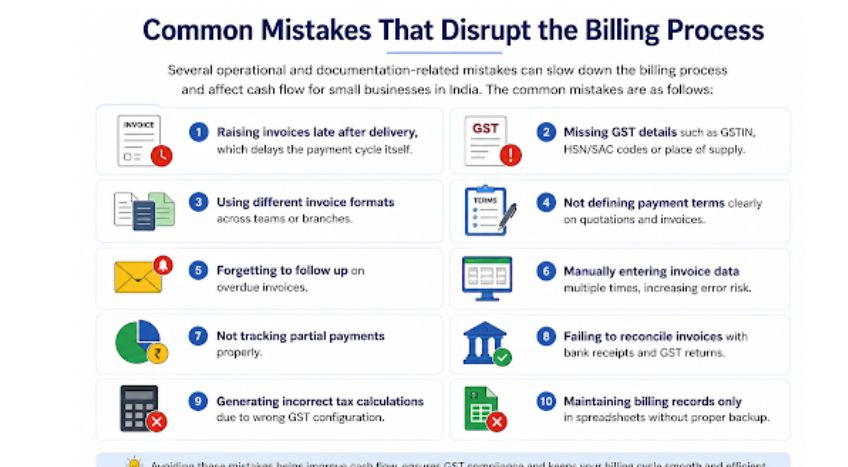
Several operational and documentation-related mistakes can slow down the billing process and affect cash flow for small businesses in India. The common mistakes are as follows:
- Raising invoices late after delivery, which delays the payment cycle itself
- Missing GST details such as GSTIN, HSN/SAC codes or place of supply
- Using different invoice formats across teams or branches
- Not defining payment terms clearly on quotations and invoices
- Forgetting to follow up on overdue invoices
- Manually entering invoice data multiple times increases error risk
- Not tracking partial payments properly
- Failing to reconcile invoices with bank receipts and GST returns
- Generating incorrect tax calculations due to the wrong GST configuration
- Maintaining billing records only in spreadsheets without proper backup
Conclusion
Each rupee in an unpaid bill is working capital your business cannot use. Businesses that get paid consistently are not the most aggressive at follow-up but the ones whose billing process leaves no room for error, from a quotation with clear payment terms to a reconciled receipt that closes the books accurately. With updated penalising laws for buyers for delays, sellers with clean billing records are in the strongest position to enforce that right.
TallyPrime handles the entire billing cycle, from GST-compliant invoicing and e-invoice generation to receivables tracking and bank reconciliation, all in one place.














