










Choosing the right budgeting method means selecting a planning approach that determines how a business estimates income, controls expenses and allocates resources in a way that matches its operational reality. It directly affects how accurate, flexible and actionable the budget will be in day-to-day decision-making.
Budgeting methods differ in how they build financial plans. Some focus on adjusting past budgets, others rebuild costs from zero, and some continuously update projections based on real-time performance.
The most common approaches include incremental, zero-based, rolling, activity-based, value proposition and flexible budgeting, each suited to different levels of business complexity and planning needs.
Common budgeting methods and how they work
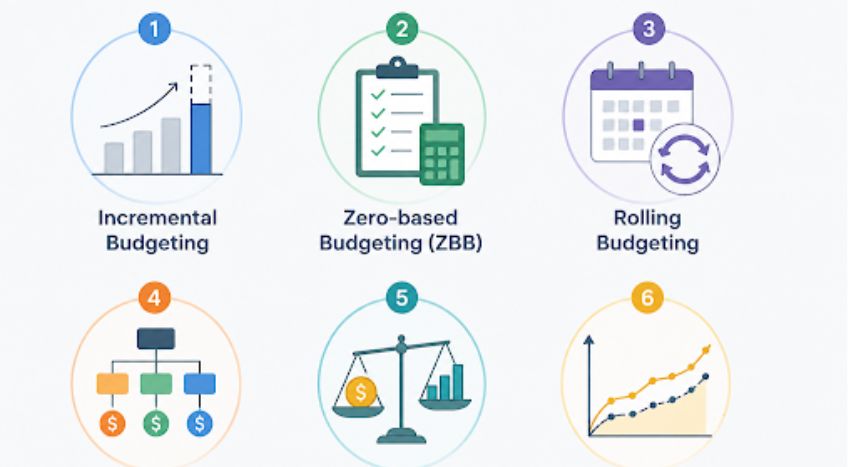
Businesses use different budgeting methods based on their size, industry and financial goals. The most widely used methods are as follows:
1. Incremental budgeting
Incremental budgeting works by taking the previous period’s actual figures as the base and adjusting them with a percentage increase or decrease to form the current budget. It is widely used because it is simple and quick to prepare, requiring minimal financial expertise.
It suits businesses with stable cost structures. However, it can carry forward inefficiencies year after year and may encourage budget padding, where estimates are inflated in anticipation of cuts.
2. Zero-based budgeting (ZBB)
Zero-based budgeting starts from zero for each new period, and every expense must be justified based on current needs rather than past spending. Nothing is automatically carried forward.
It is useful for cost reduction, eliminating waste and realigning spending priorities. However, it is time-intensive, requires detailed justification from each department and is difficult to sustain without strong finance support.
3. Rolling budgeting
A rolling budget is continuously updated by adding a new period (monthly or quarterly) as the most recent period closes, always maintaining a forward-looking window such as 12 months.
This makes it more adaptable to changing conditions and suitable for fast-growing or seasonal businesses. The trade-off is higher maintenance effort and the need for frequent updates.
4. Activity-based budgeting (ABB)
Activity-based budgeting builds the budget based on activities required to achieve output or revenue targets. It first defines goals, then identifies the activities needed and finally estimates the cost of those activities.
It is useful for complex operations like manufacturing, healthcare and construction, but requires detailed data on cost drivers and is more complex to implement.
5. Value proposition budgeting
Value proposition budgeting evaluates each expense based on the value it delivers to the business. Only costs that clearly contribute to business value are included.
It offers a balance between incremental budgeting and zero-based budgeting, making it suitable for businesses seeking cost control without full restructuring.
6. Flexible budgeting
Flexible budgeting adjusts based on actual activity levels by separating fixed and variable costs and recalculating figures as output changes. This allows for more meaningful performance comparisons since actual results are measured against adjusted expectations rather than fixed assumptions.
It works best in environments where costs vary with production or revenue, such as manufacturing or project-based businesses.
Which budgeting method fits your business best?
The right budgeting method depends on how predictable your revenue and costs are, and how quickly your business conditions change.
Most businesses move between methods as they grow, but the fit can usually be mapped like this:
- If you are running a startup or early-stage business: Startups often face frequent changes in revenue, hiring plans and operating costs. A rolling budget works better here because it is updated regularly instead of being fixed for the full year. This helps track cash flow and runway more accurately as conditions shift.
- If your business has stable revenue and predictable expenses: Businesses with consistent sales and recurring costs can use incremental budgeting effectively. It builds on last year’s budget with adjustments where needed, saving time while still providing a structured financial plan.
- If you are trying to reduce unnecessary spending: Zero-based budgeting is suitable when cost control is the priority. Every expense must be justified from scratch, which helps identify and remove costs that no longer add clear value, such as unused subscriptions or redundant operational expenses.
- If your sales fluctuate throughout the year: Flexible budgeting works well for seasonal or demand-driven businesses. Since it adjusts based on actual revenue or activity levels, it keeps budgets aligned with real performance instead of fixed assumptions.
- If different departments have different spending needs: Activity-based budgeting is useful when departments need to justify spending by the activities driving their costs. It ties budgets to actual cost drivers and produces more realistic estimates for each department.
- If you operate in a constantly evolving industry: Fast-changing industries like technology or high-growth startups often benefit from a mix of rolling budgeting and activity-based budgeting. This links spending to actual business activity while allowing regular updates as conditions change.
Conclusion
The effectiveness of a budget depends on choosing a method that matches how the business actually operates, not just how it plans on paper. Since no single approach works for every situation, many businesses combine methods and refine them over time based on real performance.
The key takeaway is to treat budgeting as an ongoing process, not a one-time exercise and to consistently compare plans with actual results to improve accuracy and control.
TallyPrime supports this by providing built-in budget tracking, variance analysis, cost centre reporting and real-time financial visibility within the same system used for day-to-day accounting, helping businesses keep planning and execution closely aligned.














