










Working capital assessment is the process of determining the funds a business needs to run its daily operations and the amount of financing banks are willing to provide against that requirement. Net working capital is the difference between current assets and current liabilities, and it reflects a company’s short-term liquidity position in practice.
Businesses assess working capital using financial ratios and operating cycle analysis to understand liquidity and funding needs. Banks, on the other hand, use committee-recommended frameworks to decide how much of that requirement they will finance and under what terms.
For Indian businesses, understanding both approaches is essential to present an accurate, well-prepared loan application and avoid underestimation or rejection.
Working capital assessment methods used by businesses
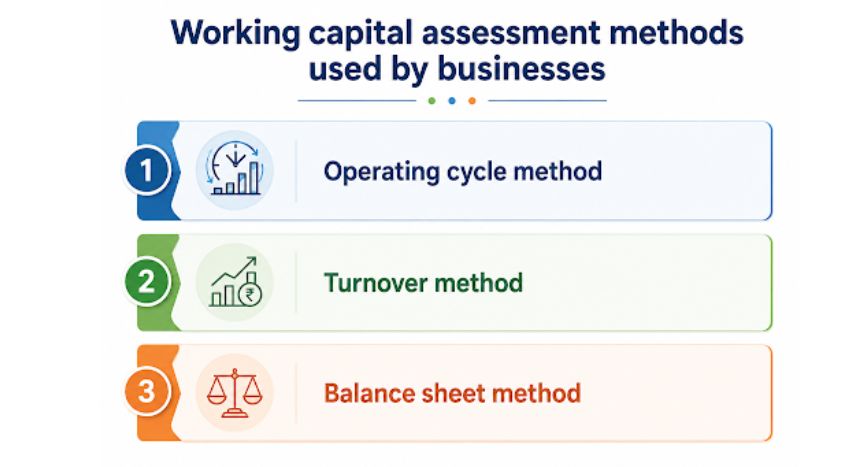
From a business’s perspective, working capital assessment focuses on measuring liquidity at a point in time and evaluating the efficiency of the operating cycle over time. These methods may vary depending on the purpose: internal management, bank appraisal or regulatory compliance. The main methods used by businesses are as follows:
Operating cycle method
This method estimates working capital by calculating how long cash remains tied up in the business before it is recovered through customer collections.
Formula: Working Capital Required = Daily Operating Cost × Operating Cycle in Days
To apply it:
- Calculate total annual operating costs covering purchases, wages and overheads.
- Divide by 365 to arrive at the daily operating cost.
- Estimate the operating cycle by adding average inventory holding days and average debtor collection days, and subtracting average creditor payment days.
- Multiply the daily operating cost by the resulting cycle length.
For example, a pharmaceutical distributor in Ahmedabad has annual operating costs of ₹91,25,000, giving a daily operating cost of ₹25,000. It holds inventory for 40 days, collects from customers in 50 days and pays suppliers in 30 days.
Operating cycle = 40 + 50 − 30 = 60 days.
Working capital required = ₹25,000 × 60 = ₹15,00,000.
Turnover method
This method estimates working capital as a percentage of projected annual turnover based on the historical relationship between sales and funding needs.
Formula: Working capital requirement = Projected Annual Sales × Working Capital as % of Sales
The percentage is derived from past financial performance. If a business typically requires 20% of turnover and projects sales of ₹5 crore, the estimated working capital requirement is ₹1 crore.
This method works well for stable businesses with predictable sales patterns but is less reliable during rapid growth or major changes in the operating cycle.
Balance sheet method
This method uses the balance sheet to determine whether current assets are sufficient to cover current liabilities.
Formula: Net working capital = Current assets − Current liabilities
A positive net working capital indicates stronger short-term financial health. This method is also commonly used in credit appraisal to assess liquidity and working capital needs.
Additional Working capital assessment methods used by banks
When a business approaches a bank for working capital finance, the bank conducts an independent RBI-guided assessment to determine the financing limit and borrower margin. It also reviews financial statements, stock reports, debtor ageing and cash budgets to evaluate funding needs and repayment capacity.
Nayak committee turnover method
The Nayak Committee method was introduced by the RBI in 1991 to simplify working capital assessment for small borrowers who lacked detailed financial records. It recommends a turnover-based approach for Micro, Small and Medium Enterprises (MSE) borrowers with projected annual turnover up to ₹5 crore.
Formula: Working Capital Requirement = 25% of Projected Annual Turnover
Under this framework, banks typically finance 80% of the assessed requirement (equivalent to 20% of turnover), while the borrower contributes 20% (equivalent to 5% of turnover).
For example, a wholesale distributor projecting annual sales of ₹2 crore will require a working capital of ₹50 lakh. The bank may finance ₹40 lakh, while the borrower contributes ₹10 lakh as margin.
This method is widely used for MSE lending, although exact appraisal practices may vary across banks based on internal credit policies.
Tandon committee method: Maximum permissible bank finance (MPBF)
The MPBF method was introduced by the Tandon Committee in 1974 to standardise working capital assessment. It proposed multiple methods, with Method II becoming the most commonly referenced framework.
Although the RBI withdrew the rigid MPBF system in 1997, it remains an important reference in credit appraisal. Today, banks use it as a benchmark alongside turnover-based and cash flow–based methods, especially for larger working capital limits.
Method I: MPBF = Working Capital Gap − 25% of Working Capital Gap
Where, Working capital gap = Current assets − Current liabilities (excluding bank borrowing)
Method II (most widely used): MPBF = Working Capital Gap − 25% of Total Current Assets
This method requires the borrower to fund at least 25% of total current assets from their own resources. The resulting minimum acceptable current ratio under this method is 1.33:1.
For example, say a manufacturing company has current assets of ₹100 lakh and current liabilities (excluding bank borrowings) of ₹30 lakh.
Working capital gap = ₹100 lakh − ₹30 lakh = ₹70 lakh
Borrower’s contribution under Method II = 25% of ₹100 lakh = ₹25 lakh
MPBF = ₹70 lakh − ₹25 lakh = ₹45 lakh
Therefore, the bank may provide working capital finance of up to ₹45 lakh, while the borrower contributes ₹25 lakh from its own resources.
Cash budget method
The cash budget method is used for businesses with seasonal, cyclical or irregular cash flows where balance sheet-based methods may not accurately reflect funding needs. The borrower prepares a month-wise cash budget (usually for 12 months) showing projected inflows and outflows.
The bank analyses monthly surpluses and deficits, identifies the peak cash deficit and sets the working capital limit accordingly. This method is commonly used for construction companies, contractors, sugar mills, educational institutions and other businesses with uneven cash flows, often alongside other appraisal methods.
Conclusion
Most working capital challenges arise not from low sales, but from limited visibility into how cash flows through the business. When businesses understand how to assess their working capital needs and how banks evaluate them, they can plan funding rather than react to shortages.
Strong working capital planning depends on timely, accurate financial data. TallyPrime helps businesses maintain this visibility through structured reports, receivables tracking and real-time inventory insights, making both internal assessment and bank appraisal more reliable and efficient.














