










Capital budgeting decisions determine how businesses allocate funds to long-term investments such as expansion, technological upgradation, product diversification and research and development. These projects usually involve substantial capital and can influence a company's profitability, competitiveness and future growth for years. Since such investments are often difficult to reverse, businesses must evaluate them carefully before committing resources.
What is capital budgeting?
Businesses use capital budgeting to evaluate and choose long-term investments, such as new facilities, equipment or product lines, that are expected to generate returns over a number of years. Unlike working capital expenditures, these investments have long-term repercussions on a company's financial position and are difficult to reverse. Its primary objectives include:
- Wealth maximisation for stakeholders and shareholders
- Efficient utilisation of available funds
- Increased profitability as a result of informed investment decisions
- Long-term business growth and sustainability
(Created using AI)
What are the types of capital budgeting decisions?
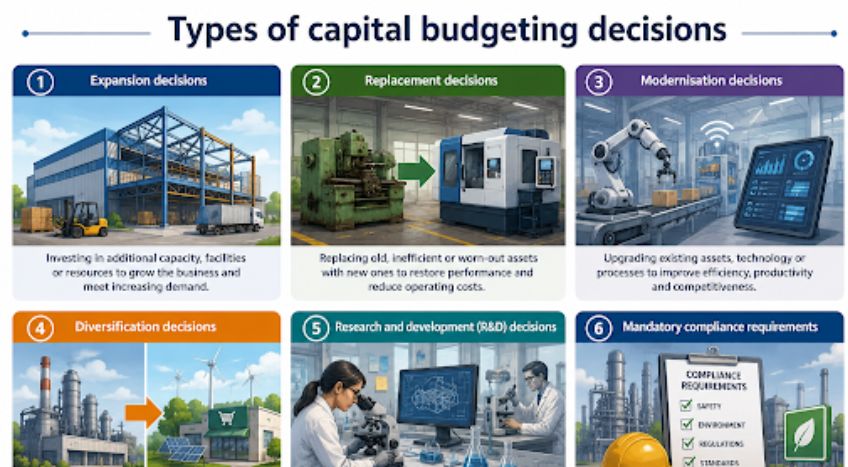
Depending on the goals of a company, such as expanding operations, modernising current assets or fulfilling regulatory requirements, capital budgeting decisions differ. The different types of capital budgeting decisions are explained here.
Expansion decisions
Businesses make expansion decisions by investing in projects that increase capacity and support growth to meet rising demand. These investments can include building new production facilities, branches or warehouses. Since expansion decisions depend on accurate demand forecasting, they usually entail the highest capital expenditure and greater risk. For example, an Indian shoe manufacturer decides to open stores in Nepal to expand its market.
Replacement decisions
Replacement choices involve replacing outdated or inefficient assets with newer ones to ensure operational continuity. These decisions are typically lower risk because the business already understands the asset's purpose, allowing decision-making to focus on cost reduction and efficiency gains.
Modernisation decisions
Modernisation decisions focus on upgrading machinery, equipment or processes to increase productivity, reduce waste or lower operating costs. They involve replacing outdated systems with newer technology. Unlike replacement decisions, the objective is technological improvement rather than simply restoring existing capacity. For example, a business may transition from traditional accounting software to an AI-based accounting platform.
Diversification decisions
Diversification decisions include entering new markets or product categories to reduce reliance on a single source of revenue. Because the business is expanding beyond its core operations, these decisions require extensive market research. For example, if an IT company establishes a fintech subsidiary, it would be considered a diversification decision.
Research and development (R&D) decisions
R&D decisions involve investing in innovation, product development and process improvements. Although these investments may not generate immediate profits, they are crucial for maintaining long-term competitiveness, especially in technology-driven and industrial sectors. For example, a pharmaceutical company may invest continuously in R&D to develop new medicines and improve existing products.
Mandatory compliance requirements
Certain capital expenditures are required to meet safety, environmental or other regulatory standards and are therefore mandatory. These decisions are evaluated based on achieving compliance in the most cost-effective manner rather than on profitability alone. For example, installing pollution-control equipment to treat waste before disposal may be a legal requirement that a business cannot avoid. Such investments help businesses remain compliant and avoid penalties, fines or legal action.
Common techniques for capital budget evaluation
Businesses use several quantitative techniques to determine whether a proposed investment is financially worthwhile. Some of the most common methods are explained below.
Payback period
It calculates the time required for an investment to recover its initial outlay. Although simple and useful for assessing investment risk, it ignores cash flows generated after the payback period.
Formula: Payback period = Initial investment / Annual net cash inflow
Net present value (NPV)
It measures an investment's profitability by calculating the difference between the present value of expected future cash inflows and the cash outflows incurred to undertake the investment. This method explicitly accounts for the time value of money.
Formula: NPV = Σ [Cash flowₜ ÷ (1 + r)ᵗ] − Initial investment
Where,
t is the time period
r is the discount rate
Internal rate of return (IRR)
It is the discount rate at which the NPV of a project equals zero. In simple terms, IRR represents the annualised rate of return that an investment or project is expected to generate. A higher IRR often indicates a more profitable investment.
Formula: Σ [Cash flowₜ ÷ (1 + IRR)ᵗ] − Initial investment = NPV = 0
Profitability index (PI)
It is the ratio of the present value of future cash inflows to the initial investment. A project is generally considered financially viable if its PI exceeds 1.
Formula: PI = Present value of future cash inflow / Initial investment
Accounting rate of return (ARR)
It estimates expected profitability using accounting profit rather than cash flows. Although easier to calculate, it does not account for the time value of money.
Formula: ARR = (Average annual accounting profit / Average Investment) × 100
Indian businesses frequently blend various approaches rather than depending on a single technique.
How to ensure efficient capital budgeting
Discussed below are some strategies that can help ensure efficient capital budgeting:
- Before committing funds, assess the business's financial position by analysing cash flow forecasts, financing costs and funding availability.
- Base demand and revenue projections on historical data and market research rather than assumptions.
- Assess how changes in key variables, such as financing costs or raw material prices, affect project feasibility.
- Ensure every capital project supports the company's long-term strategic goals, rather than short-term opportunities.
- Compare actual project performance with initial estimates after implementation to improve future capital budgeting decisions.
Importance of capital budgeting decisions
Capital budgeting decisions have a significant impact on the financial and operational efficiency of a business.
- Optimal resource allocation: Capital budgeting helps allocate funds to high-return projects instead of spreading resources across low-impact initiatives.
- Aids long-term growth: Well-planned investments create the capacity and infrastructure required for long-term growth.
- Improves profitability: Selecting projects based on thorough evaluation improves operational efficiency and overall profitability.
- Assists risk management: Structured evaluation techniques help identify and assess risks before investment decisions are made.
- Increases competitive advantage: Timely investments in technology and capacity expansion help businesses maintain a competitive edge.
- Raises shareholder value: Improved profitability and sustainable growth ultimately create greater value for shareholders.
Conclusion
Businesses that monitor cash flows, asset depreciation and project expenses in real time can evaluate capital investments more effectively and revise projections as circumstances change. TallyPrime provides real-time reporting and accounting insights that support informed capital budgeting decisions. Explore TallyPrime today.














