










A costing system is a structured framework that captures and assigns all business costs- materials, labour and overheads- to products, services or activities, enabling accurate pricing, cost control, planning and decision-making.
It also supports statutory cost record maintenance for compliance under the Companies Act, 2013. Companies in specified sectors under Rule 3 of the Companies (Cost Records and Audit) Rules, 2014, with annual turnover above ₹35 crore, must maintain cost records in the prescribed format under Section 148 of the Act.
What is a costing system?
A costing system is a combination of procedures, records, forms and reports that a business uses to determine the cost of its products or services. It links operational data, such as purchase invoices, payroll records and machine logs, to the management decisions that depend on accurate cost information.
A well-designed costing system consistently answers three key questions:
- What did it cost to produce one unit of output?
- Which cost centres or departments generated which costs?
- Where do actual costs diverge from planned or standard costs?
What are the steps involved in installing a costing system?
Installing a costing system requires a structured, step-by-step approach that aligns business operations with accurate cost tracking and reporting to ensure reliable decision-making and compliance.
Step 1: Secure top management commitment
A costing system requires active participation from teams, which will not happen unless management mandates its use and acts on the information it generates. Installation should begin only after directors or owners commit to it, communicate its purpose internally and invest in training and infrastructure.
Step 2: Study the business and its production processes
Before designing the system, the cost accountant must understand the business in detail: its products or services, production or delivery process, inputs used, cost drivers and how output is measured.
Step 3: Define the objectives of the system
Clear objectives prevent both over-design and under-design. The system should only collect useful data that supports decision-making. Where statutory cost records are required under the Companies (Cost Records and Audit) Rules, 2014, compliance must be included as an objective from the start.
Step 4: Choose an appropriate costing technique
Select the costing method based on the production process, not convention. This may include job costing, process costing, batch costing or other suitable methods, depending on the business's operations.
Step 5: Design the cost centre structure
A cost centre is a unit, department, machine, process or location where costs are assigned. Costs are first traced to their originating centres, and then service cost centres are allocated to production cost centres using appropriate bases.
Step 6: Design cost records, forms and reporting structure
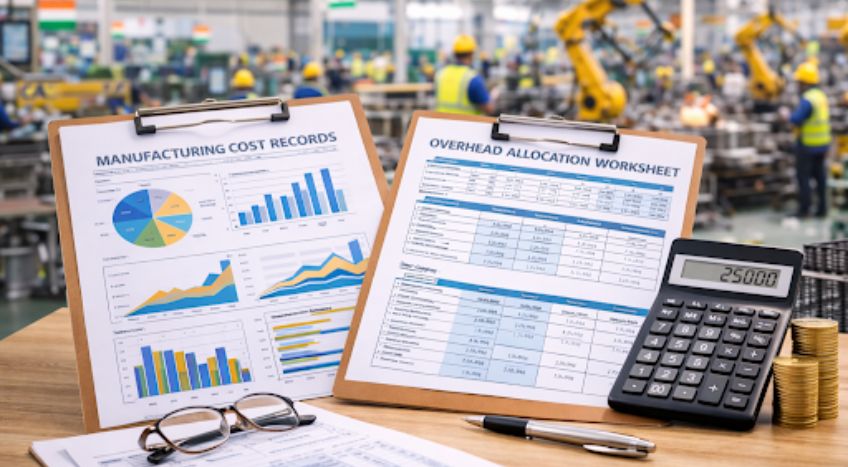
Once cost centres and allocation methods are defined, establish the documentation system. This includes material requisitions, stores issues, labour and machine records, overhead absorption sheets and cost sheets to capture data at source.
Step 7: Integrate cost records with the financial accounting system
Where possible, the costing system should be integrated with financial accounting software. If not, a reconciliation process must be maintained to ensure consistency between cost records and financial accounts.
Step 8: Train staff and run in parallel
A costing system is only as reliable as the data entered. Staff must be trained on what to record, how to record it and why accuracy matters. A parallel run helps identify gaps before full implementation.
Key considerations in installation
In addition to the installation steps, the following factors determine whether a costing system is practical, accurate and useful for decision-making.
The system must be commensurate with the business
The cost and complexity of the system must match the scale and nature of operations. A simple manufacturer producing a few products will not benefit from complex activity-based costing, while a multi-product FMCG business with shared resources may require it.
Consistency in classification of cost elements
All cost elements must be consistently classified as direct or indirect, fixed or variable, and production or non-production across accounting periods. Inconsistent classification makes variance analysis unreliable and reduces comparability over time.
Overhead absorption rates require realistic capacity assumptions
Fixed overheads are allocated using a predetermined absorption rate based on budgeted production or activity levels. If capacity assumptions are unrealistic, the system will produce persistent under- or over-absorption, leading to incorrect unit costs and distorted decision-making.
Conclusion
Costing system installation is both a management practice and, for some companies, a statutory requirement. When implemented correctly, it reveals true product and service costs, enabling better pricing, cost control and operational efficiency. Value comes from consistency: aligned classification, accurate records and reconciliation between financial and cost data.
TallyPrime supports this alignment through integrated cost centre accounting and unified reporting, helping businesses maintain reliable records while improving both compliance and decision-making.














