



Cost and management accounting are two financial systems a business can adopt to manage internally, yet they are often confused with each other. Cost accounting is the process of counting what it actually costs to make your product or deliver your service. Management accounting (MA) takes that number and asks the harder question: given this, what should we actually do?
The gist is that one tells you what things cost. The other helps you decide what to do about it.
For Indian businesses running on tight margins, that distinction is important. When you know which system is answering which question, you can build tighter financial control instead of guessing your way through pricing, budgeting and planning.
What is cost accounting?
Cost accounting is the technique of recording, classifying and analysing all costs associated with producing a product or delivering a service. It covers direct costs such as raw materials and labour, as well as indirect costs like factory rent and electricity.
The primary goal is to determine the cost of producing one unit of output and identify areas where those costs can be reduced.
Core formulas for cost accounting
- Total Cost = Fixed Costs + Variable Costs
Fixed costs remain unchanging regardless of output (rent, salaries), while variable costs vary with production levels (raw materials, packaging).
- Cost per Unit = Total Cost of Production ÷ Number of Units Produced
For example, if a bakery in Pune spends ₹1,20,000 per month on ingredients, packaging, labour and utilities, and produces 4,000 units, the cost per unit is ₹30.
- Variance = Standard Cost − Actual Cost
A positive variance means the business spent less than expected. A negative variance signals overspending and triggers a closer look at what went wrong.
The main cost accounting methods
- Job costing: Used when each order is unique. A printing press or a construction firm would use this to track costs for each project.
- Process costing: Suited to industries with continuous, uniform production such as cement, textiles or chemicals. Costs are averaged across all units produced.
- Activity-based costing (ABC): Assigns overhead costs based on activities that actually drive those costs, rather than spreading them equally. Gives a more precise picture for businesses with diverse product lines.
- Standard costing: Predetermined cost benchmarks are set for materials and labour, and actual results are compared against them each period.
- Marginal costing: Considers the cost of producing one additional unit. Particularly useful for pricing decisions and assessing whether increasing output is worthwhile.
In India, under Section 148 of the Companies Act, 2013, read with the Companies (Cost Records and Audit) Rules, 2014, businesses in specified sectors like pharmaceuticals, cement, steel, sugar, telecom and electricity, may be legally required to maintain cost records, depending on turnover thresholds and applicability conditions.
What is management accounting?
MA uses financial data, including output from cost accounting, alongside non-financial information to help management plan, control operations and make strategic decisions. Where cost accounting looks backwards at what was spent, MA looks forward through budgeting, forecasting, performance analysis and scenario planning.
Unlike cost accounting, MA has no mandatory standards to follow. Reports get built around what the business needs to know, not around a prescribed format.
Core formulas and tools for management accounting
- Break-Even Point (BEP) = Fixed Costs ÷ (Selling Price per Unit − Variable Cost per Unit)
This tells a business how many units it must sell to cover all its costs. Selling beyond this point generates profit.
For example, a food processing company in Coimbatore has monthly fixed costs of ₹3,00,000, a selling price of ₹150 per unit and variable costs of ₹90 per unit. Its break-even point is: ₹3,00,000 ÷ (₹150 − ₹90) = 5,000 units.
- Contribution Margin = Sales Revenue − Variable Costs
This shows what remains after variable costs are covered, available to absorb fixed costs and eventually generate profit. Businesses use this to compare the profitability of different products and decide which ones to prioritise.
- Return on Investment (ROI) = (Net Profit ÷ Cost of Investment) × 100
Used whenever a business is evaluating a capital purchase, a new branch or any significant expenditure.
MA also encompasses budgeting, rolling forecasts, cash flow projections and scenario analysis. A business owner deciding whether to hire more staff, enter a new market or discontinue a product would rely on MA-style analysis to make that call with confidence rather than instinct.
How does cost accounting differ from management accounting?
Both disciplines serve internal business needs but differ significantly in purpose, scope and application.
|
Parameter |
Cost Accounting |
Management Accounting |
|
Definition |
Records and controls the costs of production |
Uses financial and non-financial data to support business decisions |
|
Primary focus |
Cost tracking and control |
Planning, budgeting, forecasting |
|
Scope |
Narrow: production and cost data only |
Wide: financial and non-financial data |
|
Time orientation |
Looks backwards at historical costs |
Looks forward through forecasts and plans |
|
Mandatory in India |
Yes, for specified industries under the Companies Act 2013 |
No, entirely voluntary for all businesses |
|
Standards followed |
Cost Accounting Standards (CAS) by ICAI-CMA |
No mandatory standards exist |
|
Reports produced |
Cost sheets, variance reports and cost audits |
Budgets, forecasts and profitability dashboards |
|
Primary users |
Cost managers and production teams |
Business owners and senior management |
|
Dependency |
Functions as a standalone system |
Relies on cost accounting data as its base |
|
Decision type supported |
Operational: how to produce efficiently |
Strategic: what to do and where to invest |
How do cost accounting and management accounting work together?
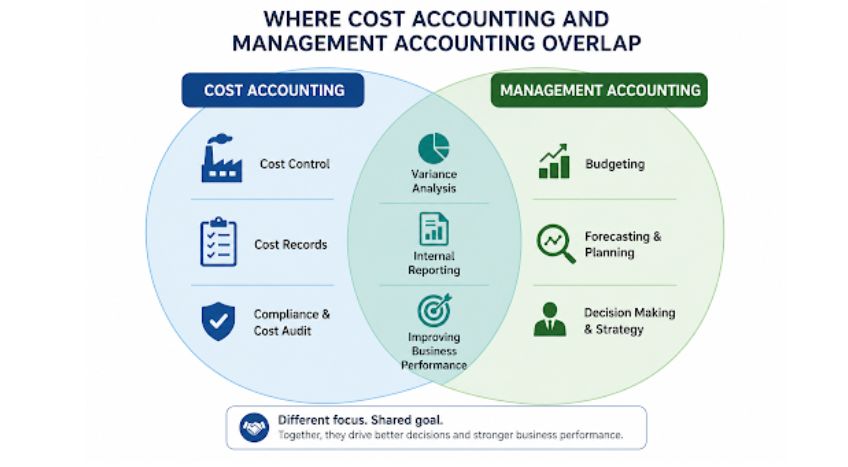
(This image was created using AI)
Despite their differences, both disciplines are internal functions used within an organisation rather than for statutory reporting or external stakeholders. They also contribute to the same broader goal of improving business performance.
Variance analysis sits in both disciplines. Cost accounting calculates the variance at the production level. MA interprets it at the business level, determining whether it signals a supply chain issue, a pricing problem or an operational gap.
Most importantly, MA depends on cost accounting. A budget or forecast built on inaccurate cost data produces unreliable decisions. The two work best as a connected system.
How can businesses use cost accounting and management accounting together?
Understanding the distinction matters only if it translates into better business practice. Here is how the two disciplines work together in practice:
- Pricing decisions: Cost accounting helps identify the lowest cost at which a product can be sold without a loss. MA evaluates market conditions and the margin required to sustain the business. Together, they support pricing that is both profitable and competitive.
- Product mix decisions: Contribution margin analysis from MA, built on cost data, helps identify which products to push, which to reprice and which to drop.
- Capacity planning: Cost accounting provides the current cost per unit at existing capacity; MA models the scenarios at higher volumes.
- Vendor and supply chain management: Variance reports that consistently show overspending on materials signal a need to renegotiate supplier contracts or diversify sourcing. This insight begins in cost accounting and leads to an MA decision.
- Cash flow management: Rolling cash flow forecasts help businesses anticipate shortfalls before they become crises, particularly important for SMEs in India, where working capital constraints are common.
- Compliance and audit readiness: For businesses in regulated sectors, maintaining proper cost records is a legal requirement. Organised cost accounting also makes management reporting faster and more reliable.
Conclusion
Treating cost accounting and management accounting as separate concerns is where most businesses lose the advantage. The two work best as one system: cost data feeding straight into the planning and pricing decisions built on top of it.
TallyPrime brings both functions into one system, giving you cost centre tracking, variance reports and profitability dashboards without the complexity.
If you are ready to move from reactive to deliberate financial management, TallyPrime is where to start.














