










Assets and liabilities are the two main components of a business balance sheet and together reflect its financial position. Assets represent resources owned or controlled by the business, while liabilities represent obligations that must be settled in the future.
Understanding how each is classified is important for accurate financial reporting, GST compliance, tax filings, and financial analysis.
What are assets and their key characteristics?
Any resource that a firm owns or controls and that has current or future economic worth is considered an asset. Over time, assets are expected to support operations, reduce expenses, or generate income. They should have a quantifiable monetary worth and be expected to provide future financial gains.
Types of assets and their classification
Based on their liquidity and duration of use, assets are often classified into two broad categories on the balance sheet: current and non-current assets.
Current assets
All liquid resources of the company that may be sold, used, or converted to cash within a single fiscal year or regular operating cycle are considered current assets. The table below shows the assets that fall in this category:
|
Current assets |
What it includes |
|
Cash and cash equivalents |
Bank balance, physical cash holdings, short-term deposits |
|
Account receivables (Debtors) |
List of all customers who have received delivery of goods or services but have not paid yet and owe funds to the company |
|
Inventory items (Stock-in-trade) |
Raw material, work-in-progress, finished goods |
|
Short-term investments |
List of all investments that will mature within 12 months |
|
Prepaid expenses |
Payments made in advance for future services, like insurance premiums |
|
Input tax credit (ITC) |
ITC claimed but not yet offset against output tax liability |
|
Advance to suppliers |
Payments made before the receipt of goods or services |
|
Accrued income |
Income earned but yet to be received |
Non-current assets
Long-term assets, often known as non-current assets, are illiquid resources that a company expects to hold and use for more than a year. The costs of these assets are capitalised and spread over their useful lives through depreciation, amortisation, or depletion, rather than expensed immediately.
Listed here are the different non-current assets:
|
Non-current assets |
What it includes |
|
Property, Plant and Equipment (PPE) |
Land, buildings, plants, machinery, vehicles, etc., used in the production process |
|
Intangible assets |
Non-physical assets that hold long-term economic value, like goodwill, patents, trademarks, software licences, etc. |
|
Long-term investments |
Investments held for over a year, like bonds, shares in subsidiary companies, etc. |
|
Capital work-in-progress |
Assets that are under construction but not yet ready for use |
|
Deferred tax assets |
Tax benefits arising from deductible temporary differences that can reduce future tax liabilities |
|
Security deposit |
Refundable deposits recoverable after more than 12 months, such as office space and utility deposits |
What are liabilities and their key characteristics?
A liability is a financial obligation arising from a previous transaction that the company is required to repay through cash outflows, asset transfers, or the provision of services. Its settlement value must be quantifiable in monetary terms and it should be legally enforceable.
Types of liabilities and their classification
On the balance sheet, liabilities are usually classified as current or non-current based on their nature, liquidity, and other factors.
Current liabilities
Short-term financial commitments or debts that a business must settle within a year or one operational cycle, whichever comes first, are known as current liabilities. These are listed below:
|
Current liabilities |
What it includes |
|
Accounts payable (trade creditors) |
Amounts that a business owes to vendors for products or services obtained |
|
Short-term borrowings |
Credit from banks and financial institutions, like overdrafts, working capital loans, etc., that are due within 12 months |
|
Goods and Services Tax (GST) payable |
Output GST due for remittance, which is net of ITC |
|
TDS payable |
Tax deducted at the source (TDS), but not yet deposited with the government |
|
Accrued expenses |
Costs, like salary, that are incurred but not yet billed or paid |
|
Advance from customers |
Payment that customers have already paid and goods or services are due to be delivered |
|
Income tax payable |
The tax liability due but yet to be paid |
|
Short-term provisions |
Money that companies lay aside to pay for anticipated future costs or commitments during the following 12 months |
Non-current liabilities
Long-term liabilities, often referred to as non-current liabilities, are debts or financial commitments that a company does not have to pay off within 12 months. Since they are used to finance significant capital investments and corporate development, they are essential to ensure long-term viability.
|
Non-current liabilities |
What it includes |
|
Long-term borrowings |
Payable-terms loans, funds raised through debentures or bonds, etc. |
|
Deferred tax liabilities |
Tax liability that will become payable at a later date |
|
Long-term provisions |
Gratuity, employee benefit obligations, etc. |
|
Lease liabilities |
Contractual liability to make future lease payments according to the terms of the lease agreement |
|
Security deposit received |
Refundable deposits obtained from tenants or dealers |
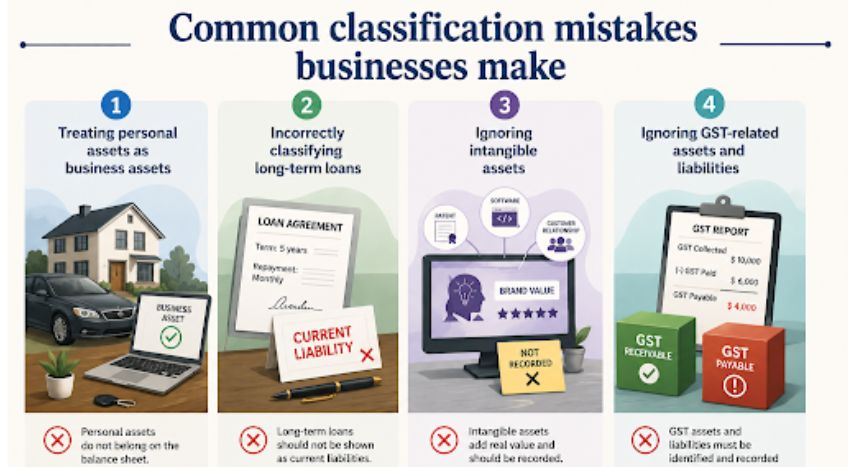
Common classification mistakes businesses make
Even with a complete list of assets and liabilities, classification errors are common. Here are the mistakes businesses most frequently make:
- Treating personal assets as business assets: Proprietors must clearly distinguish their personal assets and liabilities from the business's, as they have no place in the company's records. For small businesses, if an owner contributes a personal asset for business use, it should be treated as a capital contribution.
- Incorrect classification of loans: Loans payable in instalments often cause classification confusion. For instance, a loan with a five-year term is not completely non-current. The amount payable within the year can be categorised as a short-term obligation.
- Ignoring intangible assets: Small and medium-sized businesses often overlook intangible assets, such as goodwill, in their records. This reduces the accuracy of financial statements and should be avoided.
- Ignoring GST-related assets and liabilities: While ITC receivable is a current asset, output GST is a current liability. Clarifying GST treatment in this case is essential to avoid reconciliation errors.
Conclusion
Incorrect classification of assets and liabilities can affect the accuracy of financial statements, create compliance challenges, and result in an incomplete view of a business's financial position. Maintaining complete and correctly classified records is essential for reliable financial reporting, regulatory compliance, and effective financial management.
TallyPrime helps businesses classify transactions, maintain accurate ledger balances, and manage financial records within a single system, supporting efficient accounting and financial reporting processes.














