










When people think of “AI in enterprises,” they often picture large teams of engineers training massive models from scratch, racks of GPUs crunching data, custom algorithms tuned for every problem, and researchers pushing the limits of intelligence. Training certainly has its place- it powers foundational models, enables breakthroughs in areas like speech recognition or medical imaging, and can be useful when a company’s data is so unique that off-the-shelf models won’t suffice.
But for many enterprises, this path is impractical. Training large models requires a large amount of data, significant infrastructure and a lot of time. Even then, the results aren’t guaranteed to automatically align with day-to-day business needs.
That’s why the real opportunity for enterprises lies in using powerful pre-trained models like GPT-4, Gemini, or Llama and focusing on how to connect them to company data. The challenge isn’t inventing new intelligence, but making sure existing intelligence delivers answers that are accurate, safe, and trustworthy.
In this article, we’ll bust the myth that enterprise AI is all about model training and show why information retrieval and orchestration are often the real heroes of practical AI adoption.

What is Enterprise AI?
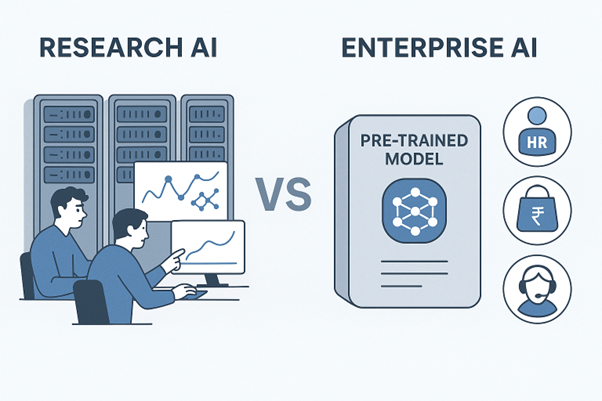
In a business context, enterprise AI means applying existing AI to solve real problems at scale. Instead of training new models, companies embed pre-trained ones into their workflows — powering things like HR chatbots that answer leave policy questions, finance assistants that help check expenses, or customer support systems that handle routine queries.
The emphasis is on reliability, compliance, and usability. Unlike research AI, which focuses on breakthroughs, enterprise AI succeeds when employees and customers can trust it in day-to-day use.
The myth of model training
The idea that AI always means training from scratch comes from the research world, where the goal is to build new systems. But enterprises rarely need that.
Modern models are already trained on vast amounts of information, giving them strong language and reasoning abilities out of the box. Rebuilding that inside a company would cost crores and require specialized teams.
When customization is needed, businesses adapt existing models. This might mean refining the way prompts are written, making small adjustments, or giving the model access to the right documents at the right time. It’s far more practical to extend what works than to reinvent the wheel.
What enterprises could do
Instead of training new models, companies wrap existing ones in systems that make them useful for day-to-day work. This usually involves two pillars:
1. Retrieval-Augmented Generation (RAG)
Rather than expecting the model to “remember everything,” RAG lets it look up information when needed. For example, if an employee asks a policy question, the system searches company documents for the most relevant section and passes it to the model. The model then uses that snippet to give a grounded answer. This way, responses are always tied to actual company data instead of just relying on the model’s memory.
2. Orchestration (Workflows around the model)
Orchestration is the glue that ties everything together. It’s not just the model producing data, it’s the workflow around it: interpreting the user’s question, retrieving the right data, generating a response, cleaning it up, and applying company rules before showing it. For instance, if a chatbot is connected to financial data, orchestration might add a rule that prevents it from showing numbers without double-checking them. This ensures answers are both useful and safe.
Together, retrieval and orchestration turn a general-purpose model into a trusted enterprise assistant.
Why this approach matters
This approach matters because it directly improves the things enterprises care about most:
1. Faster deployment: Solutions can launch in weeks/months instead of years.
2. Lower costs: Training requires massive infrastructure; orchestration and retrieval run on standard systems.
3. Always up to date: Retrieval ensures the AI can use new documents or policies immediately.
4. Trust and safety: Rules and checks prevent errors and misuse.
5. Scalability: Companies can swap models, add data, or integrate tools without starting over.
A simple example
Imagine you’re building a chatbot for an HR team. You don’t train a new model. Instead, you connect an existing one to the HR policy documents.
Here’s how it works:
1. HR policies and FAQs are split into small, searchable sections.
2. When someone asks, “How many days of parental leave do we get?”, the system finds the most relevant policy. (Retrieval)
3. That piece of text is added to the original question before sending it to the model. (Augmentation)
4. The model reads both and generates a response:
“According to section 5.2 of the HR policy, employees are entitled to 30 days of parental leave.” (Generation)
5. Orchestration ensures guardrails double-check the response before showing it, for example, confirming the number is from an official source.
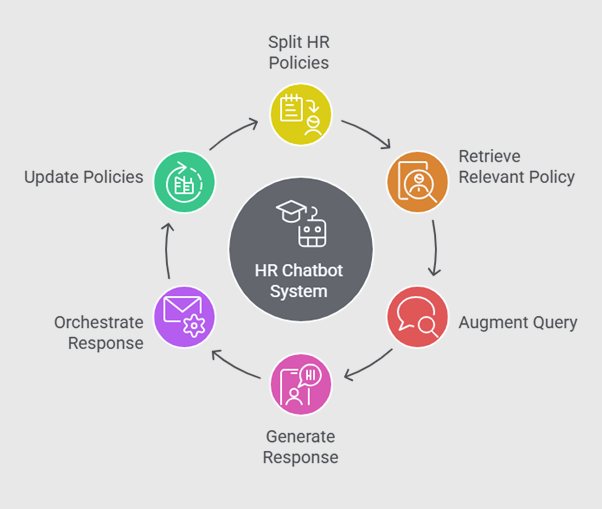
The model isn’t memorizing policies, it’s reading them at runtime. This makes the approach accurate, scalable, and easy to maintain. When HR updates a document, the AI automatically uses the latest version.
Enterprise AI isn’t necessarily about building new models, it’s about making the most of the ones we already have. Pre-trained models provide the intelligence, while retrieval and orchestration provide the structure that makes them reliable for business use.
By focusing on these layers, enterprises can:
• Launch solutions quicker.
• Keep answers accurate and current.
• Ensure trust and compliance.
• Scale easily as technology evolves.
The real measure of success in enterprise AI won’t be who trains the largest models, but who integrates existing ones into workflows that are accurate, safe, and scalable.














