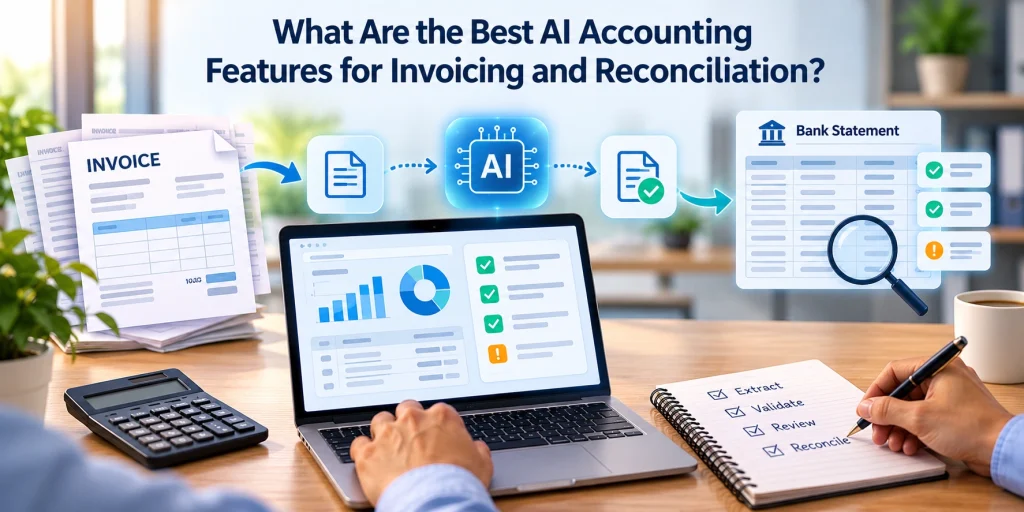
An invoice can be extracted correctly in most fields and still contain an error that affects a supplier balance or tax calculation. A bank transaction can match an amount in the books and still belong to a different invoice. These are not merely data-entry problems; they are questions of accounting evidence and control.
AI-assisted document processing can help prepare invoice information, while reconciliation workflows compare bank transactions with accounting records. The real test is whether each process makes errors visible, supports correction and distinguishes a plausible result from a verified accounting outcome.
For small and medium-sized businesses (SMEs), the most useful accounting features are not necessarily those that automate the largest number of transactions. They are the features that reduce repetitive work while helping accountants identify missing information, correct inaccurate suggestions and investigate exceptions before they affect the books.
Essential AI features for invoice processing
1. Accurate invoice data extraction
Invoice processing begins with extracting information from a source document. Depending on the transaction, this may include the supplier name, invoice number, invoice date, GSTIN, taxable value, tax amounts, total invoice value and other relevant fields.
An AI-assisted system should do more than recognise text. It should capture the information required to prepare the accounting voucher and make it possible to review the extracted values against the original invoice.
For example, consider a purchase invoice with the following details:
|
Particulars |
Amount |
|
Taxable value |
₹10,000 |
|
CGST at 9% |
₹900 |
|
SGST at 9% |
₹900 |
|
Invoice total |
₹11,800 |
The arithmetic is correct, but that alone does not establish that the invoice has been captured accurately. The accountant must still check whether the supplier, invoice number, date, taxable value and tax amounts agree with the source document and the applicable transaction details.
Docs by Ira is an AI-powered document-processing plug-in for TallyPrime that extracts information from supported invoice documents and helps prepare draft vouchers. Its purpose is to reduce repetitive entry, not to eliminate the need for accounting review.
The key evaluation question is therefore not simply whether a system extracts data quickly. It is whether the extracted information is sufficiently complete, visible and correctable for the business to use it responsibly.
2. Line-item capture and validation
Invoice-level totals do not always reveal errors in individual items. An invoice may contain several products or services, different quantities, rates, discounts and tax treatments. If a line item is omitted, merged with its description or assigned an incorrect value, the total transaction may require correction even when some of its other fields are accurate.
Useful capabilities include:
- Capturing item descriptions, quantities, rates and values where supported.
- Preserving the distinction between individual line items and their descriptions.
- Highlighting missing or inconsistent values.
- Making it possible to correct extracted data before finalising the voucher.
- Checking whether the voucher total agrees with the source document.
Arithmetic checks are valuable, but they cannot prove that every extracted field is correct. Two incorrect values may even produce a mathematically consistent total.
The accountant should therefore compare the extracted information with the source invoice and review relevant tax and ledger details. Validation should support source-document verification rather than replace it.
3. Supplier mapping and duplicate detection
Businesses may receive invoices from suppliers whose names are written differently across documents. A supplier might appear as “ABC Traders” on one invoice and “ABC Traders Private Limited” in the accounting records.
A useful system should help identify an existing supplier master or flag a possible mismatch instead of encouraging the creation of unnecessary duplicate masters. Matching rules may consider identifiers such as GSTIN and supplier name, depending on the workflow and available information.
For example, suppose an invoice contains these details:
|
Field |
Illustrative value |
|
Supplier on invoice |
ABC Traders |
|
Existing supplier master |
ABC Traders Private Limited |
|
Invoice number |
INV-1048 |
|
Invoice date |
12 October 2026 |
|
Invoice amount |
₹23,600 |
A similar name may suggest a possible match, but it is not sufficient evidence on its own. The accountant should check the relevant identifiers and transaction details before accepting the mapping.
Duplicate detection is equally important. If the same invoice is imported more than once, the system should help identify the potential duplicate before a second voucher is finalised. However, a duplicate alert is a prompt for investigation, not proof that two records represent the same transaction. Different invoices may share similar amounts, while a genuine duplicate may contain variations in formatting or references.
Docs by Ira provides master mapping and the identification of potential duplicates. These facilities can assist the review process, but the final decision must consider the source document and existing accounting records.
4. Handling missing or uncertain information
An accounting system should not encourage users to treat incomplete extraction as a completed transaction. Missing invoice numbers, unreadable dates, uncertain supplier details and incomplete line items should remain visible for review.
This is particularly important when invoices are scanned, contain complex layouts or include handwritten or overwritten information. Tally’s Docs by Ira FAQ identifies document quality and layout variations among the reasons why some values may not be extracted correctly.
A dependable workflow should make it possible to:
- Review the source invoice alongside the extracted information.
- Correct inaccurate or incomplete values.
- Resolve missing or mismatched masters.
- Identify potential duplicates before finalising a voucher.
- Leave an item pending when the available evidence is insufficient.
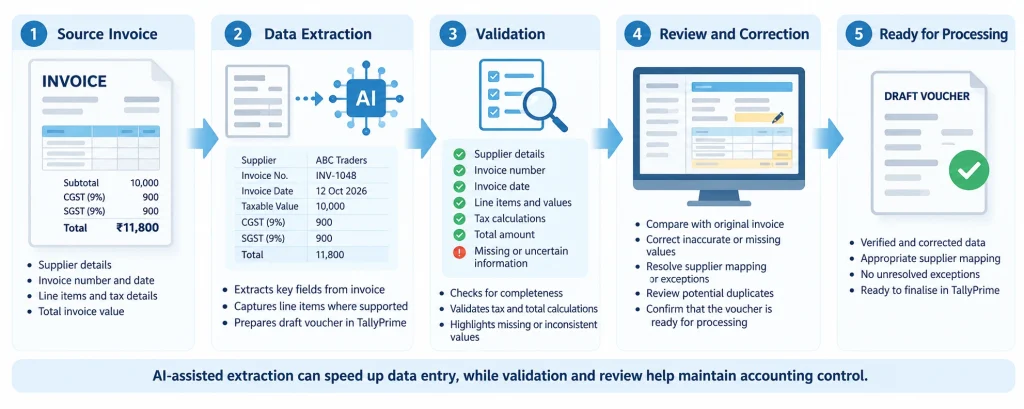
AI-assisted extraction can speed up data entry, while validation and review help maintain accounting control.
What makes AI-assisted invoicing dependable?
The quality of invoice processing cannot be judged only by the number of fields extracted or the speed at which draft vouchers are created. Businesses also need to understand how the workflow behaves when the source document is unclear, a supplier cannot be identified confidently or a duplicate is suspected.
In my practical testing of Docs by Ira, some invoice fields were extracted correctly, while others required some corrections. I also found that some supplier-mapping and duplicate-detection suggestions required manual verifications. These observations reinforce the importance of reviewing extracted information and suggested results rather than assuming that every output is ready for final accounting use. They describe the cases I tested, not a general accuracy measurement for the product.
This experience highlights three practical evaluation criteria.
Source visibility: Can the accountant compare the extracted details with the original invoice? The source document should remain accessible during the relevant review process.
Correction and exception handling: Can the user correct extracted values and resolve mapping or other exceptions without losing control over the transaction?
Clear review outcomes: Can the accountant distinguish a transaction that is ready for processing from one that still needs attention? A visible unresolved item is preferable to an uncertain result being treated as complete.
These controls matter because an extraction system can recognise most fields correctly and still make a material error in a particular transaction. Businesses should test performance using their own invoice formats and document quality rather than relying on general claims about automation.
Reconciliation requires more than matching amounts
Invoice processing and bank reconciliation solve different problems. Invoice processing interprets information from a document to help prepare an accounting entry. Reconciliation compares accounting records with bank transactions to establish whether the entries correspond and whether differences require investigation.
Matching amounts can be useful, but a dependable reconciliation workflow must accommodate partial payments, combined settlements, bank charges, inconsistent references and transactions that appear similar but may not belong together.
In TallyPrime bank reconciliation workflow includes exact matches, potential matches, partial reconciliation and the linking of one or multiple book transactions with bank transactions.
The following scenarios illustrate why reconciliation requires accounting judgement as well as matching functionality.
1. Partial payments against an invoice
Suppose a supplier invoice is recorded for ₹50,000, but the business makes a payment of only ₹30,000.
|
Particulars |
Amount |
|
Original invoice |
₹50,000 |
|
Payment made |
₹30,000 |
|
Outstanding balance |
₹20,000 |
The bank payment does not equal the full invoice value, but the difference does not necessarily indicate an error. It may be a valid partial settlement.
The accountant must establish which invoice the payment relates to and confirm that the remaining ₹20,000 continues to be accounted for correctly. A system that treats every difference as an error may create unnecessary investigation, while one that automatically treats every partial match as complete may conceal an outstanding liability.
The required capability is the ability to link the relevant transactions, represent the partial reconciliation appropriately and preserve the remaining balance for follow-up.
2. One payment covering multiple invoices
|
Invoice |
Amount |
|
Invoice A |
₹18,000 |
|
Invoice B |
₹12,000 |
|
Invoice C |
₹18,000 |
|
Combined payment |
₹48,000 |
The bank statement shows one payment of ₹48,000, while the accounting records contain three invoices. The total agrees, but the accountant still needs to establish that the payment settles those particular invoices.
The supplier’s remittance advice, payment reference, invoice balances and relevant ledger entries can help confirm the allocation. If the payment relates to different invoices or includes an adjustment, matching the combined amount alone would produce a misleading result.
The workflow should support multiple book transactions being linked with one bank transaction where appropriate, while leaving the allocation open to review when the supporting evidence is incomplete.
3. Bank charges and net settlements
Consider a payment expected to appear in the bank account as ₹20,000, but the statement records a credit of ₹19,900.
The ₹100 difference might be explained by bank charges, a deduction, an incorrect accounting entry or another adjustment. It should not automatically be classified as a bank charge simply because the amount is small.
The accountant should review the bank statement, payment advice and applicable accounting entries. If the difference is confirmed as a bank charge, the appropriate charge should be recorded and the reconciliation completed in accordance with the supporting evidence.
The important feature is not merely the ability to tolerate a difference. It is the ability to identify a partial match, investigate the reason and correct or supplement the accounting record where necessary.
4. Inconsistent bank references
A bank statement might display a reference such as “SB ENTERP UTR 78291”, while the accounting entry contains “Shree Balaji Enterprises”.
A difference in wording does not necessarily mean that the transactions are unrelated. Equally, similar names and matching amounts do not establish that they belong together.
The accountant should compare the amount, transaction direction, date, party identity, UTR or remittance reference and other available evidence. Date differences may also arise from timing or period-end processing, so they should be investigated rather than automatically ignored.
Configurable matching rules can help accommodate differences in reference formatting. However, matching based on rules is not the same as understanding the underlying business context. The accountant remains responsible for determining whether the proposed link is valid.
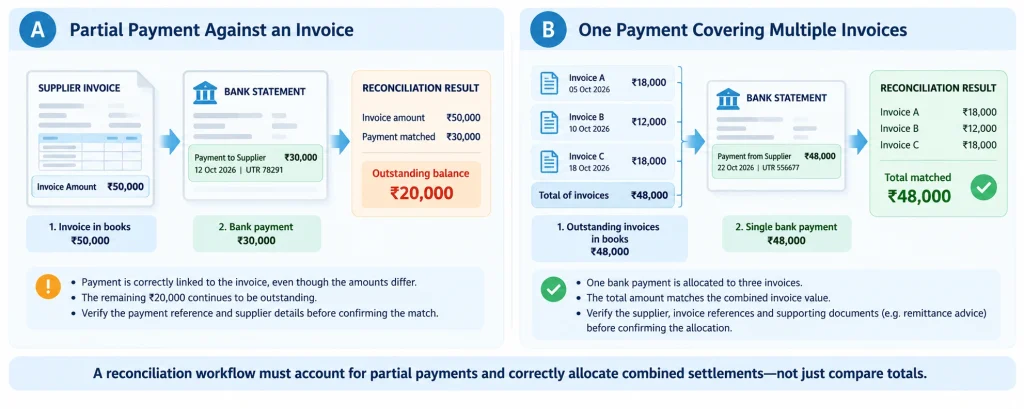
A reconciliation workflow must account for partial payments and correctly allocate combined settlements.
Why apparent matches still need investigation
Even when a system identifies a potential match, the accountant must consider whether the transactions genuinely belong together. A false match can be more difficult to detect than an obvious mismatch because the proposed link may initially appear reasonable.
- Similar invoice values: Two invoices from the same supplier are each for ₹15,000, but one has already been paid. The amount alone cannot establish which invoice a new bank transaction settles.
- Different transaction dates: A book entry is dated 1 April, while the corresponding bank transaction appears on 31 March. The difference may relate to timing or accounting-period treatment and requires investigation.
- Duplicate bank transactions: An imported bank statement or repeated receipt entry may cause a transaction to appear more than once. The accountant must establish whether the entries represent separate events or duplicate records.
- Incomplete payment references: A transaction may have a matching amount but insufficient information to establish the supplier or invoice involved.
A useful decision process is to identify the potential match, review the relevant evidence, resolve the transaction when the evidence supports the link, or retain it as unresolved when it does not.
The last outcome is important. Leaving a transaction unresolved is not necessarily a failure of automation. It can be the correct accounting decision when the available evidence is incomplete.
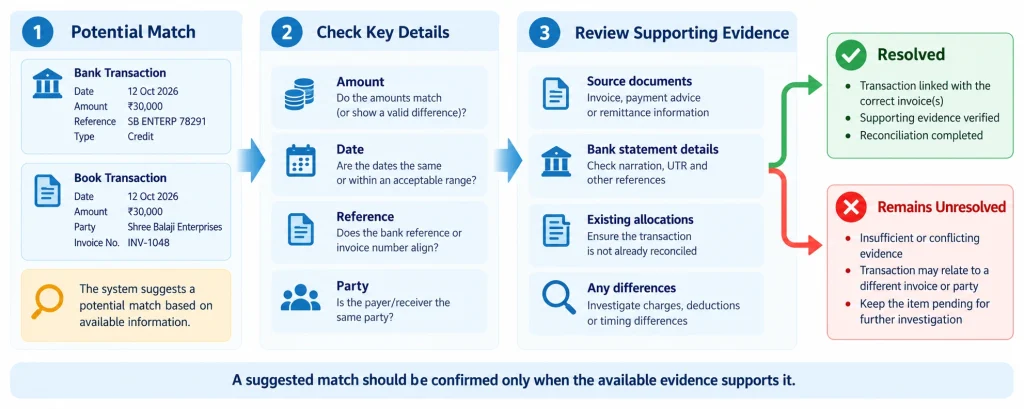
A suggested match should be confirmed only when the available evidence supports it.
TallyIra and TallyPrime: Complementary roles
Tally’s document-processing workflow and TallyPrime’s bank reconciliation functionality address different stages of accounting.
Docs by Ira uses AI to process supported invoice documents and help to create draft vouchers in TallyPrime. Using the TallyIra app users can send transaction documents to TallyPrime through the app.
TallyPrime’s bank reconciliation workflow, meanwhile, provides documented facilities for identifying exact and potential matches, linking transactions, handling partial reconciliation and correcting or unlinking incorrect matches. These are reconciliation capabilities; their existence alone does not establish that the matching process is AI-powered.
In my practical testing of TallyPrime, the partial-payment and combined-matching workflows I tested worked as expected. The distinction matters when businesses evaluate accounting automation. AI-assisted document extraction helps interpret information in source documents. Reconciliation matching compares recorded transactions using available details and matching rules. Human review is needed when the result is uncertain or the accounting evidence does not support an immediate decision.
Used together, these capabilities can help reduce repetitive work while keeping invoice preparation and bank reconciliation subject to appropriate accounting controls.
Essential capabilities versus optional enhancements
Businesses should prioritise the controls that directly affect the correctness of their accounting records before considering additional automation features.
|
Essential capabilities |
Optional enhancements |
|
Review of extracted values against source documents |
Advanced dashboards and visual summaries |
|
Correction of inaccurate or incomplete invoice data |
Customisable workflow notifications |
|
Supplier mapping and potential duplicate identification |
Additional automation for routine follow-up |
|
Visibility of exceptions and unresolved items |
Advanced analytics and trend reporting |
|
Support for partial and combined reconciliation |
More extensive workflow customisation |
|
Ability to review, correct or unlink proposed matches |
Additional reporting and productivity features |
Optional features can provide value, particularly for businesses processing high volumes of transactions. The essential question is whether the system helps the business maintain correct records and identify exceptions before they become accounting problems.
How businesses should test these features before relying on them
Before adopting an AI accounting feature, a business should test it against representative transactions from its own operations. A demonstration using a clean invoice and an exact bank match is not enough to establish how the system will behave in everyday use.
|
Test case |
What to evaluate |
|
Standard invoice |
Accuracy of supplier, date, invoice number, values and taxes |
|
Invoice with an extraction error |
Whether incorrect or missing fields can be identified and corrected |
|
Ambiguous supplier name |
Whether mapping suggestions can be checked against relevant identifiers |
|
Duplicate invoice |
Whether a potential duplicate is flagged for investigation |
|
Partial payment |
Whether the outstanding balance remains correctly represented |
|
Combined settlement |
Whether a bank transaction can be linked to the appropriate invoices |
|
Bank charge |
Whether an unexplained difference can be investigated and accounted for |
|
Inconsistent reference |
Whether alternative matching evidence can be reviewed |
|
False potential match |
Whether the accountant can reject an incorrect suggestion |
|
Duplicate bank transaction |
Whether repeated entries can be identified and investigated |
The results should be assessed using the actual source documents, bank statements and accounting records. The business should record the errors encountered, the corrections required, the exceptions that remain unresolved and the effort needed to complete each case.
Businesses should also confirm the product version, supported document formats, available functionality and applicable subscription requirements before implementing a workflow. Product features and eligibility conditions can change, so current official documentation should guide implementation decisions.
Conclusion: Making automation reliable in everyday accounting
Automation can extract invoice information, identify potential matches and reduce routine manual work. But those capabilities do not remove the need to establish whether the underlying information is correct.
For businesses evaluating AI accounting features, the distinction matters. Invoice processing must preserve the accuracy of the source document, while reconciliation must establish that the bank transaction and accounting entry genuinely belong together. Where evidence is incomplete, a visible unresolved item is preferable to an incorrect match treated as complete.
The most valuable features combine efficient processing with source visibility, correction options, exception handling and appropriate matching flexibility. Businesses should test these capabilities against their own transactions before relying on them in daily accounting.
The value of automation, therefore, lies not in eliminating every manual intervention, but in helping accountants process routine transactions efficiently while retaining control over the decisions that affect the accuracy of the books.