

The email came in at 6.40 on the evening of the 10th. The accountant at a Fancy Bazaar hardware wholesaler, apologetic as always, attached a sales sheet with "FINAL" in the file name. It was the third file that month with "final" in the name.
The Christian Basti practice I was sitting with, about 120 GST registrations on its books, had prepared GSTR-1 from the version sent on the 3rd. Bikash, the junior on that client, had matched it, the senior had reviewed it, and the manager had already ticked it off on the whiteboard. Filing would have taken ten minutes the next morning. Instead Bikash stayed till nine.
Ask most practices what GST compliance costs them and they quote filing time. The real hours go into downloading, cleaning Excel, chasing missing bills, fixing GSTINs, matching, explaining differences to the senior and then redoing a working paper because the data under it moved. At 50 registrations that is annoying. At 300 it is a second office.
What happens before anyone files
Somebody collects the sales and purchase data, checks it is complete, corrects GSTINs and rates, downloads what the portal holds, matches the books against GSTR-2B, chases the differences, prepares the working paper and gets the client to confirm. Then the return.
The matching can't be skipped either. GSTR-2B is an auto-drafted ITC statement built from what suppliers report, and the GST portal's own FAQ tells taxpayers to reconcile it with their records, to make sure no credit is availed twice for any document, and to reverse credit in GSTR-3B where the law requires it.
Four files called final
Sales on the 3rd. Purchases on the 5th. A revised sales sheet on the 8th, three missed invoices on WhatsApp on the 9th (photographed at an angle on someone's desk), and the 6.40 email on the 10th. The wholesaler isn't careless. They just have no single point where the month closes, so the CA's office becomes that point by default, and pays for it in staff hours that never appear on an invoice.
|
CA Tip: One checklist, one channel, one cut-off date per GST client. I would rather lose a client who refuses to send data through anything except WhatsApp voice notes than keep absorbing the rework. |
800 invoices, and the 25 that matter
A trading client with 800 purchase bills a month will usually have some that don't match GSTR-2B: missing invoices, value and tax differences, bills the supplier reported in a later month, suppliers who haven't filed, the odd duplicate, credit notes, and a few credits that look doubtful. Downloading 2B takes a minute. Finding those 25 among 800 is where the afternoon goes. At the Fancy Bazaar wholesaler, the 25 carried about ₹3.4 lakh of ITC between them, which is not money anyone wants to get wrong. The time goes mostly because a manual process gives every one of the 800 roughly the same attention.
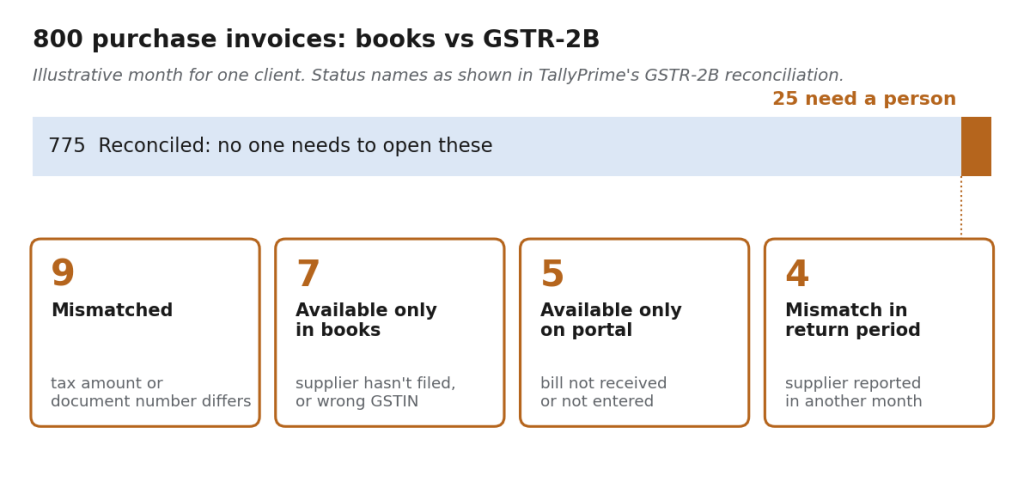
Where the client keeps books in TallyPrime, a good part of that sorting can happen inside the books. With Connected GST the team downloads GSTR-1, GSTR-3B, GSTR-2A and GSTR-2B from within TallyPrime (Alt+Z, All GST Options), or imports the portal's JSON or Excel file. The GSTR-2B reconciliation then puts every purchase into a status: Reconciled, Mismatched, Available Only in Books, Available Only on Portal, Mismatch in Return Period. A separate Potential Matches list catches entries where value and tax agree but the GSTIN, bill number or section is off, which is often where the "missing" invoices turn up. GSTR-1, GSTR-3B and CMP-08 upload from the same place, and GSTR-1 can be filed with DSC or EVC. All of this needs API access enabled on the GST portal for the client's GSTIN and, under the newer portal process, consent given to the GSP-ASP pair the software uses, since TallyPrime can request the portal OTP only after that. Both have to be set up for each GSTIN, and the API session runs for a chosen period (30 days or 6 hours) before it needs renewing, which trips up more firms than it should, usually in filing week.
It won't tell you whether a credit is eligible, or whether that freight bill from a Jorhat transporter belongs in this month. Those still need someone who knows the client.
Rough numbers for an 80-client practice
Illustrative, not a survey, though not far off what I have seen across a few mid-sized firms:
|
Activity |
Average time per client |
|
Data collection and cleaning |
30 minutes |
|
Downloading and arranging portal data |
15 minutes |
|
Reconciliation and matching |
45 minutes |
|
Follow-up on differences |
30 minutes |
|
Final review and filing preparation |
30 minutes |
|
Total |
2.5 hours |
Eighty clients, 200 staff hours a cycle. Take 40 minutes per client out of collection, downloading and matching and about 53 hours come back. Taking an illustrative junior salary of ₹25,000 for about 200 working hours a month, that is roughly ₹6,700 of time every month on paper.
Partners tend to hear that as a salary saving. With the same people on the payroll it is capacity, and it only becomes cash if it avoids overtime in filing week, a temporary hand, or the hire you were about to make. The hours are still valuable. Most firms I know have a pile of notices and half-finished advisory work that would happily take them.
When one late file reopens three papers
The senior reviews GSTR-3B. The client sends another purchase file. The junior updates the reconciliation, the senior reviews it again, and two days later somebody notices the GSTR-1 working was still built on the old sales sheet. That chain, more than any single slow task, is what makes manual GST expensive.
The portal has also become less patient. Where the liability reported in GSTR-1 or IFF exceeds what GSTR-3B reports by more than the prescribed threshold, the portal may issue an intimation in DRC-01B under Rule 88C, and the difference has to be paid or explained.
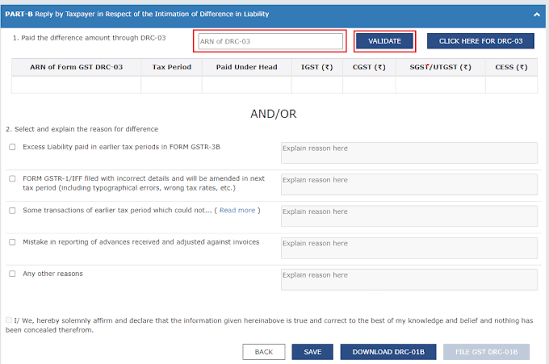
DRC-01C works the same way under Rule 88D, inserted by Notification 38/2023-Central Tax, where ITC claimed in 3B exceeds what 2B shows beyond the applicable threshold. In both cases the taxpayer generally has seven days to pay with interest or explain, and not responding can restrict GSTR-1 or IFF for a later period. A reconciliation skipped in a busy month can come back as a blocked return and a client on the phone.
Partner time nobody prices
A junior spends three hours on a return. If the working paper is muddy, the manager spends another hour working out what was done, and if differences aren't classified, some of it gets redone. I now push firms to put a half-page exception summary on top of every return before final review: major GSTR-1 and GSTR-2B differences, ITC reversals, odd adjustments, confirmations still pending from the client, anything carried forward. Bikash's firm started doing it in August. The juniors grumbled for about two weeks.
What I'd automate first
Downloads, imports, matching, duplicate checks, difference reports and the standard "please send these three bills" email. Everything there is copying, and copying is where errors creep in at 8 pm. ITC eligibility, place of supply, classification calls, the strange credit note, anything with a related party: those stay with a person, and should be visible in the exception summary so the senior sees them.
Filing week
Most of the month is fine. Then the window opens and everyone is busy at once, alongside TDS, an audit, a notice, and a client who wants to talk about advance tax. Firms whose clients update their books through the month have purchases entered and checked before GSTR-2B lands on the 14th, so they can start reconciling as soon as it is available instead of the night before GSTR-3B is due, chase missing bills while suppliers still pick up the phone, and get exceptions to seniors with time left to think.
Bikash, for what it's worth, now leaves by seven most evenings in filing week.