







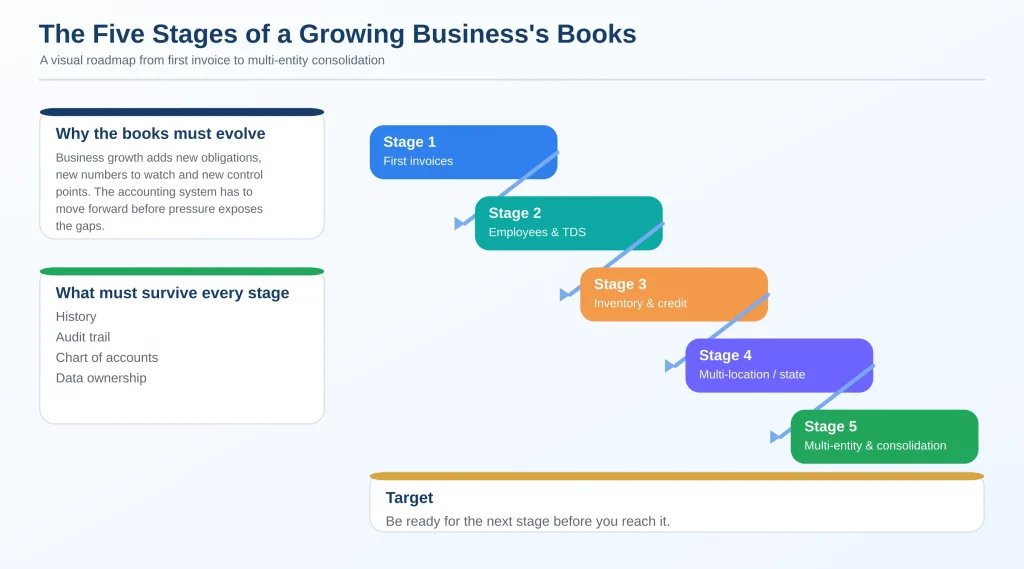
A business almost never calls me because its accounting broke. It calls because the accounting quietly stopped keeping up, and by the time anyone notices, the company is two sizes bigger than the system running its books.
It starts small. Ten invoices a month, one bank account, no real pressure. Then the hires come. Credit sales climb. Stock begins moving between locations. A second state opens. Eventually the promoter floats a second company. Every one of those shifts asks something new of the books, and when the books don't move with them, the bill lands later, when the business is bigger, the numbers messier, and nobody quite trusts them.
The cause is almost never the software. It's running yesterday's process in a business that has become something else. Here are the five stages, and what your books have to carry at each.
Stage 1: the first invoices
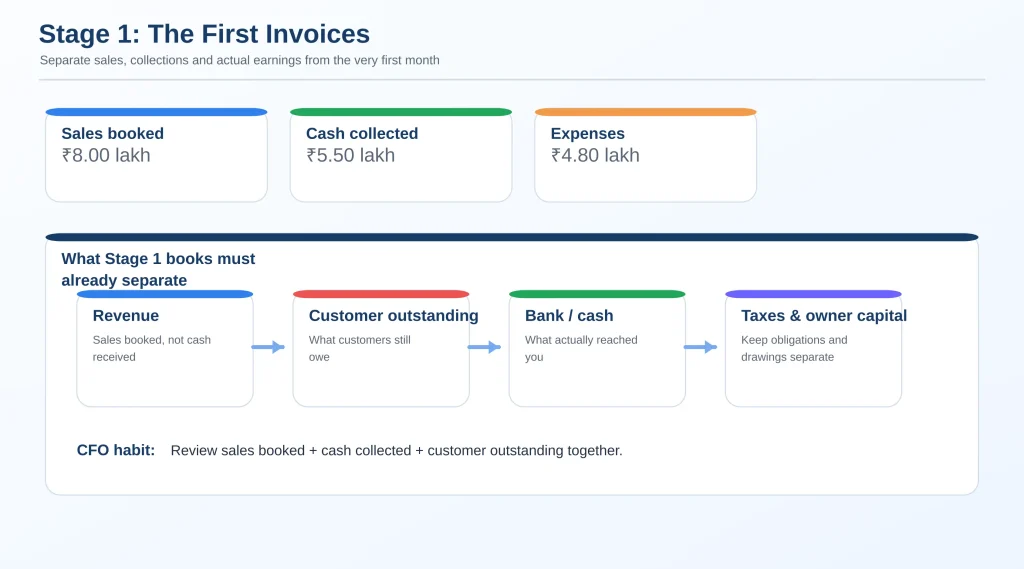
Early on, accounting feels trivial. A handful of sales invoices, some supplier bills, one bank account, a few expenses, maybe no staff yet. Most owners at this point ask one question: how much did we sell?
Two more belong right next to it from the start. How much did we collect, and how much did we actually earn. They are not the same number. Invoice ₹8 lakh in a month, watch only ₹5.50 lakh reach the bank while expenses run ₹4.80 lakh, and the ₹8 lakh you're celebrating and the balance the bank is showing you are telling two different stories.
Even this early, the system should keep revenue, customer outstanding, expenses, bank, cash, taxes, and the owner's capital or drawings apart from one another. If you're GST-registered, the invoices need the prescribed GST particulars. Clean invoice numbering and proper customer masters are worth starting now, at ten transactions, not at five thousand. Bad habits set hard, and pulling them out later is far more work than never forming them.
|
CFO Tip: From the first month, read three numbers side by side: sales booked, cash collected, and customer outstanding. That one habit stays useful at every stage that follows. |
Stage 2: the first employee changes more than the salary line
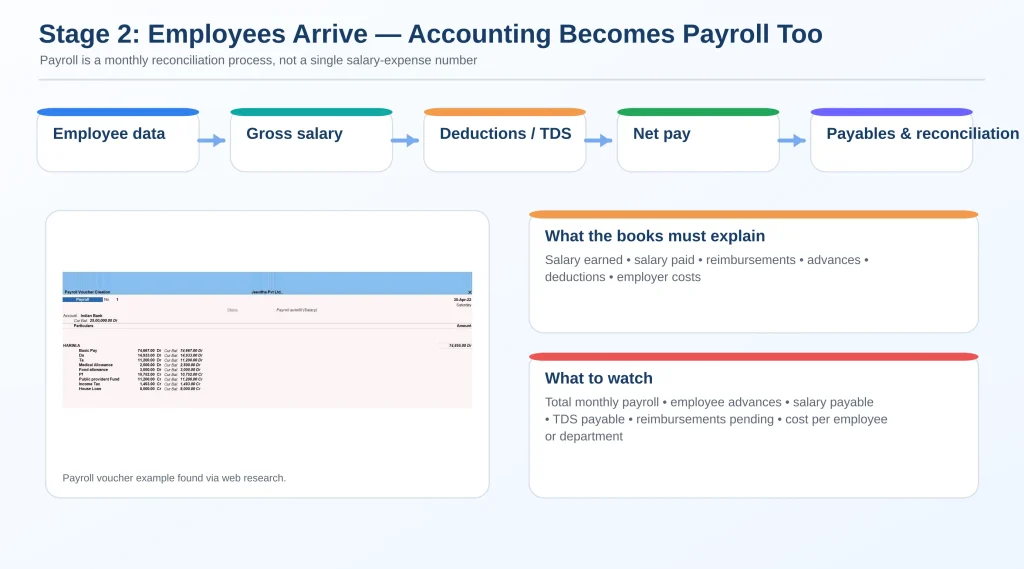
Hiring one person adds more than a salary expense. The books now have to explain salary earned against salary paid, reimbursements, advances, deductions, and the employer's own costs. As the team grows, TDS on salaries comes into it, calculated and deducted under the applicable income-tax provisions, and depending on headcount, state, and salary structure, other statutory payroll obligations may apply too.
This is where casual accounting turns risky. Writing "Salary ₹4 lakh" for the month is easy. What finance actually needs is which employee, which month, what advance was adjusted, what reimbursement got bundled in, what deduction is still pending, and how much is still payable.
I had this wrong in my own head early on. I treated payroll as one monthly expense, when it's really a monthly reconciliation. Seen that way, the things to watch are plain enough: total monthly payroll, employee advances, salary payable, TDS payable, reimbursements pending, and cost per employee or department.
The chart of accounts starts to matter here as well. If every new expense spawns a new random ledger, reporting turns to mush quickly.
Stage 3: inventory and credit start eating the cash
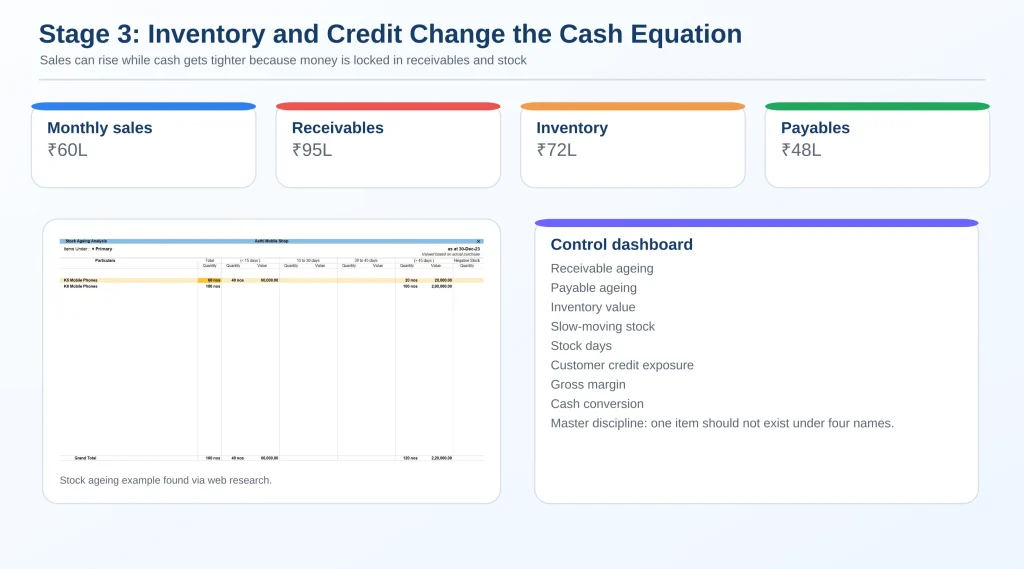
Plenty of growing businesses feel successful and cash-poor at the same time, and this is usually the stage where it happens. Sales are up, stock is up, and customer outstanding is climbing right alongside them. That combination drains cash quietly.
Picture ₹60 lakh of monthly sales sitting against ₹95 lakh of receivables, ₹72 lakh of inventory, and ₹48 lakh of payables. The Profit and Loss can look perfectly healthy while ₹1.67 crore is locked up in receivables and stock. At that point recording transactions isn't enough. The accounting has to help control working capital: receivable and payable ageing, inventory value, slow-moving stock, stock days, customer credit exposure, gross margin, cash conversion.
Stock masters get serious here too, because one item can't live under four names. A single bearing showing up as "Bearing 6204," "6204 Bearing," "Bearing-6204," and "BRG 6204" looks harmless at a hundred invoices and becomes a real reporting problem at fifty thousand. Before you scale inventory it pays to have the basics locked: one clean item master, clear units of measurement, customer credit limits, receivable ageing, stock-movement reporting, and regular physical-stock checks.
Stage 4: one business, several states
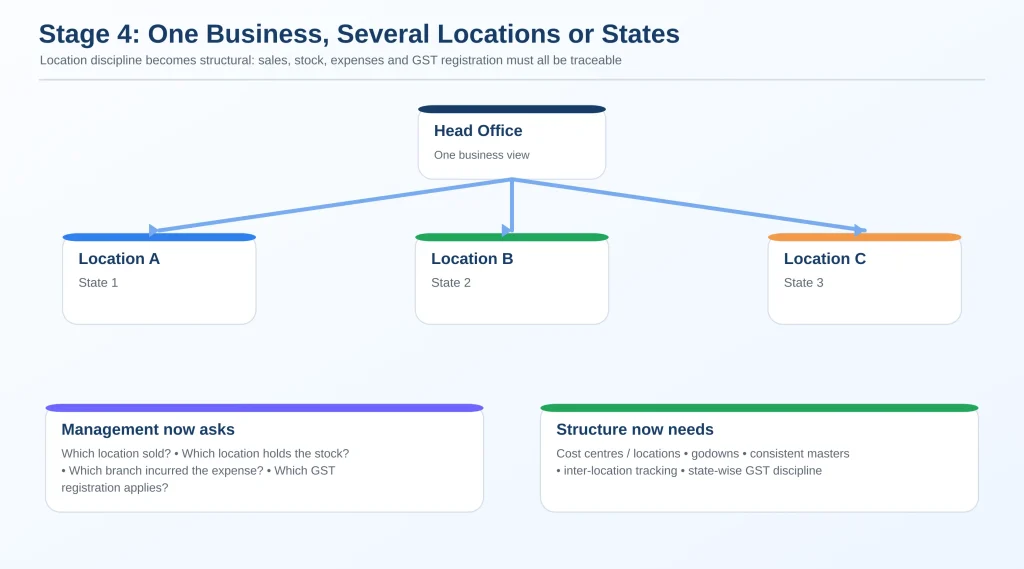
Opening another location feels like an operations decision. The books quickly show you it's a structural one. You now have to know which location sold, which one holds the stock, which branch spent the money, which GST registration applies, and which customer belongs where.
On GST, registrations in different states are treated as distinct persons, and where you're required to register in another state, that state carries its own registration and its own compliance position. So "it's all one company, so it's all one GST account" doesn't hold. The books need location discipline, and inter-location stock movement needs proper tracking, or head office will keep showing stock that physically sits three states away.
The questions management asks have to sharpen at this point:
|
Earlier question |
Better question |
|
What are total sales? |
Which location generated them? |
|
How much stock do we have? |
Where is that stock? |
|
What are total expenses? |
Which branch incurred them? |
|
What is customer outstanding? |
Which location owns collection? |
This is usually where cost centres, locations, godowns, and consistent masters start earning their keep. One customer shouldn't turn into a different customer in every branch unless the structure genuinely calls for it. The stage goes wrong when each location invents its own accounting language, and growth needs one financial language across the whole business.
Stage 5: from one company to a group
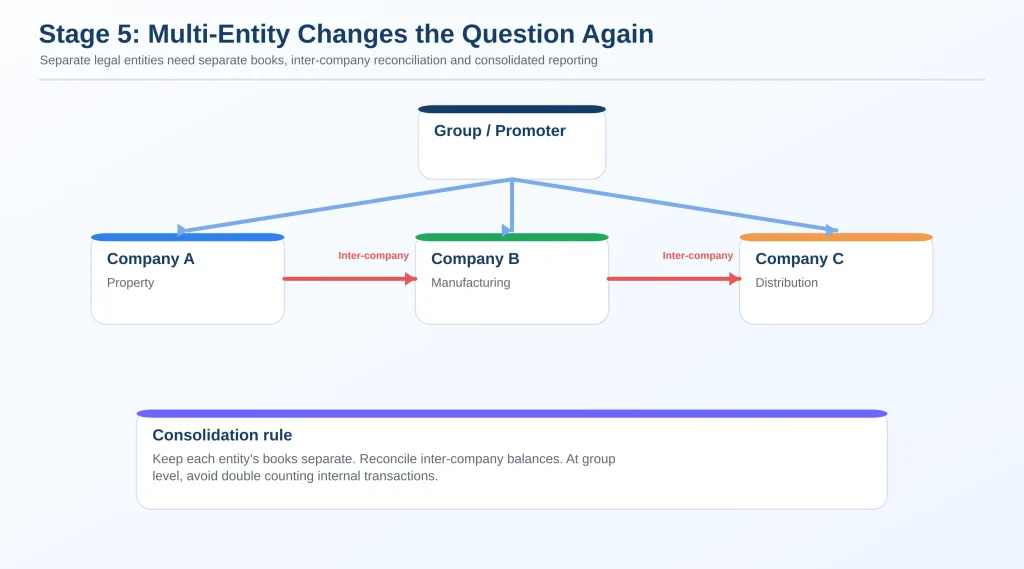
Then comes a different kind of jump. The promoter sets up another entity. One company holds the property, another manufactures, a third handles distribution. This isn't one business with several locations any more. These are separate legal entities, and the distinction matters.
Each entity needs its own books: its own bank balances, customers and vendors, assets, liabilities, taxes, loans, capital, and profit or loss. Transactions between them need recording properly. If Company A pays ₹12 lakh of expenses on behalf of Company B, that can't just vanish into "group expenses." One entity paid, the other took the benefit, and the inter-company balance has to reconcile.
At group level you'll often want a combined view, and that carries its own trap: internal transactions can't be counted twice. If one group company sells ₹50 lakh to another, consolidation may require that internal sale to be eliminated. For companies under the Companies Act, a holding company with subsidiaries may also carry statutory consolidated financial-statement requirements, and applicable associates and joint ventures come into the consolidation framework as well. Year-end gets much harder here if the structure was never designed for it.
|
CFO Tip: For every transaction in a group, make sure your system can answer four things: which entity, which location, which account, and which counterparty. Get those four right and consolidation stops being a nightmare. |
Four things that have to survive every stage
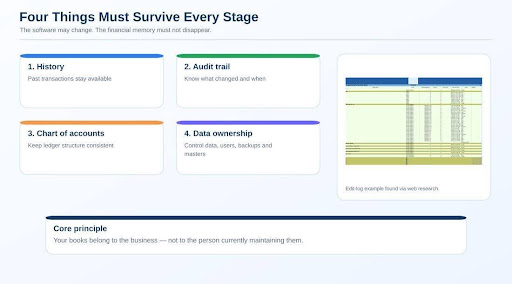
Businesses swap software as they grow, and that's fine. What can't get lost in the move is the financial memory.
History first. Past transactions have to stay available, and for companies the Companies Act requires books of account for at least the eight preceding financial years to be preserved. Migrating by carrying only opening balances and dropping everything behind them is exactly how that history quietly disappears.
Then the audit trail, so you know what changed and when. For companies using accounting software, the Companies (Accounts) Rules require software with an audit-trail and edit-log feature for financial years beginning on or after 1 April 2023. Even where that specific rule doesn't apply to you, keeping transaction history is simply good control.
The chart of accounts should grow carefully rather than get rebuilt from scratch at every branch or entity, because consistency is what makes comparison possible at all. And data ownership stays with the business. Accountants change, CAs change, software providers change, but the accounting data, the user access, the backups, the masters, the passwords, and the historical records belong to the business, not to whoever happens to be maintaining them today.
The transitions that go wrong most
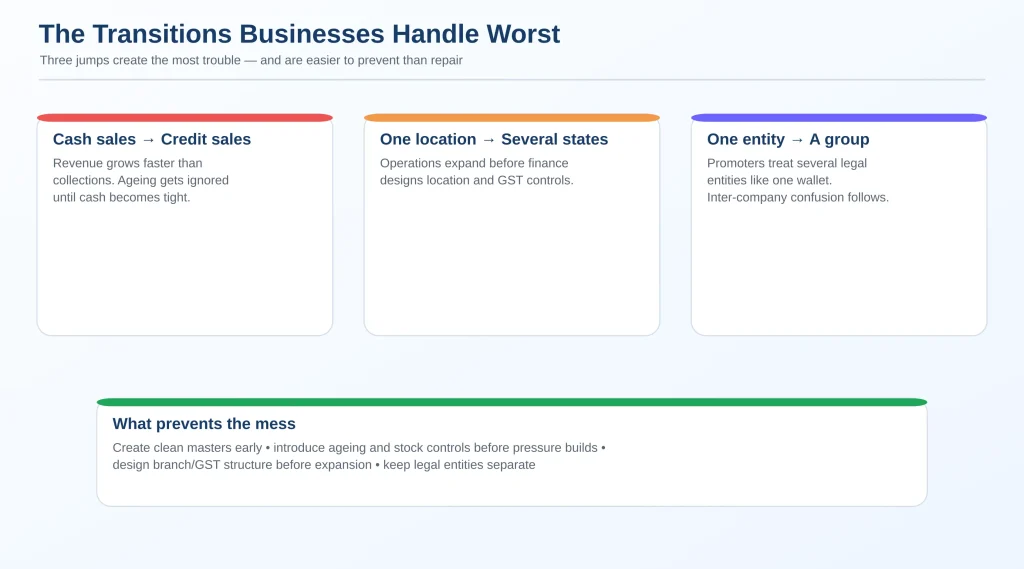
Three jumps cause the most trouble, in my experience. The move from cash sales to credit sales, where revenue grows faster than collections and nobody watches ageing until the cash gets tight. The move from one location to several states, where the business expands operationally before finance has designed the location and GST controls. And the move from one entity to a group, where promoters keep treating several legal entities like a single wallet and the inter-company position turns into a mess.
All three are far cheaper to prevent than to repair. A clean structure set up before expansion costs almost nothing. Cleaning up five years of mixed data can take months.
Where this leaves you
Growing businesses rarely catch the exact day their accounting outgrew itself. They notice later, when collections are unclear, the stock doesn't match, or the group balances won't reconcile. The aim is to let the books grow a stage ahead of the pressure instead of a stage behind it.
Keep sales and collections separate from day one. Build payroll and TDS controls as the team grows. Get inventory and credit under watch before working capital tightens. Put location controls in before you expand geographically. Keep each legal entity's books clearly separate. And carry the history, the audit trail, the masters, and the data ownership through every move. The point is simple enough: have the books ready for the next stage before you get there, not after.