










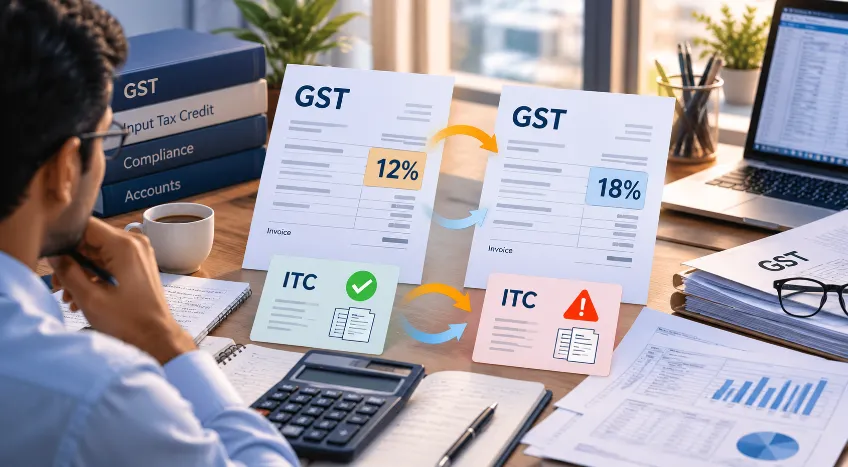
Every time the GST Council revises a rate, businesses run into the same practical question: which rate applies to a transaction that straddles the effective date, and what happens to the input tax credit (ITC) already taken or yet to be taken? The answers are not a matter of judgment — they are laid down in the CGST Act, 2017 itself. This article sets out the rules in simple terms, along with the errors businesses commonly make and a quick checklist to stay compliant.
1. Old rate vs new rate — which one applies?
The general rules for time-of-supply under Section 12 (goods) and Section 13 (services) are overridden the moment there is a change in rate of tax. Section 14 of the CGST Act then decides the applicable rate by looking at three dates — date of supply, date of invoice, and date of payment — and applying a simple “two-out-of-three” logic.
If the supply itself was completed before the rate change: the new rate applies only if both the invoice and the payment come after the change (rate as on whichever of the two is earlier). If either the invoice or the payment was already done before the change, the old rate continues to apply, taken from whichever of those two events happened before the change.
If the supply itself was completed after the rate change: the logic mirrors the above — the old rate applies only if both invoice and payment were completed before the change; otherwise the new rate applies, taken from whichever of invoice or payment falls after the change.
The Act’s own illustration makes this easy to follow. Assume the rate changes with effect from 1st June (old rate 28%, new rate 5%):
| S. No | Date of Supply | Date of Invoice | Date of Payment | Time of Supply | Rate Applicable |
|---|---|---|---|---|---|
| 1 | 26-05 | 01-06 | 01-07 | 01-06 | New rate: 5% |
| 2 | 26-05 | 27-05 | 11-06 | 27-05 | Old rate: 28% |
| 3 | 26-05 | 05-06 | 29-05 | 29-05 | Old rate: 28% |
| 4 | 04-06 | 30-05 | 03-06 | 03-06 | New rate: 5% |
| 5 | 04-06 | 30-05 | 31-05 | 30-05 | Old rate: 28% |
| 6 | 04-06 | 03-06 | 30-05 | 03-06 | New rate: 5% |
One practical trap: “date of receipt of payment” is the date it is entered in the supplier’s books or credited to the bank, whichever is earlier — but if the bank credit happens more than 4 working days after the rate change, the bank-credit date is taken instead. This prevents back-dating a cheque to claim the old rate.
2. Impact of GST rate changes on ITC claims
A reduction in your output rate does not, by itself, require you to reverse ITC already validly availed on goods in stock. Reversal under Section 18(4), read with Rule 44, is triggered only when the goods or services become wholly exempt (i.e., the rate becomes nil) — not merely cheaper.
Where reversal is genuinely required, Rule 44 prescribes the mechanics: ITC on inputs held in stock and inputs in semi-finished/finished goods is reversed proportionately based on the original invoices; ITC on capital goods is reversed on a pro-rata basis over a notional 5-year useful life. The reversed amount is added to output tax liability and reported in Form GST ITC-03.
A point that is frequently misunderstood: if the rate merely drops (say from 12% to 5%) but the supply remains taxable, Section 18(4) does not apply at all — even if the new, lower rate happens to be a “without ITC” rate — unless the rate notification itself specifically treats that category as exempt for this purpose.
3. Invoice, supply and payment dates during rate transitions
Because the rate turns entirely on these three dates, businesses should be able to evidence each one independently, especially for goods in transit around the cut-off. Keep the following on file for transactions near a rate change:
- Delivery challan, lorry receipt/GR and proof of delivery (POD), to fix the actual date of supply — particularly for FOR-destination contracts where delivery may fall well after the invoice date.
- The invoice date as recorded in the accounting/e-invoicing system, along with the IRN generation timestamp.
- Bank credit date and books-of-account entry date for payments, to apply the earlier-of-the-two rule and the 4-working-day proviso correctly.
Where the invoice date and the actual delivery date fall on different sides of the change, review the transaction against Section 14 before assuming the invoice rate is correct — the wrong assumption is one of the most common sources of short or excess billing during a rate revision.
4. ITC on purchases made before and after the rate change
From a recipient’s perspective, there is no separate “old-rate purchase” or “new-rate purchase” category for ITC purposes. Eligibility depends entirely on whether the conditions of Section 16 are met — a valid tax invoice, receipt of goods or services, tax actually paid by the supplier, and the return filed — and on the invoice being within the time limit under Section 16(4). The rate charged on that invoice is whatever was correctly determined under Section 14, whether that happens to be the old or the new rate.
A change in your own outward supply rate has no bearing on ITC already validly claimed on inward supplies — that credit is not disturbed merely because your selling rate later changes.
5. Handling credit/debit notes and pending transactions
Section 34 ties a credit or debit note to the original supply, not to a fresh one. A credit note issued for a rate difference, sales return or deficiency must carry the same GST rate that applied on the date of the original invoice — never the rate prevailing on the date the credit note itself is issued. For example, goods sold at 18% and later returned when the rate has moved to 12% still call for a credit note at 18%, since the note is only an adjustment to the earlier transaction. Where the recipient issues a fresh sale invoice instead of a return, the current rate applies, since that is a fresh supply and not an adjustment.
On debit notes, ITC eligibility for the recipient runs from the date of the debit note itself — not the date of the original invoice — following the 2021 amendment to Section 16(4). This is useful where a supplier has to raise a debit note to correct short-billing at the original invoice rate after a rate change.
For advances or part-payments spanning the change date, apply the same Section 14 combination logic, and retain the receipt voucher date as documentary evidence of when the payment was actually received.
6. Common ITC errors during GST rate revisions
- Reversing ITC on existing stock merely because the output rate has reduced, without checking whether the goods have become wholly exempt — Section 18(4) applies only to the latter.
- Issuing a credit note at the rate prevailing on the date of issue instead of the rate on the original invoice.
- Applying the invoice date for payments received late, while ignoring the 4-working-day bank-credit proviso.
- Reversing ITC under Rule 44 without filing Form ITC-03, or without the chartered accountant/cost accountant certification required where invoices for the stock are not available.
- Continuing to bill at the old rate after the effective date (or applying the new rate too early) because the rate master in the accounting software was not updated in time.
- Treating the invoice date as the date of supply for goods still in transit, instead of the actual delivery date.
- Not passing on the price benefit on MRP-linked goods where a rate reduction genuinely warrants it under the anti-profiteering obligation in Section 171.
7. Updating GST rates in accounting software
- Update the HSN/SAC-wise rate master a day ahead of the effective date, and lock billing on the old master at midnight of the cut-off.
- Reconcile pending sales orders and advance receipts against the change date before invoices are raised.
- Tag the effective date in the system so that credit/debit notes automatically default to the original invoice’s rate rather than the current rate master.
- Cross-check e-invoice (IRN) and e-way bill templates immediately after the change — a mismatch between the invoice rate and the e-invoice JSON is a common rejection reason right after a rate revision.
- Brief billing and dispatch staff on the three-date rule so that goods moving around the cut-off are invoiced at the correct rate.
- Run a rate-change reconciliation report for the first return period after the change to catch any invoices raised at the wrong rate before the return is filed.
8. Quick compliance checklist for businesses
- Identify the exact effective date of the rate change from the notification.
- Map the date of supply, invoice and payment for transactions around the cut-off, and apply Section 14.
- Update rate masters in the accounting, billing and e-invoicing systems before the effective date.
- Do not reverse ITC on existing stock merely because the output rate has reduced — check only for “wholly exempt” cases under Section 18(4).
- Issue credit and debit notes at the rate of the original invoice, not the rate current on the date of issue (Section 34).
- Where reversal is genuinely required, work it out under Rule 44 and file Form ITC-03 within time.
- Pass on the price benefit on MRP-based products where required under Section 171.
- Retain delivery challans, PODs, receipt vouchers and bank credit records as proof of the relevant dates — disputes on rate applicability are ultimately decided on this evidence.
Rate revisions are a recurring feature of GST, not a one-off event. Businesses that build the Section 14 date-mapping, the correct ITC treatment and the credit-note rule into their standard billing checklist — rather than relearning it each time — avoid most of the disputes that follow a rate change.







