










Business software in India is changing. Is your accounting system keeping up?
I have spent more than 15 years working around accounting, business processes and the practical challenges faced by finance teams.
One thing I have noticed repeatedly is that the role of accounting software has changed significantly.
Earlier, the primary question was:
"Can this software maintain my books correctly?"
Today, businesses need to ask much more.
- Can it connect with banking?
- Can I track payment status?
- Can I generate e-Invoices and e-Way Bills without switching between systems?
- Can I reconcile GST data efficiently?
- Can the system validate HSN/SAC information?
- Can AI reduce repetitive invoice entry?
- Can I see reports from a browser or mobile device?
- Can I consolidate multiple companies?
- Can I track changes made to financial records?
- Can the software continue to support the business as its operations become more complex?
This shift is important because Indian businesses now operate in an environment where accounting, taxation, banking, payments and digital compliance increasingly overlap.
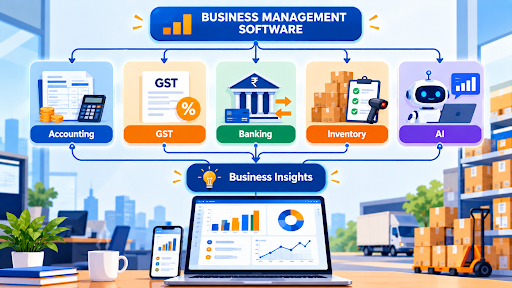
The result is a new generation of business management software that aims to connect these activities instead of treating accounting as an isolated function.
So, what should businesses actually look for?
Let's look at the features that matter today.
1. Connected banking: From bank statements to payment status
Banking is one of the first areas where disconnected workflows can create unnecessary work.
Traditionally, an accountant might:
- Download a bank statement.
- Open the accounting software.
- Enter or import transactions.
- Match them with the books.
- Reconcile differences.
- Separately check whether payments were successful.
Modern business software is increasingly bringing these activities closer together.
For example, connected banking capabilities can provide access to bank balances and statements within the accounting environment. Some systems also support automated reconciliation and payment workflows.
In TallyPrime, Connected Banking allows supported bank accounts to be connected so users can access bank balances and statements. Its banking capabilities also include automated reconciliation and payment-status tracking.
What should businesses actually expect from connected banking?
Because the objective isn't simply to "connect a bank."
The bigger benefit is creating a more connected workflow:
Bank → Transaction → Accounting → Reconciliation → Payment status
That reduces the need for accountants to repeatedly move information between different systems.
Practical tip
When evaluating software, don't just ask:
"Does it support bank integration?"
Ask:
"What can I actually do after the bank is connected?"
Check whether you can:
- retrieve statements
- reconcile transactions
- create accounting entries
- initiate payments
- track payment status
- identify failed or pending transactions
These details determine whether an integration is genuinely useful.
2. GST compliance is becoming more connected
GST has changed what businesses expect from accounting software.
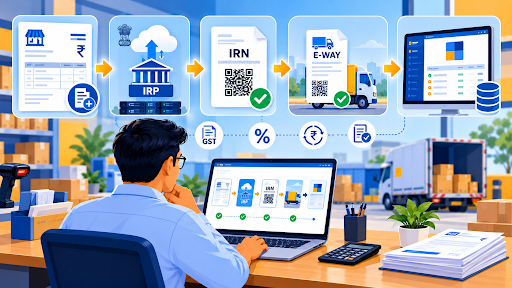
E-Invoicing is not simply about creating an invoice PDF. It involves interaction with the Invoice Registration Portal and generation of an Invoice Reference Number (IRN) and QR code for applicable transactions.
The current e-invoicing ecosystem also continues to evolve. For example, GSTN issued a June 2026 advisory covering changes involving e-Invoice/e-Way Bill APIs, including mandatory capture of Ship-to GSTIN in relevant Bill-to/Ship-to transactions.
This is one reason modern accounting software needs to stay aligned with the GST ecosystem.
TallyPrime supports e-Invoice and e-Way Bill workflows directly from the software, including generation and tracking-related capabilities. Its release history also documents enhancements around e-Way Bills, e-Invoices, HSN/SAC validation and GST reporting.
What should businesses look for?
A modern system should make it easier to:
- generate e-Invoices
- generate e-Way Bills
- capture IRN information
- handle QR codes
- track e-Way Bill status
- identify exceptions
- manage cancellations or amendments where applicable
- keep the compliance workflow connected with accounting
The important point is integration.
If the accountant creates an invoice in one system, downloads a file, logs into another portal and then manually updates the accounting records, there is still considerable process friction.
3. IMS reconciliation and GST data: The new compliance workflow
The GST ecosystem is increasingly becoming data-driven.
The Invoice Management System, or IMS, gives recipients a mechanism to review invoice records and take actions such as accept, reject or keep certain records pending. GSTN introduced additional IMS functionality from the October 2025 tax period, including options related to credit notes, amendments, remarks and ITC reduction.
For businesses, this means GST reconciliation is no longer simply:
Books vs GST return
There can be several layers of information to review.
A modern accounting system should therefore help finance teams identify:
- missing invoices
- mismatches
- differences in taxable value
- GST differences
- ITC-related exceptions
- supplier-side discrepancies
- records requiring attention
This becomes particularly important for businesses with a high volume of purchases.
What should you check?
Don't just ask whether the software says "GST reconciliation."
Ask:
"Can I identify exactly which transactions need my attention?"
That distinction is important.
A useful reconciliation system should help an accountant move from:
Thousands of transactions
to:
A manageable list of exceptions.
4. Can your software catch GST classification errors early?
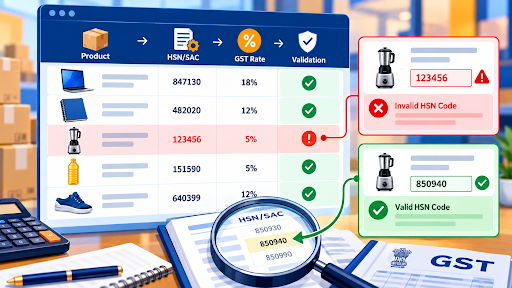
HSN and SAC data may appear to be a small part of accounting, but incorrect classification can create problems in GST reporting and invoicing.
Modern accounting software is therefore increasingly incorporating validation into the transaction workflow rather than leaving all checks to the end.
TallyPrime, for example, provides online HSN/SAC validation, and its recent feature updates include GST-related HSN reporting enhancements.
The larger principle is important:
Good software should prevent errors where possible, not simply report them later.
For businesses, this means checking whether the software can validate or flag:
- HSN/SAC codes
- GSTIN details
- tax rates
- GST classifications
- transaction-level exceptions
This can reduce the amount of correction required during return preparation.
5. AI-powered document capture: From invoice to accounting entry
This is perhaps one of the biggest changes happening in accounting software.
For years, accountants have spent significant time reading invoices and entering:
- supplier name
- GSTIN
- invoice number
- date
- item details
- quantity
- taxable value
- CGST
- SGST
- IGST
- ledger information
AI-powered document processing is changing this workflow.
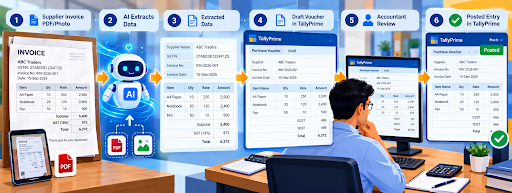
Modern AI accounting tools can read information from invoices and other documents and use it to prepare accounting entries.
TallyPrime's Docs by Ira is one example. It uses AI-powered document processing to create draft vouchers from PDF or image documents, with the accountant able to review the result before posting. Tally says the tool can also assist with master creation during voucher creation.
The important part, in my view, isn't simply the word AI.
It is the workflow:
Document → AI extraction → Accounting draft → Human review → Final entry
That last step matters.
Accounting is not just about extracting text from a document. The system also needs to understand accounting context, GST information and the relevant masters.
But is AI actually reducing accounting data entry?
Before adopting an AI feature, ask:
- What documents can it process?
- How accurately does it capture GST information?
- Can it identify duplicate documents?
- Can it map information to existing masters?
- Can users review the generated entry?
- Can users correct the AI output?
- What happens when the AI is uncertain?
- Is there a clear exception-handling process?
The objective should be less manual work without losing accounting control.
6. Multi-company management and consolidated reporting
As businesses grow, accounting rarely remains limited to one legal entity.
A business group may have:
- multiple companies
- sister concerns
- subsidiaries
- branches
- different GST registrations
- separate books
But management often wants one answer:
"How is the entire group performing?"
This is where multi-company consolidation becomes important.
TallyPrime's Group Company functionality can consolidate financial information across related companies and provide group-level reports such as consolidated Balance Sheet, Profit & Loss and Trial Balance, while retaining the individual books of each company.
Similarly, data synchronisation can help businesses share and consolidate information across branches and warehouses.
Why does this matter?
Without consolidation, management may have to manually combine reports from multiple entities.
That creates another spreadsheet problem:
Company A + Company B + Company C → Excel consolidation → Management report
7. Business reporting beyond the office desktop
Business owners don't always sit in front of the accounting computer.
They may be:
- visiting customers
- travelling
- at another branch
- attending meetings
- working from home
- at a warehouse or factory
This has increased the importance of browser and mobile access.
But there is an important distinction.
Mobile access doesn't necessarily mean the entire accounting application runs on a phone.
Some systems provide browser-based access primarily for reports and visibility.
TallyPrime's Reports in Browser allows authorised users to view frequently used business reports from browsers on laptops, tablets and mobile devices. The available reports include Balance Sheet, Profit & Loss, Cash Flow, receivables, payables, sales, purchases and stock-related reports.
This means an owner can check business information without necessarily being physically present at the accounting desk.
What should you check?
Ask:
- Which reports are available remotely?
- Is mobile viewing supported?
- Can users drill down into reports?
- Can reports be downloaded?
- Can access be controlled by the user?
- Does remote access expose the entire database or only authorised information?
The last question is particularly important from a control perspective.

8. Audit trails: Visibility into who changed what
As accounting systems become more automated, another question becomes increasingly important:
Who changed what, and when?
Imagine that an invoice amount is modified after it was originally recorded.
Or a ledger master is changed.
Or a transaction is altered before an audit.
A modern accounting system should provide mechanisms to track such changes where required.
TallyPrime's Edit Log records activities in transactions and masters. Tally also distinguishes its Edit Log offering for businesses that require audit-trail compliance under applicable requirements from the standard product's logging capabilities for internal control.
This is more than an audit feature.
It is about accountability and control.
Look for capabilities such as:
- user identification
- date and time of change
- original information
- changed information
- transaction history
- audit reports
- controlled access
The more automated a financial environment becomes, the more valuable a clear audit trail can be.
9. From accounting software to business management platform
This is the bigger change behind all these features.
Accounting software used to primarily answer:
"What happened financially?"
Modern business management software increasingly tries to answer:
"What is happening now, why is it happening, and what should I pay attention to?"
That means accounting is increasingly connected with:
- sales
- purchases
- inventory
- banking
- payments
- GST
- receivables
- payables
- reporting
- document processing
- compliance
The value isn't necessarily in having 100 separate features.
The value is in how well those features work together.
For example:
- Purchase Invoice
- AI Document Capture
- Accounting Entry
- GST Information
- IMS/GST Reconciliation
- Payment
- Bank Reconciliation
- Financial Reporting
That is a much more connected workflow than traditional bookkeeping.
10. What's next: The future of business management software
The next phase of business management software is unlikely to be about simply adding more buttons.
The bigger shift will be toward connected and intelligent workflows.
We can expect areas such as:
AI-assisted accounting
AI will increasingly assist with:
- document processing
- transaction classification
- reconciliation
- exception detection
- data validation
- report interpretation
But human review will remain important for exceptions, judgement-based transactions and compliance-sensitive decisions.
Connected banking
Accounting systems are likely to become more closely connected with:
- bank accounts
- payment workflows
- payment status
- reconciliation
- cash-flow visibility
Proactive compliance
Instead of simply generating reports after transactions are recorded, systems can increasingly identify potential issues earlier.
For example:
Missing information → Warning
Invalid HSN → Alert
GST mismatch → Exception
Unreconciled transaction → Action required
Conversational interfaces
As AI becomes better at understanding business language, users may increasingly interact with financial information using natural-language questions.
For example:
"Show me customers whose outstanding amount increased this month."
or:
"Which expenses increased compared with last month?"
The important question will be whether the underlying financial data is reliable enough to support those answers.
Connected business ecosystems
Accounting software will increasingly sit at the centre of an ecosystem involving:
Banking + GST + Payments + Inventory + Documents + Analytics + AI
This is where the idea of "business management software" becomes more meaningful than simply "accounting software."
How should an Indian business evaluate modern business management software?
Features alone shouldn't decide the purchase.
I recommend looking at the software through these seven questions:
|
What to evaluate |
What to ask |
|
Accounting |
Can it handle the complexity of your books? |
|
GST & Compliance |
Does it support current GST workflows? |
|
Banking & Payments |
Can accounting and banking work together? |
|
Automation & AI |
Does automation actually reduce manual work? |
|
Reconciliation |
Can the system identify exceptions quickly? |
|
Access & Reporting |
Can authorised users access important information remotely? |
|
Control & Audit |
Can you track important changes and maintain accountability? |
The right question isn't:
"How many features does the software have?"
It is:
"How many of my everyday business processes can the software connect, simplify and control?"
Final thoughts
After working in accounting for more than 15 years, I believe the biggest change in business software isn't simply that accounting has become digital.
It is that the boundaries between accounting, compliance, banking, payments and business operations are becoming less rigid.
A modern system should help businesses reduce repetitive work while giving accountants and owners better visibility and control.
Features such as connected banking, e-Invoicing, e-Way Bills, IMS reconciliation, HSN/SAC validation, AI document processing, multi-company consolidation, browser access and audit trails are examples of this broader shift.
And AI will accelerate that change.
But businesses shouldn't adopt a feature simply because it has "AI" in its name.
The better question is:
Does this technology solve a real business problem, work with my actual data, and still keep the people responsible for the accounts in control?
That is likely to remain the most important test for business management software—today and in the years ahead.
FAQS
1. What is modern business management software?
Modern business management software connects accounting with business processes such as GST compliance, inventory, banking, payments, reporting, reconciliation and document processing. Increasingly, AI and automation are also becoming part of these workflows.
2. What features should Indian businesses look for in accounting software?
Important capabilities include GST compliance, e-Invoicing, e-Way Bills, HSN/SAC validation, banking and payment integration, reconciliation, inventory management, reporting, remote access, multi-company management and audit controls.
3. How is AI being used in accounting software?
AI can assist with activities such as invoice and document processing, data extraction, transaction classification, reconciliation and exception identification. For example, TallyPrime's Docs by Ira uses AI to process PDF and image documents and prepare accounting entries for review.
4. What is IMS in GST?
IMS stands for Invoice Management System. It provides taxpayers with a mechanism to review certain invoice records and take actions such as accepting, rejecting or keeping eligible records pending. GSTN introduced additional IMS functionality from the October 2025 tax period.
5. Why is HSN/SAC validation important?
HSN and SAC codes are important for GST classification and reporting. Validation within accounting software can help businesses identify incorrect or invalid codes before they create downstream reporting or compliance issues.
6. Can business owners access accounting reports from mobile devices?
Some modern accounting systems provide browser-based reporting that can be accessed from smartphones and tablets. TallyPrime, for example, provides Reports in Browser with mobile-responsive access to several business reports for authorised users.
7. What is an audit trail in accounting software?
An audit trail records changes made to financial transactions or masters, helping businesses identify who made a change and when. The exact functionality and compliance applicability can differ between software products and configurations.
8. What is the future of accounting software in India?
The direction is toward increasingly connected workflows involving accounting, GST, banking, payments, reconciliation, document processing, analytics and AI. The emphasis is likely to shift from simply recording transactions toward identifying exceptions, reducing repetitive work and providing more timely business information.







