A service business can have a strong order book, healthy revenue and a busy team and still discover that a project is not making the money it expected.
Consider an IT implementation company that wins a six-month project worth ₹20 lakh. When the contract is signed, the business estimates that the project will cost ₹14 lakh, leaving an expected margin of ₹6 lakh.
Three months later, the picture begins to change.
The project team has spent more hours than expected. Additional professional support has been brought in. Travel and other project-related expenses have increased. One milestone has taken longer than planned, and the client's approval for completed work is still pending.
The finance team may still see invoices being raised. But the business owner now has a more important question:
Is this project still as profitable as we expected it to be?
That question is at the heart of accounting for service businesses.
Unlike a traditional trading business, where the relationship between purchases, sales and inventory can often be relatively straightforward, a service business may spend months delivering a project before the final financial outcome becomes obvious. Costs can accumulate before billing milestones are reached, and an invoice raised does not necessarily mean that cash has been collected.
For a growing service business, accounting therefore needs to do more than record transactions. It needs to help management connect project costs, revenue, billing milestones and receivables.
Project profitability: Revenue is not the whole story
A common mistake in a growing service business is to look at revenue as the main measure of project performance.
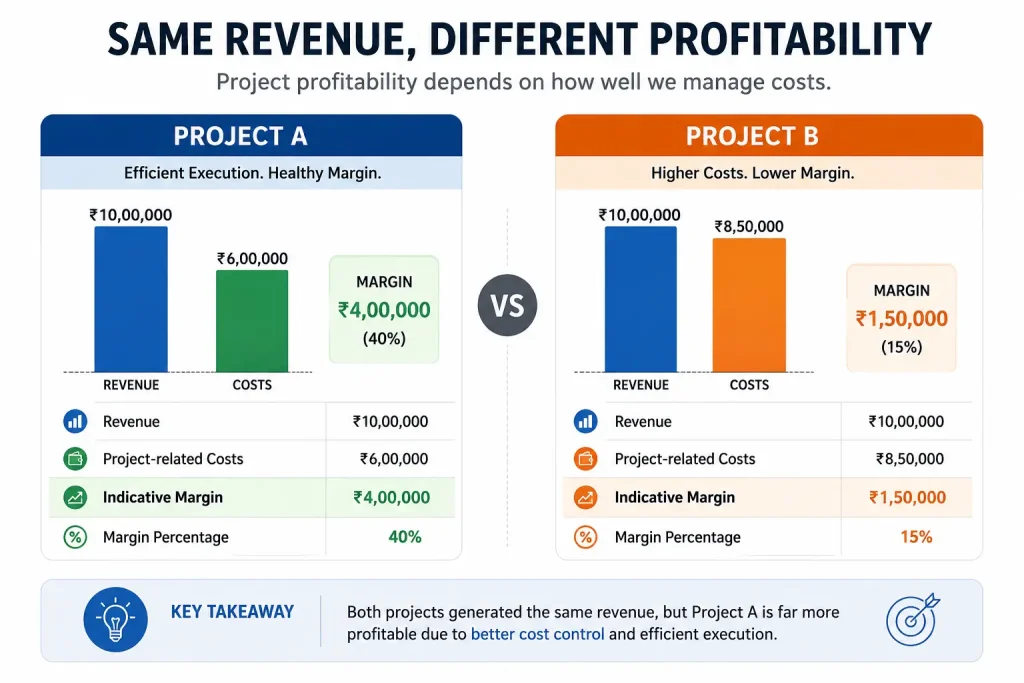
Consider two different service projects with the same revenue:
| Project A | Project B | |
|---|---|---|
| Revenue | ₹10 lakh | ₹10 lakh |
| Project-related costs | ₹6 lakh | ₹8.5 lakh |
| Indicative project margin | ₹4 lakh | ₹1.5 lakh |
Both projects generated the same revenue. Their contribution to the business, however, is very different.
Project B may look successful from a sales perspective, but its margin is significantly lower. If the additional costs are identified only after the project is completed, the business has already lost much of its opportunity to correct the problem.
This is why project profitability needs to be monitored while the work is still in progress, not only after the final invoice is raised.
For a service business, some of the most useful questions are:
How much revenue has been generated by each project?
What costs have been incurred against that project?
Are actual costs tracking the original estimate?
Are project-related expenses being captured under the correct project?
Is the project still commercially viable at its current pace?
A project that looked comfortably profitable when the contract was signed can become much less attractive if the team spends additional hours, external professionals are engaged, or other direct costs rise without a corresponding change in the commercial terms.
Tracking project costs without creating another system
Project profitability becomes meaningful only when the business can see the costs associated with delivering the project.
For an IT implementation or consulting engagement, these may include:
Employee or consultant effort
External professional fees
Travel and site-visit expenses
Project-specific purchases
Outsourced services
Other directly attributable expenses
Some costs are obvious. Others are easier to overlook.
For example, an implementation project may initially be budgeted around the expected effort of the internal team. Halfway through the engagement, the client requests additional customisation. The company assigns another specialist for several weeks.
The additional professional cost may be recorded correctly in the books. But if it is not connected to the relevant project, management may see the expense at company level without immediately seeing its effect on that project's margin.
That is the difference between recording a cost and using the cost for management insight.
Where the accounting setup is designed appropriately, project-related income and expenses can be associated with relevant Cost Centres or jobs and analysed through the available reports.
TallyPrime's Job Costing functionality allows businesses to allocate and track project-related costs and revenues. Its Job Work Analysis report provides a project/job-level view of income, expenses and net profit or loss.
Current project position
Returning to our ₹20 lakh implementation project, suppose that at the current stage:
Project revenue recorded to date: ₹10 lakh
Project-related costs incurred to date: ₹5 lakh
Current project-level profit: ₹5 lakh
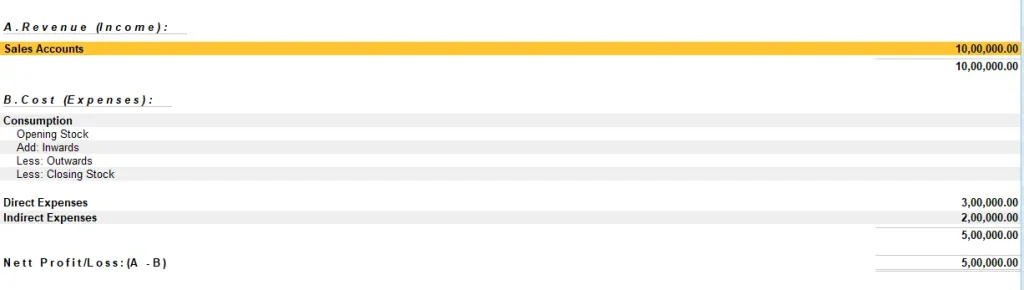
This should not be confused with the original full-project estimate of ₹14 lakh cost and ₹6 lakh expected margin. Those were the expectations for the entire project; the ₹5 lakh cost and ₹5 lakh profit represent the position captured at the current stage.
The value of the report lies in whether it helps management act while the project is still in progress. The objective is to answer a business question early enough to act on it:
Where is the margin being made, and where is it being lost?
The quality of this analysis, however, depends on the quality of the underlying accounting data. Projects need to be identified consistently and relevant transactions need to be allocated appropriately. Software can analyse information that has been captured; it cannot recover project-level visibility from transactions that were never classified correctly.
A simple discipline can therefore make a significant difference:
Identify the project → capture the relevant transaction → allocate it correctly → review the project position regularly.
For a growing service business, this can turn accounting from a historical record into an early-warning system.
Milestone billing: When project progress drives invoicing
For many service businesses, especially IT implementation and consulting firms, the customer does not pay the entire project value at the beginning or at the end. Instead, the contract links billing to agreed milestones.
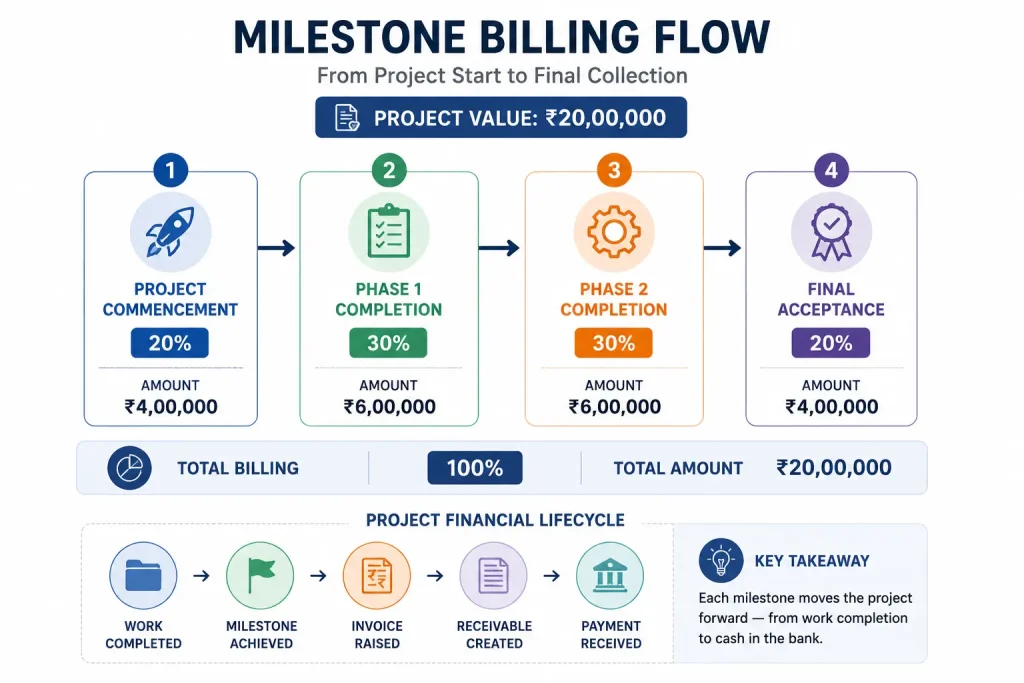
Consider the ₹20 lakh implementation project introduced earlier:
| Project milestone | Billing percentage | Amount |
|---|---|---|
| Project commencement | 20% | ₹4 lakh |
| Phase 1 completion | 30% | ₹6 lakh |
| Phase 2 completion | 30% | ₹6 lakh |
| Final acceptance | 20% | ₹4 lakh |
| Total | 100% | ₹20 lakh |
At first glance, this looks straightforward. But the accounting team has to track more than the invoice amount.
A milestone may be commercially agreed, operationally completed, awaiting customer approval, already billed, or still unpaid. These are different stages of the same project.
That distinction becomes important when management asks:
How much work has been completed, how much has been billed, and how much has actually been collected?
Milestone achieved does not automatically mean cash collected
Suppose Phase 1 is completed and the company raises the ₹6 lakh invoice. The invoice becomes part of receivables, but the customer may have a 30-day or 45-day payment term.
The project has therefore moved through several stages:
Work completed → Milestone achieved → Invoice raised → Receivable created → Payment received
Each stage has a different business implication.
A service business that tracks only invoices may know what it has billed. A business that tracks the entire cycle can also see what remains to be collected and where delays are occurring.
There is another accounting distinction that should not be overlooked.
Billing under a contract and revenue recognition are not necessarily the same event.
Where a performance obligation is satisfied over time, revenue is generally recognised by measuring progress towards its satisfaction, subject to the requirements of Ind AS 115.
Therefore, a milestone schedule should not automatically be treated as a substitute for the business's revenue-recognition assessment.
The practical implication is straightforward:
Keep contractual billing, accounting recognition and cash collection visible as related but distinct parts of the project lifecycle.
Retainer billing: When the service relationship is ongoing
Not every service engagement has a defined project completion date.
Consider a technology consultant who provides ongoing support and advisory services to a client for a monthly retainer of ₹75,000.
There may be no Phase 1, Phase 2 or final acceptance milestone. Instead, the commercial arrangement may provide for recurring services and periodic billing.
The accounting process now needs to answer different questions:
Which customers are currently under a retainer arrangement?
What is the agreed billing frequency?
Has the invoice for the current service period been raised?
Which invoices remain outstanding?
Recurring billing can make the invoicing process more predictable, but it does not eliminate the need for control.
A missed recurring invoice can create an avoidable gap between the service delivered and the amount recorded as receivable. Similarly, an invoice that is raised correctly but not followed up can remain outstanding well beyond its expected collection date.
The underlying principle is the same as milestone-based projects:
The accounting system should help the business see what has been billed, what is due, and what has actually been collected.
Billing, revenue and cash are three different numbers
This is one of the most useful distinctions a service-business owner can make.
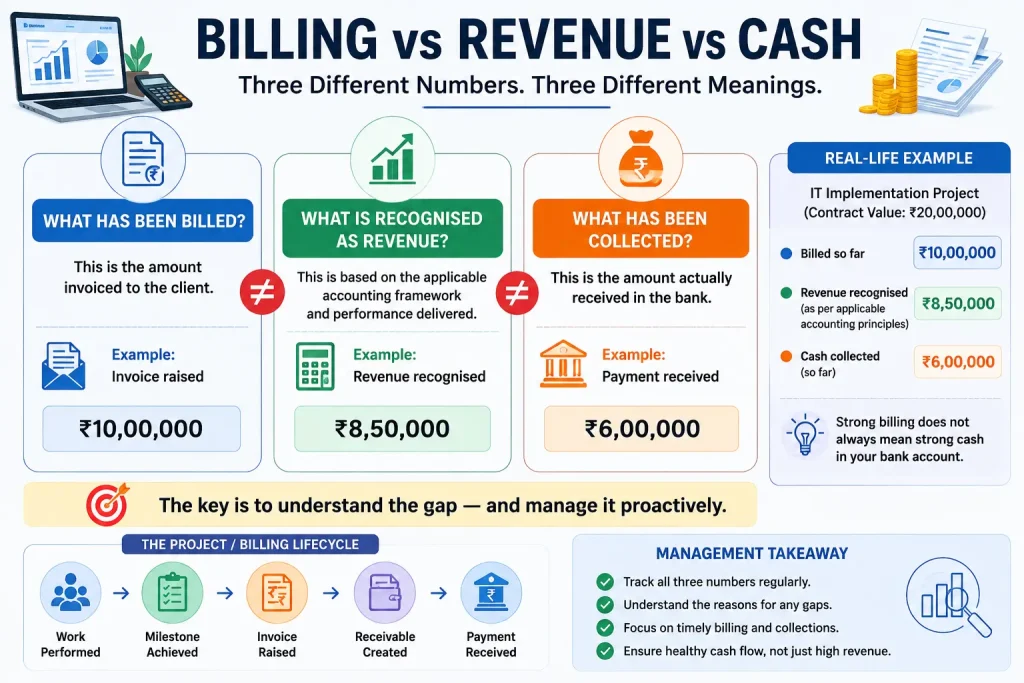
Return to our ₹20 lakh implementation project.
Suppose the business has:
Amount invoiced so far: ₹10 lakh
Amount collected: ₹6 lakh
Amount outstanding: ₹4 lakh
The calculation is straightforward:
₹10 lakh invoiced − ₹6 lakh collected = ₹4 lakh outstanding
A quick look at the invoice register may tell the owner that ₹10 lakh has been billed. The bank balance, however, reflects only ₹6 lakh received. The remaining ₹4 lakh is outstanding from customers.
Now add another complication: the next milestone has been completed operationally, but the client's formal sign-off is still pending. The business may have delivered substantial work while the next billing event remains delayed under the contractual arrangement.
A business can therefore report strong billing and still face a cash-flow problem.
It can also have a profitable project while waiting for customer collections to convert that performance into cash.
For management, the important objective is not to choose one number over the others. It is to connect all three numbers and understand the reason for the gap between them.
TDS on professional fees: Look at both sides of the transaction
Professional fees are common for a service-based business. An IT implementation company may engage an independent consultant for specialised work, while the same company may itself provide consulting services to a corporate customer.
This creates two different TDS situations, and both need to be understood.
When the service business receives professional fees
Suppose ABC Tech Solutions provides professional consulting services to a corporate client for ₹1,00,000.
For transactions to which the Income-tax Act, 2025 applies, the corresponding TDS provisions are contained in Section 393. The applicable provision, threshold and rate depend on the nature of the payment and the parties involved. The Income Tax Department confirms that the transition to the new Act is determined by the earlier of credit or payment.
For illustration, assuming the payment is subject to TDS at 10% under the applicable provision:
Professional fee / invoice value: ₹1,00,000
Illustrative TDS deduction: ₹10,000
Net amount received: ₹90,000
The service provider therefore needs to reconcile the full professional fee, the TDS deduction and the net amount received.
When the service business pays another professional
Now consider the other direction.
ABC Tech Solutions engages an independent specialist for a project and becomes liable to pay professional fees of ₹80,000.
Where the applicable TDS provisions apply, the company may need to deduct TDS before making the payment to the professional. The accounting process therefore needs to connect:
Professional fee payable → Applicable TDS deduction → Net payment → TDS liability
The exact applicability, threshold, rate and timing depend on the nature of the payment, the parties involved and the applicable provisions. Businesses should therefore avoid treating a single percentage as a universal rule for every professional payment.
A 2026 transition point
The transition to the Income-tax Act, 2025 is particularly relevant for businesses maintaining accounting and tax systems.
For TDS, the governing law depends on the earlier of the event of credit or payment. Where that earlier event occurs on or before 31 March 2026, the Income-tax Act, 1961 applies. Where it occurs on or after 1 April 2026, the corresponding provisions of the Income-tax Act, 2025 apply. The Income Tax Department specifically confirms this transition rule.
For a service business, the practical objective is straightforward:
Record the full commercial transaction, account for the TDS correctly, reconcile the deduction, and ensure the tax credit or liability does not disappear between the books and the compliance process.
When client sign-off becomes a receivables problem
A service business can complete substantial work and still find itself waiting for the customer to formally approve it.
This is particularly common in project-based engagements. Consider the implementation project again.
The team completes Phase 2. The agreed milestone is worth ₹6 lakh. The project manager considers the work complete, but the client's internal team has not yet completed its review.
The result?
Work completed → Client review pending → Sign-off pending → Billing delayed
If the contract makes customer acceptance a condition for raising the relevant invoice, the accounting team may have no invoice to record yet.
Even when an invoice has already been raised, customer approval and internal processing can affect how quickly the receivable is collected.
This is where project accounting and receivables management meet. The finance team needs more than an outstanding balance. An outstanding report may show that ₹4 lakh remains outstanding. But management also needs to understand why it is outstanding and whether any part of it has become overdue.
There is a meaningful difference between:
An invoice that is due next week
An invoice that is already overdue
Work completed but waiting for customer sign-off
A milestone that has not yet been achieved
A disputed invoice
An invoice held up because the customer requires additional documentation
Each situation needs a different action.
TallyPrime's Bills Receivable and Ledger Outstanding reports can show pending amounts, due dates and overdue information. Its age-wise analysis can classify pending receivables based on Bill Date or Due Date.
Receivables ageing in the current example
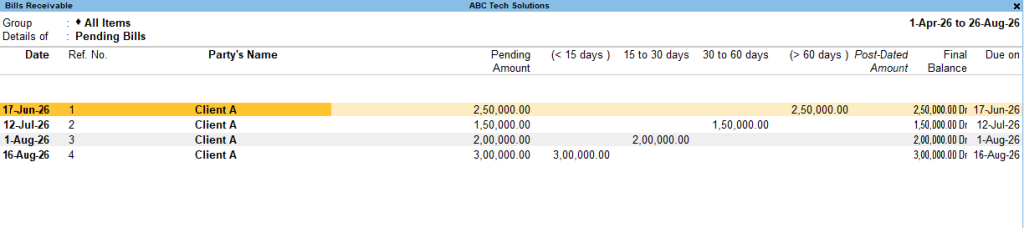
Suppose the ₹4 lakh outstanding from our project is distributed as follows:
| Receivables age | Outstanding |
|---|---|
| Less than 15 days | ₹1,00,000 |
| 15–30 days | ₹1,00,000 |
| 30–60 days | ₹50,000 |
| More than 60 days | ₹1,50,000 |
| Total | ₹4,00,000 |
The total outstanding is ₹4 lakh. But the ageing tells management something more important: ₹1.5 lakh has already moved beyond 60 days. That amount may deserve more immediate attention than an invoice that is only a few days old. This is why an outstanding balance alone is not enough.
Make the sign-off process part of the project plan
For milestone-based service contracts, the project team and finance team should know:
What exactly constitutes completion of the milestone?
Who on the customer's side provides approval?
What documentation is required?
When should the invoice be raised?
What are the agreed payment terms?
Who follows up if approval is delayed?
These questions may sound operational rather than accounting-related, but they have a direct financial impact. A delay of two weeks in customer sign-off can become a delay in billing. A delay in billing can become a delay in collection. These small delays can create significant working-capital pressure.
Receivables discipline starts before the invoice
Collection management does not begin when an invoice becomes overdue. It begins much earlier, with a clearly defined billing trigger, documented project completion, timely customer sign-off and accurate invoicing.
Once an invoice is raised, the finance team can monitor the receivable by customer, due date and ageing, and coordinate with the business team for follow-up. A better goal is to prevent avoidable delays from entering the receivables cycle in the first place.
The four management views a service business owner should review regularly
Accounting reports become more useful when they are connected to decisions.
A service-business owner does not necessarily need to review every report every day. But a regular management review of a few key areas can reveal whether projects are performing as expected, whether customer money is getting stuck, and whether reported profitability is translating into cash.
1. Project profitability: Which projects are actually making money?
The first question is: Are our projects delivering the margins we expected?
TallyPrime's Job Costing and Job Work Analysis capabilities can be used to analyse project-level income, expenses and net profit or loss, where the relevant Job Costing setup is used.
For our current project position, the report shows:
Revenue: ₹10 lakh
Project-related costs: ₹5 lakh
Current project profit: ₹5 lakh
The report should lead to questions such as:
Which projects are above their expected margin?
Which projects are losing margin?
Are additional costs temporary or becoming a pattern?
The value is not simply the profit figure. It is the opportunity to act while the project is still in progress.
2. Receivables: How much money is still with customers?
The second question is: How much of our billed revenue is still waiting to be collected?
In our example: ₹10 lakh invoiced − ₹6 lakh collected = ₹4 lakh outstanding.
The ageing view shows:
₹1 lakh, less than 15 days
₹1 lakh, 15–30 days
₹0.5 lakh, 30–60 days
₹1.5 lakh, more than 60 days
The ₹1.5 lakh that has crossed 60 days may require more immediate follow-up than newer invoices. TallyPrime supports age-wise analysis of outstanding receivables using Bill Date or Due Date as the ageing method. A regular review should therefore ask:
Who owes us money? How old is it? Why is it pending? And who is responsible for the next action?
3. Cash flow: Is profit turning into cash?
The third question is different:
Even if the business is profitable, do we have enough cash moving through the business?
This is where Cash Flow reporting becomes useful. The relationship with receivables is particularly important:
Projects are profitable → invoices are raised → customers delay payment
The Profit & Loss statement may continue to look healthy, but the bank balance may tell a different story. A cash-flow review can therefore help management consider whether expected customer collections are sufficient to support employee payments, professional fees, taxes and other upcoming commitments.
Our objective is not to treat cash flow as a replacement for profitability analysis. It is to understand the relationship between profitability, receivables and available cash.
4. Profit & Loss: What does it mean for the business as a whole?
The final view brings the discussion back from individual projects to the business:
Project-level analysis tells management where performance is coming from. The Profit & Loss statement provides the broader picture of income and expenses for the business. The two views should complement each other. Project reports tell you where the performance is coming from. The Profit & Loss statement tells you what that performance means for the business as a whole.
One project, from contract to collection
Consider the ₹20 lakh IT implementation project we have followed through this article.
At the beginning:
Contract value: ₹20 lakh
Expected full project cost: ₹14 lakh
Expected margin: ₹6 lakh
As the project progresses, the accounting process needs to capture more than invoices.
Project begins: The project is identified and relevant costs are associated with it.
Management question: What resources and costs are we committing to this project?
Work progresses: Employee effort, professional fees, travel and other project-related costs begin accumulating.
Management question: Are actual costs still tracking the original estimate?
First milestone is completed: The agreed billing milestone is reached and the relevant invoice is raised according to the contractual terms.
Management question: What has been billed, what is receivable and what has been collected?
Additional work is requested: The customer requests changes that require additional effort.
Management question: Does the additional scope have a corresponding commercial agreement? If not, an apparently profitable project can gradually lose its margin.
Final approval is delayed: The project team considers the work complete, but customer sign-off is pending.
Management question: What does the delay mean for billing, receivables and cash flow?
Management review: Project profitability → Receivables → Cash Flow → Overall P&L
The four views tell different parts of the same story. That is the real purpose of accounting information in a service business. It should not merely explain what happened last month. It should help management recognise what is changing now and decide what to do next.
Where accounting software makes the difference
The value of accounting software for a service business is not simply the ability to record invoices, expenses or receipts faster. Its greater value comes from connecting those transactions into information that management can use.
A properly structured accounting system can help the business move from:
Transactions → Project visibility → Billing visibility → Receivables visibility → Cash-flow visibility → Better decisions
But the quality of that information still depends on the quality of the underlying accounting process.
Projects need to be identified consistently. Costs and income need to be allocated appropriately. Customer accounts need to be maintained accurately. Due dates need to be captured. TDS and other statutory deductions need to be accounted for correctly.
Software can make the information easier to organise, analyse and review. It helps to make the right numbers available early enough for someone to do something useful with them.
Conclusion: From recording transactions to running the business
A service business can grow rapidly without always having clear visibility into where its profits are coming from or why cash is taking longer to arrive.
Project profitability, milestone billing and receivables are therefore not isolated accounting topics. They are connected parts of the same business cycle.
A project begins with an expected commercial outcome. Costs accumulate as the work is delivered. Billing follows agreed terms or milestones. Revenue is accounted for under the applicable accounting framework. TDS and other deductions may affect the settlement process. Customer approvals can influence billing and collections. Finally, the money reaches or remains outside the business.
For service businesses, good accounting is therefore about more than keeping the books accurate. It is about knowing which projects are creating value, knowing what has been billed and collected, and knowing where the next cash-flow or profitability problem may come from before it becomes one.