
Introduction: The e-commerce accounting paradox
In my 20 years as a financial controller, the question I hear most from D2C founders is: "I sold 10 lakhs this month, so why did only 7 lakhs hit my bank?"
The answer is simple: Your payout doesn't match your sales because e-commerce platforms are not just payment gateways; they are complex clearinghouses. They accumulate customer payments, apply contractually defined service fees, withhold mandatory taxes, and maintain risk-mitigating rolling reserves before disbursing a net residual. In traditional retail, a sale is a clean ledger entry. In e-commerce, a single bank deposit is a "composite batch", a financial soup of current revenues, historical refunds from weeks ago, and source-deducted marketing costs. If you are recording revenue based purely on cash receipts, you are making a fundamental accounting error that masks your true unit economics.
What is the "Anatomy of a Settlement" and why should you care?
To understand your true profitability, you must deconstruct the journey of a single rupee from the customer's "Buy" click to your bank account. I always instruct my teams to look past the nominal commission and calculate the Effective Take Rate.
The Formula for Financial Truth: Effective Take Rate = (Nominal Commissions + Processing Fees + Gateway Charges + FX Markups + Unrecovered Refund Fees) / Gross Transaction Value
|
Component |
Financial Nature |
The Bottom Line Impact |
|
Gross Order Value |
Transaction Revenue |
Initial recognition of the customer contract price. |
|
Platform Commissions |
Facilitation Expense |
The "Nominal" fee for platform access (Referral fees). |
|
Fulfillment Fees |
Logistics Expense |
Charges for shipping, pick-pack, and weight-handling. |
|
Advertising Spend |
Marketing Cost |
PPC and sponsored product fees deducted at source. |
|
Rolling Reserves |
Risk Holdback |
Balance Sheet Asset; funds held as a buffer against returns. |
|
Net Bank Credit |
Cash Payout |
The residual liquidity that finally hits your account. |
Why are reported sales, GST liability, and bank credits three different numbers?
Sellers often get trapped in a compliance "Triad" where three distinct reports show three different totals. As a senior controller, I ground this in the law:
- Reported Sales (OMS Data): The commercial top-line. This is what the customer paid, including shipping and taxes.
- GST Output Liability: This is the tax due under Section 9 of the CGST Act. You must discharge this in full based on successful transactions (gross sales minus valid returns) regardless of when the platform pays you.
- Bank Deposits: This is merely your residual liquidity. It is the amount left after "effective take rate" deductions and statutory withholdings.
Are You Recording Returns and Replacements Correctly?
Treating all returns as one bucket leads to "False Profitability." You must distinguish between the two for proper tax and inventory treatment:
- Return to Origin (RTO): The package is undeliverable. The customer never took possession, so the transaction is incomplete.
- Accounting Treatment: No revenue recognized. Record the wasted round-trip freight as an immediate expense.
- Customer-Initiated Return (CIR): A legal sale occurred and was then reversed.
- Accounting Treatment: Requires a Section 34 GST Credit Note.
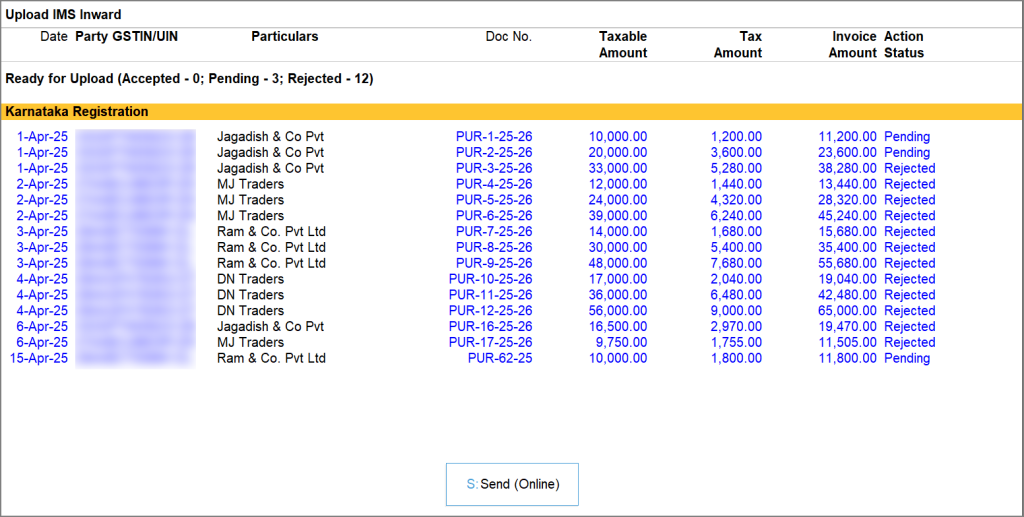
- The 2026 Framework: Under the Invoice Management System (IMS), the buyer must "Accept" the credit note for your output tax reduction to be finalized. Failure to ensure buyer ITC reversal can trigger 18% annual interest under Section 50.
Senior Controller’s Pro-Tip: Refurbishment Costs Don't just put items back in stock. Factor in real-world refurbishment: expect ₹25–₹65 per unit for apparel and ₹40–₹120 for electronics. If you miss these, your COGS is understated.
The dual-withholding trap: How to handle TCS and TDS (194-O)
Indian law mandates that platforms deduct two types of taxes. If you don't reconcile these, you're essentially giving the government a free, permanent loan of your working capital.
|
Feature |
GST TCS (Section 52) |
Income Tax TDS (Section 194-O) |
|
Standard Rate |
1% (0.5% CGST + 0.5% SGST) |
0.1% (Gross sales value) |
|
Calculation Base |
Net taxable supply value |
Gross transaction value |
|
Filing Frequency |
Monthly (by the 10th) |
Quarterly |
|
Annual Threshold |
None; applies to all |
₹5,00,000 (Resident Ind/HUF only) |
|
Portal Destination |
Electronic Cash Ledger (ECL) |
Form 26AS / AIS |
Insight from the Field: I’ve seen up to 15% of working capital get trapped simply because a seller didn't "Accept" the TCS credit on the GST portal. You must manually move these from the "TDS and TCS credit received" tab to your active Electronic Cash Ledger to offset your monthly tax.
How can TallyPrime handle multi-platform entries smoothly?
Manual data entry for 5,000 orders is an invitation for disaster. TallyPrime’s Amazon Data Import Plug-In is designed to handle this volume.
- Activating the Plugin: Enable via the Tally Solutions portal. Once active, the system generates three specific templates in your Tally path (appresources > plugins > AmazonDataImport): Sample Ledgers.xls, StockItem.xls, and Read Me.pdf.
- Mapping Stock Items: Map Amazon SKUs using SKU Aliases in the Tally Stock Item master.
- Importing MTR: Import your Merchant Tax Reports as Sales/Credit Note vouchers using the provided templates.
- Reconciling Settlements: Use a Journal Voucher (F7) in Stat Adjustment mode.
- Pro-Level Tip: When importing the settlement report, you must exclude the "Transfer" line item. This row represents the cash already processed by the bank; including it will cause duplicate bank entries.
A monthly reconciliation routine you can actually follow
To scale a brand, your finance team must move from data entry to exception-based auditing. Follow this checklist:
- Weekly Logistics Audit: Match 3PL billing (Delhivery/Shiprocket) against your catalog's weight/dimensions.
- GSTR-2B Matching: Claim the 18% ITC on marketplace service invoices (commissions/fees).
- TCS Credit Acceptance: Log into the GST portal monthly to move credits to your ECL.
- Inventory Write-offs: For damaged stock, you must reverse ITC under Rule 42.
Conclusion: Turning returns into a competitive advantage
Stop recording revenue based on bank receipts. A healthy bank balance can hide a dying business if your effective take rate is eroding your margins.
Closing thoughts for scaling:
- Adopt Accrual Accounting: Recognize revenue at the point of shipment.
- Automate the Flow: Use native ERP plugins to eliminate manual "composite batch" errors.
- Audit the Exceptions: Focus your energy on shipping weight discrepancies and unclaimed tax credits.
"Accurate data is the only true measure of e-commerce profitability. If you can't reconcile a single order down to the paisa, you can't scale it."
FAQs
1. Section 9(5) and Double Taxation?
Under 9(5), the platform is the deemed supplier for tax purposes. If the seller also pays tax on that same revenue, they are paying twice. Always report as exempt.
2. Difference between GST Credit Notes and Commercial Credit Notes?
GST Credit Notes (Section 34) reduce your tax liability and appear in GSTR-1. Commercial notes are internal accounting entries that do not affect tax filings.
3. Statutory deadlines for Credit Notes?
November 30th of the following financial year, or the filing of the Annual Return (GSTR-9), whichever is earlier.
4. How to utilize TCS credit?
You must "Accept" it on the GST portal or Use TallyPrime IMS System to move it to your Electronic Cash Ledger (ECL), where it offsets your monthly GSTR-3B payment.
5. E-invoicing applicability?
If your annual turnover exceeds ₹5 crore, you must generate an IRN and QR code for all B2B transactions and all Credit Notes.
6. Impact of Section 9(5)?
For restaurant/passenger services, the platform pays the GST. Sellers must report these as "Exempt Outward Supplies" to avoid double taxation.