Pricing
About Us Careers Tally Together Media & News
Select Country

GST software for construction services

TallyPrime – The Best GST Software for Construction Services

Works contract billing, project costs and site materials, in one set of books.

Bill each contract with the right GST, and allocate every purchase, payment and material issue to the project it belongs to. TallyPrime brings the return, the outstanding and the project's profit into one place.

What a construction business faces everyday

Eight things every contractor, sub-contractor and builder deals with, and where TallyPrime fits.

  What you do How TallyPrime is designed to manage it
Billing
You bill the client as work is completed, under a works contract
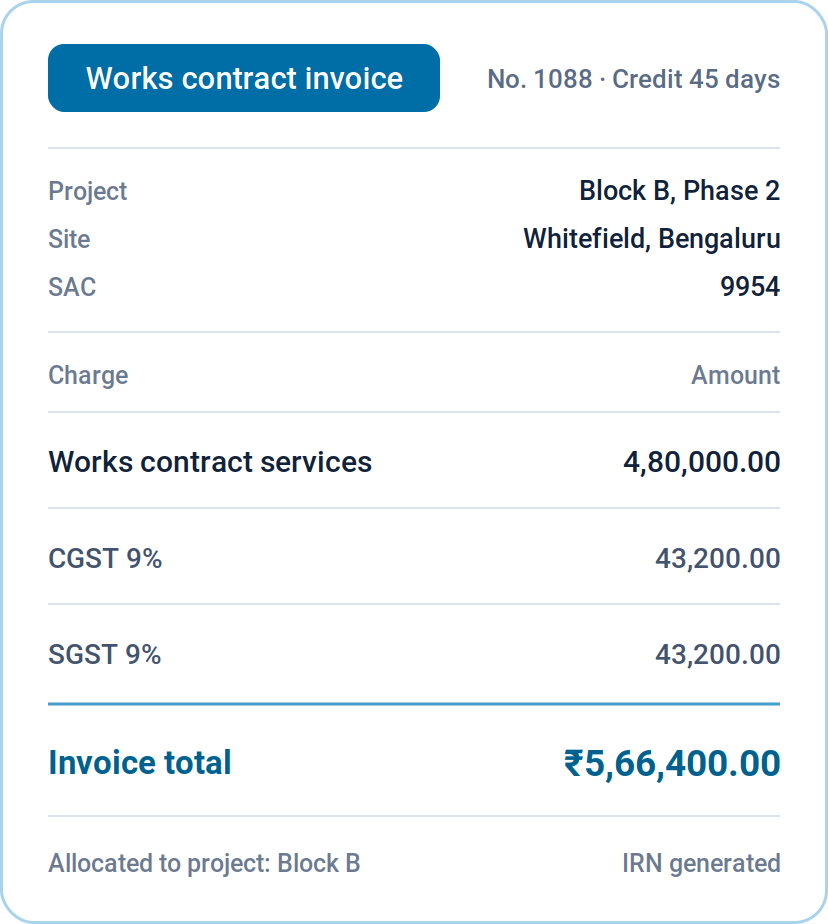
GST invoices from a works contract service ledger
Advances
Clients pay mobilisation advances before work starts
Advance receipts with GST, adjusted at the bill
Input credit
Some GST on purchases can be claimed, and some cannot
Ineligible credit marked at the ledger or item
Project costs
Materials, labour and hire charges are spread across several projects
Each project tracked as a cost centre
Materials at site
Cement, steel and fittings sit at different sites and stores
Stock tracked site by site
Sub-contractors
Part of the work goes to sub-contractors, who bill you
Payables tracked, with TDS deducted
Collections
Clients pay late, and government clients pay net of deductions
Bill-by-bill outstandings
The books
The books have to be clean for your CA and your auditor
Books, registers and returns from the same entries

Your construction business and TallyPrime

The six that decide whether the software helps or gets in the way

A construction business runs on contracts, not counters. Billing follows the work, cash arrives before and after it, credit rules are stricter than in most trades, and profit has to be judged project by project.

Works contract billing

One contract, one service, one rate

Under GST, a works contract for immovable property is a supply of services, so the whole contract is billed as one service at one rate. The law expects separate accounts for each contract.

In TallyPrime, you bill the contract from a service ledger set up with its GST rate and SAC. Once saved, the invoice appears in GSTR-1 and GSTR-3B, ready for filing.

How your business benefits

Every contract is billed and reported the same way, however many run.

Advances

Tax on the advance, adjusted at the bill

For services, GST is payable when payment is received, if that comes before the invoice. A mobilisation advance therefore carries GST in the period you receive it.

In TallyPrime, you record it as an advance receipt, reported in GSTR-1 Table 11. When the bill is raised later, the tax already paid on the advance is reversed against it.

How your business benefits

Tax on advances is paid once, in the right period, never twice.

Input tax credit

Know which credit you can claim before you claim it

GST blocks credit on works contracts received for building immovable property, other than plant and machinery, and on inputs used to build on your own account. Wrongly claimed credit must be reversed.

In TallyPrime, you mark a ledger or stock item as ineligible for input credit. Purchases recorded against it are reported as ineligible credit in GSTR-3B, not claimed.

How your business benefits

Blocked credit stays out of your claim once the purchase is recorded.

Project costing

Know which project makes money

Several projects share one set of suppliers, one labour pool and one bank account. Without project-level costing, a profitable project can hide a loss-making one.

TallyPrime’s job costing treats each project as a cost centre. Purchases, expenses, material consumption and revenue are allocated as you record them, and large projects split into sub-jobs.

How your business benefits

You see each project’s margin while it is still running.

Sub-contractors

Pay them correctly, claim what you are owed

A sub-contractor’s works contract bill carries credit you can claim when it feeds your own works contract. Their payments attract TDS above ₹30,000 a payment or ₹1 lakh a year.

TDS is 1% for individuals and HUFs and 2% for others, under section 393 of the Income-tax Act, 2025. TallyPrime records it on the payment, and new sections can be added yourself.

How your business benefits

Sub-contractor bills, payments and TDS stay together in the same books.

Collections

What each client owes, and what they kept back

Construction bills are paid late, and government clients pay net of deductions: 2% GST TDS when a contract’s taxable value exceeds ₹2.5 lakh. You get a certificate in GSTR-7A.

TallyPrime tracks what each client owes, bill by bill. Ageing analysis shows how long each bill has been pending, so follow-ups go to the right client first.

How your business benefits

You can see who has paid, short-paid, or not paid at all.

The one real difference between construction businesses

What stock does a construction business carry?

A contractor's stock is the material waiting to become a structure: cement, steel, aggregate, pipes, cables and fittings, spread across sites and stores. Some of it may belong to the client. How that stock is identified differs from one business to the next. Which pattern you use is a setup decision, not a different product, and TallyPrime lets you track it the way that works for you.

How your stock is identified Typical trades How it is handled
Location Contractors running several sites, with a central store Each site as a godown, with transfers between store and site and a location summary report
Project Civil and EPC contractors costing each project separately Material consumed at a site tracked against the project it is allocated to
Unit conversions Contractors buying cement by the tonne and issuing it by the bag, or buying aggregate by the load Compound units where the conversion is fixed. Alternate units where it varies from one transaction to the next
Groups and categories MEP, interiors and finishing contractors with a wide range of materials Stock groups by material type, with stock categories that classify items across groups
Third-party stock Contractors working with material supplied by the client Separate godowns for client-owned material, kept out of your own books of accounts

Connected and AI-led

Connected and AI capabilities in TallyPrime

The manual work has been taken out, one job at a time

Data entry and reconciliation that used to be done by hand now happen inside TallyPrime — fast, accurate, and in seconds.

CapabilityWhat it replacesThe new experience in TallyPrime
Connected GSTPortal visits and manual uploadsUploading invoices, reconciling, and filing returns directly from inside TallyPrime
Connected bankingStatement downloads, line-by-line matching, and separate paymentsDownload and auto-reconcile against the bank feed, and pay directly from TallyPrime
Docs by IraTyping purchase invoices in by handScan or upload the document and AI creates the entry for your review, automatically
Bharat ConnectChasing invoices and payments over phone and emailYour vendor sends the invoice straight into TallyPrime, and you approve it to record the entry
e-Invoice and e-way billA second portal and a second loginGenerated instantly from the invoice you have already raised
TallyPrime with WhatsAppPrinting, scanning, and postingShare invoices, orders, and reminders straight from the transaction

Control and access

What it is like to run a construction business on TallyPrime

Your books stay in your hands, between the site and the office: on your own computer, backed up where you choose, and open on your phone when you need them.

  • Your data stays with you

    It sits on your computer, or on TallyPrime Cloud Access if you choose.

  • Back up where you choose

    Use a local drive, or TallyDrive cloud storage with an active TSS, and restore whenever you need to.

  • Hand your books over in one file

    Your CA or auditor gets a backup, not a stack of printouts.

  • Check the numbers from site

    Reports open in a browser on your phone or tablet.

  • Work from anywhere with Cloud Access

    With a Cloud Access subscription, run TallyPrime through a browser, with no installation.

  • See who accessed what

    Remote and browser access is recorded in an event log.

Individually these are conveniences. Together they mean your books stay yours, from site to office.

Proof

Real businesses, real outcomes

Outcomes reported by businesses running TallyPrime.

30% Lower operational costs
50% Less time to process an invoice
Instant New ledger creation
50% Less GST filing time

Fair Power Age Ltd Cut Invoice Processing Time by 50%

Read about how a distributor who deals with over 1000 invoices a month fast-tracked invoice processing time

GSTP Task & Associates Unlocks Client Inventory Insights in Minutes

From 3 days of pouring through books to 3 minutes of clicks on the computer for downloading client data

Running 20Cr+ operation in TallyPrime

10,000+ inventory items managed seamlessly with 600–700 purchase invoices reconciled in minutes

FAQs

What is the GST rate on works contract services?
Works contract services for construction are generally taxed at 18%. From 22 September 2025, three categories that were taxed at 12% also moved to 18% with ITC: works contracts that are predominantly earthwork (more than 75% of the contract value) for the government; sub-contracts to the main contractor on such government works; offshore works contracts for oil and gas exploration and production. Some specific entries carry their own rates, so check the entry that applies to your contract.
Is a works contract a supply of goods or services under GST?
Services. Under GST, a works contract covers only immovable property, and the whole contract is treated as a supply of services, even though materials are transferred as part of the work.
Can I claim input tax credit on construction purchases?
Not always. Credit is blocked on works contract services received for constructing immovable property, other than plant and machinery. It is also blocked on goods and services used to construct immovable property on your own account. The exception is a sub-contractor's works contract service that you use for your own outward works contract. In TallyPrime, you mark blocked purchases as ineligible, and they are reported in GSTR-3B accordingly.
Do I pay GST on a mobilisation advance?
Yes. For services, GST is due on the earlier of the invoice date and the date you receive payment, so an advance received before the invoice is taxed when it is received. TallyPrime records it as an advance receipt, reports it in GSTR-1 Table 11, and reverses the tax when the bill is raised.
Why does a government client deduct 2% from my payment?
That is GST TDS. Government departments and notified bodies deduct 2% when the taxable value of a contract exceeds ₹2.5 lakh, excluding GST. They file GSTR-7, and you receive a certificate in GSTR-7A.
Can I track profit for each project or site?
Yes. With job costing, each project is a cost centre, and purchases, expenses, material consumption and revenue are allocated to it as you record them. Large projects can be split into sub-jobs under the main project.
Do I need to deduct TDS when I pay sub-contractors?
Generally yes. TDS on contractor payments is 1% for individuals and HUFs and 2% for others. From 1 April 2026, it falls under section 393 of the Income-tax Act, 2025. TallyPrime supports TDS natures of payment under the new Act.

Get started

Get Started with ₹ 750

Buy Now

TallyPrime Silver

₹ 750

+ 18% GST (₹135)

  • Single user edition
  • For Standalone PC
  • Free access to all TSS Features