










Warehouses in India are typically classified into central, bonded, automated and eCommerce types, each designed to serve different storage, compliance and distribution needs. Under the Warehousing (Development and Regulation) Act, 2007, a warehouse is a premises authorised to store goods under custody, which directly impacts costs, regulatory requirements and supply chain efficiency.
4 main warehouse classification and their role in the supply chain
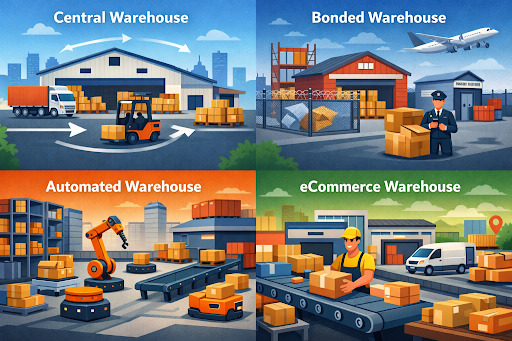
(AI generated image based on the content in this section)
A supply chain is the end-to-end network of activities, people and facilities that moves a product from its point of origin, such as a raw material supplier, manufacturer or importer, to the end consumer. Warehouses sit at critical points in this process, each serving a distinct function.
In practice, warehouses are defined not just by storage, but by the specific role they play in moving goods from origin to consumption. The four main categories of warehouses are as follows:
-
Central warehouse
A central warehouse functions as the primary consolidation point in the supply chain, where goods from different suppliers are received, stored and redistributed to multiple destinations. It helps businesses maintain control over inventory and demand planning by reducing fragmentation across locations.
In supply chain terms, it acts as a balancing hub between production and distribution, ensuring that stock is available when needed without overloading regional networks. This model is particularly useful for manufacturers and large retailers managing bulk inventory across multiple markets.
-
Bonded warehouse
A bonded warehouse is a customs-approved storage facility where imported goods can be stored without immediate payment of customs duty, with taxes payable only when the goods are cleared for home consumption or export. In practice, this is often referred to as a custom bonded warehouse, where goods remain under customs control until clearance.
Under Indian law, it is defined in Section 2(43) of the Customs Act, 1962 as a warehouse licensed under customs provisions and is governed by Chapter IX of the Act, which deals with the warehousing of imported goods. These warehouses must be licensed under Section 57 (public warehouses) or Section 58 (private warehouses).
-
Automated warehouse
An automated warehouse is designed to improve speed, accuracy and scalability within the supply chain. Instead of relying heavily on manual labour, it uses systems such as robotics, automated storage and retrieval, and warehouse management software to handle operations.
In high-volume supply chains, especially those driven by retail and manufacturing, automation reduces errors and ensures consistent throughput. It transforms the warehouse from a passive storage unit into an active processing centre that continuously moves inventory with minimal delays.
-
eCommerce warehouse
An eCommerce warehouse is built around the needs of digital retail, where order volumes are high and delivery expectations are tight. Unlike traditional storage-focused facilities, it prioritises fast picking, packing and shipping.
Within the supply chain, it operates closer to the customer end, often integrated with last-mile delivery networks. It ensures that products move quickly from storage to dispatch, which is critical in a market where delivery speed directly impacts customer satisfaction.
Essential factors to consider when choosing a warehouse type
Choosing the right warehouse type depends on several operational and business-specific factors, as it directly affects costs, compliance and delivery efficiency. These include:
- Nature and volume of goods: The type of products being stored plays a major role in warehouse selection. Imported goods are better suited to bonded warehouses due to deferred duty payments. At the same time, high-stock-keeping-unit (SKU) products are better suited to eCommerce warehouses designed for quick picking and dispatch. Bulk inventory with stable demand is typically managed through central warehouses for efficient consolidation and distribution.
- Order fulfilment speed: If a business promises fast delivery, such as same-day or next-day shipping, it requires warehouses closer to customers with strong last-mile integration. eCommerce and automated warehouses support high-speed fulfilment, while central warehouses are better suited for flexible delivery timelines.
- Budget and cash flow: Warehouse choice is also influenced by investment capacity. Automated warehouses require high upfront investment in robotics and systems, though operational costs may reduce over time. Bonded warehouses ease immediate financial pressure by deferring duty payments until goods are cleared for sale. Central warehouses entail moderate costs for land, staff and distribution.
- Regulatory and compliance requirements: Some warehouse types carry legal obligations that businesses must be prepared to meet. Those involved in imports or exports need to comply with customs regulations, as non-compliance can lead to delays, penalties or the loss of operating licences. Bonded warehouses, in particular, operate under customs supervision and are subject to specific licensing requirements under Indian law.
- Technology readiness: Some warehouse models depend heavily on technology. Automated warehouses require warehouse management systems and robotics for smooth operations, while eCommerce warehouses rely on real-time inventory tracking integrated with sales platforms. Businesses with limited technology infrastructure often start with simpler warehouse setups before scaling.
- Growth capacity: The warehouse model chosen should support business growth, as a facility that cannot keep pace will require a costly transition later. Automated and eCommerce warehouses can absorb increasing order volumes without proportional increases in headcount, while bonded warehouses are constrained by regulatory limits that can slow expansion.
- Location and logistics connectivity: The location of a warehouse relative to ports, highways, railways and customer clusters directly affects distribution costs and delivery timelines. Bonded warehouses are typically located near ports and airports, while eCommerce warehouses need to be closer to urban centres where last-mile delivery is faster and more cost-effective.
Wrapping up
Choosing the right warehouse type matters, but the real impact comes from how effectively inventory is managed within it. Even a well-placed central or automated warehouse can fall short if stock visibility, reconciliation and compliance are not handled properly.
Warehouse selection and inventory control must work together to deliver cost efficiency, accuracy and reliable fulfilment. As operations scale, businesses need systems that bring consistency across locations and reduce the risk of errors or compliance gaps.
TallyPrime supports this by helping businesses maintain accurate inventory records, streamline reporting and stay compliant with GST, making it easier to manage warehousing operations with control and confidence as the business grows.














