






Regulatory compliance refers to the legal obligation of businesses to comply with all applicable laws, rules and regulations governing their operations in India, including the Companies Act, 2013, the Income Tax Act, 1961, the GST Act, 2017, the Labour Codes, and relevant sector-specific laws. It directly determines whether a business can operate lawfully, avoid penalties and maintain its right to continue and expand operations in India’s regulated business environment.
What are the key areas of compliance regulations in India
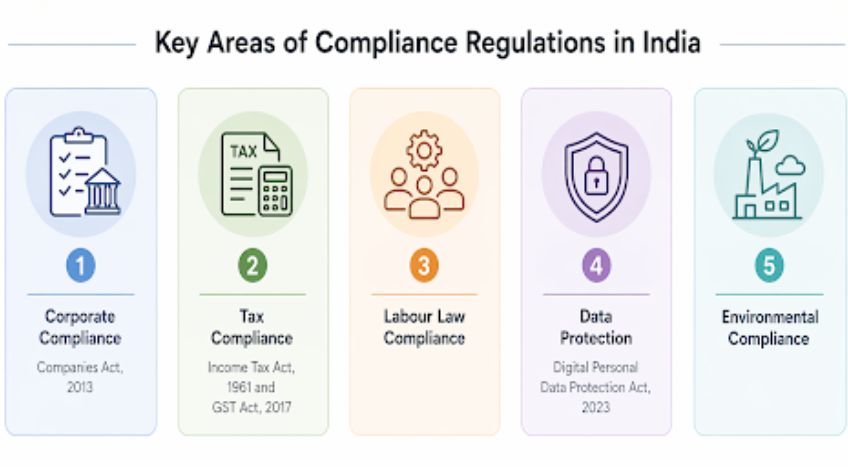
(Created this image using AI based on the content of this section)
Regulatory compliance in India is not limited to a single law or function. It cuts across different parts of a business, each with its own obligations and penalties for default. Here are the major compliance requirements businesses need to stay on top of:
Corporate compliance
Corporate compliance refers to the legal obligations companies must meet under the Companies Act, 2013. Every company in India must hold at least 4 Board meetings each year, with a gap of no more than 120 days between meetings, under Section 173(1). Annual returns (Form MGT-7) must be filed within 60 days of the annual general meeting under Section 92, while financial statements must be filed with the Registrar of Companies under Section 137.
As companies grow, governance requirements increase. Section 203 requires the appointment of a whole-time company secretary beyond the prescribed thresholds, and Section 177 mandates the appointment of an audit committee. Companies meeting CSR thresholds under Section 135 must spend 2% of average net profits on CSR activities and disclose the same in the Board’s report. Listed companies must also comply with SEBI (LODR) Regulations, 2015.
Note: Certain exemptions apply to One Person Companies (OPCs), small companies and dormant companies.
Tax compliance
Tax compliance refers to obligations under direct and indirect tax laws, including the timely deduction, payment and filing of returns. Under the Income Tax Act, 1961, businesses must deduct TDS on specified payments and deposit it by the 7th of the following month. Advance tax is payable in four instalments under Section 208, and income tax returns must be filed under Section 139 within the prescribed due dates.
Non-compliance leads to interest penalties and may result in prosecution under Section 276B, including imprisonment of up to seven years for continued defaults.
Under GST, registered businesses must file returns and pay tax within prescribed timelines. GSTR-3B is generally filed monthly by the 20th of the following month, while eligible taxpayers under the QRMP scheme file quarterly returns. Businesses with turnover above ₹5 crore must file GSTR-1 monthly, while others may file quarterly. Delays attract late fees under Section 47 and interest at 18% under Section 50.
Note: Under the Income Tax Act, 2025 (effective April 1, 2026), TDS provisions have been reorganised under Sections 392 and 393, with no significant changes to compliance obligations.
Labour law compliance
Labour compliance refers to obligations related to employee welfare, wages and workplace conditions under India’s Labour Codes. These include the Code on Wages, 2019; the Code on Social Security, 2020; the Industrial Relations Code, 2020; and the Occupational Safety, Health and Working Conditions Code, 2020.
Under the Code on Social Security, eligible establishments must contribute to the provident fund and the Employees’ State Insurance schemes. Gratuity is payable under the Payment of Gratuity Act, 1972, to employees completing five years of service. Non-payment attracts penalties under Section 9.
The Maternity Benefit Act, 1961, provides 26 weeks of paid maternity leave for eligible women employees for the first two children, with penalties for non-compliance under Section 21.
Data protection
Data protection compliance refers to obligations under the Digital Personal Data Protection Act, 2023, governing the collection, storage and processing of personal data. Businesses acting as data fiduciaries must obtain valid consent, ensure data accuracy, implement security safeguards and delete data once its purpose is fulfilled.
Failure to comply can result in penalties imposed by the Data Protection Board of India, especially in cases involving data breaches or misuse of personal data.
Environmental compliance
Environmental compliance refers to legal obligations for industrial and manufacturing businesses under environmental protection laws. Businesses must obtain approvals, such as Consent to Establish (CTE) and Consent to Operate (CTO), from relevant pollution control authorities under the Environment (Protection) Act, 1986, the Water Act, 1974, and the Air Act, 1981.
Following amendments under the Jan Vishwas (Amendment of Provisions) Act, 2023, several violations now attract monetary penalties instead of imprisonment. However, serious or repeated non-compliance can still lead to higher penalties.
What are the key challenges in regulatory compliance?
Despite efforts to simplify compliance, businesses often face practical challenges:
- Keeping up with multiple laws at once: Most businesses are not dealing with just one regulation. They manage requirements under company law, tax laws, labour laws and sometimes industry-specific rules together. This overlap often makes compliance feel more complex than it actually is.
- Constant changes in regulations: Laws and filing requirements do not remain static. Updates, amendments and new notifications are issued frequently, and missing even a small change can lead to compliance errors.
- Managing compliance with limited internal resources: Not every business has a dedicated compliance team. Smaller organisations, in particular, often rely on limited staff handling multiple responsibilities, increasing the risk of oversight.
- Handling documentation and record-keeping requirements: Compliance is heavily documentation-driven. Maintaining accurate records, supporting documents and audit trails requires consistency and attention to detail, which can become time-consuming.
- Differences in state-level regulations: For businesses operating across multiple states, compliance becomes more layered. Certain requirements vary in implementation, adding another level of coordination and monitoring.
- Uncertainty in interpretation and enforcement: At times, the challenge is not just understanding the law, but also how it is applied in practice. Businesses often need clarity on the regulatory interpretation of specific provisions.
How can businesses stay compliant with regulations in India
Managing compliance in India is not just about knowing the laws; it is also about building systems that prevent anything from slipping through the cracks. These practices help businesses handle compliance requirements more effectively:
- Map laws to your business activities: Instead of tracking every regulation, identify exactly which laws apply to your operations, such as company law, GST, labour or sector-specific rules, and focus only on those.
- Break compliance into monthly, quarterly and annual tasks: Grouping filings by frequency makes tracking easier. For example, GST returns are monthly, while ROC filings are annual. This reduces last-minute pressure.
- Maintain a single source of truth for documents: Keep all compliance-related records, such as returns, challans and registrations, in a single, organised system. Scattered documentation is one of the biggest reasons businesses struggle during audits.
- Review compliance status before key business decisions: Before raising funds, applying for loans or expanding to a new state, ensure compliance records are in order. Lenders and regulators often check this first.
- Do not treat compliance as a year-end activity: Many businesses delay filings until the deadline approaches. A rolling approach, with monthly reviews, reduces errors and avoids penalties.
- Use software to reduce dependency on manual tracking: As compliance requirements grow, spreadsheets become unreliable. Using accounting or compliance tools helps ensure accuracy and timely filings.
Conclusion
Compliance is an ongoing responsibility, not a one-time activity. Laws change, thresholds shift and filing deadlines remain constant, making it essential for businesses to stay consistently aligned with regulatory requirements. Understanding regulatory compliance and maintaining discipline across compliance regulations helps businesses avoid penalties, disruptions and operational risks.
A structured approach, supported by the right systems, makes this process far more manageable. TallyPrime helps businesses stay on top of statutory obligations, from GST and TDS to payroll, with greater accuracy and efficiency, making compliance simpler to track and maintain.