



- What is MIS?
- What is the need for MIS?
- Components of MIS
- Types of information system
- Types of MIS reports in TallyPrime
Organisations today use data-driven strategies to lead their business. They generate reports to measure their achievements and design future directions for every business area. Management Information System (MIS) reports help organisations succeed in maintaining and managing the pieces of information gathered to generate reports for further analysis and business improvement.
In this detailed guide, we will discuss the meaning, purpose, and types of MIS reports available while also focusing on how these reports are created, what industries use MIS reports, what challenges your businesses face when using MIS reports, and how TallyPrime can enhance these reports.
What is MIS Report — Meaning and Definition
A Management Information System (MIS) report in accounting is a structured document that converts raw business data into meaningful insights. These reports help business owners and managers track performance, identify trends, and make informed decisions. Essentially, an MIS report acts as a decision-support tool, enabling leaders to measure achievements, allocate resources efficiently, and plan for future growth.
In accounting, MIS reports bring together financial and operational data to give a clear snapshot of how the business is performing. For instance, a company can generate reports to monitor cash flow, profitability, sales, or productivity, helping management stay proactive rather than reactive.
Why MIS Reports Matter for Decision-Making
In today’s competitive environment, data-driven decision-making is crucial for sustainable business growth. MIS reports simplify large data sets into actionable insights that:
- Highlight key performance indicators (KPIs) across departments
- Identify areas of cost leakage or inefficiency
- Improve forecasting and budgeting accuracy
- Help businesses comply with financial and regulatory requirements
Whether it’s a small retail store tracking daily sales or a manufacturing company analyzing production efficiency, MIS reports ensure that decision-makers always have real-time, accurate information at their fingertips.
Difference Between MIS Report and Financial Report
MIS reports (Management Information System reports) and financial reports both support decision-making, but they serve different purposes and audiences.
MIS Report is used for internal management decisions and focuses on operational insights.
Financial Report is used for external and statutory reporting and shows the financial position of a business.
| Basis | MIS Report | Financial Report |
|---|---|---|
| Purpose | Helps in internal decision-making | Shows financial performance and position |
| Audience | Management (internal use) | External stakeholders (investors, banks, regulators) |
| Nature | Flexible and customizable | Standardized and regulated |
| Frequency | Daily, weekly, or monthly | Quarterly or annually |
| Content | Operational data, KPIs, trends | Balance sheet, P&L, cash flow |
| Compliance | Not mandatory | Mandatory under accounting laws |
Who Benefits from MIS Reports?
MIS reports are essential across all business sizes and industries, including:
- Small and Medium Enterprises (SMEs): For cash flow tracking, expense management, and performance evaluation
- Large Enterprises: For multi-department analysis, consolidated reporting, and compliance tracking
- Retail Sector: To monitor sales performance, customer preferences, and stock movement
- Manufacturing: For production planning, supply chain optimization, and cost control
- Healthcare: For financial management, billing efficiency, and service quality tracking
- Finance and Banking: To ensure regulatory compliance, assess profitability, and improve decision-making accuracy
By providing accurate, structured, and visual information, MIS reports act as the foundation of data-backed management in every industry.
Why does your business need an MIS report?
The following are some of the justifications for having an MIS system
- Decision makers need information to make effective decisions. Management Information Systems (MIS) make this possible.
- MIS systems facilitate communication within and outside the organization – employees within the organization are able to easily access the required information for the day to day operations. Facilitates such as Short Message Service (SMS) & Email make it possible to communicate with customers and suppliers from within the MIS system that an organization is using.
- Record keeping – management information systems record all business transactions of an organization and provide a reference point for the transactions.
Key components of MIS
The major components of a typical management information system are;
- People – people who use the information system
- Data – the data that the information system records
- Business Procedures – procedures put in place on how to record, store and analyze data
- Hardware – these include servers, workstations, networking equipment, printers, etc.
- Software – these are programs used to handle the data. These include programs such as spreadsheet programs, database software, etc.
Types of information system
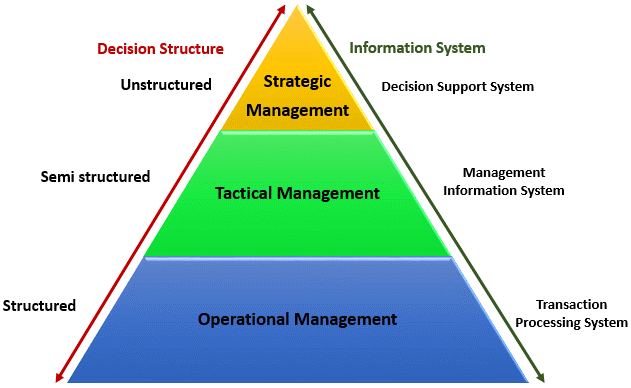
Management information systems find their way into just about every aspect of a company. They work with the people in the company, the technology in the company, its products, and the inter-relationships between all of these on a day-to-day basis. If you implement an MIS in your company, then the levels of efficiency you could potentially achieve with it are mind boggling.
Types of MIS reports — Financial, Operational, Sales and HR
MIS reports can be categorised based on business functions. The most commonly used types are:
1. Financial reports
Financial MIS reports help gain an in-depth view of a company’s financial health and are needed for budgeting, forecasting, and investment planning. Some of the examples include:
Profit & loss statement – Summarises revenue, expenses, and net profit
Balance sheet – Gives the company’s snapshot of assets, liabilities and equity
Cash flow report – Records cash flows to ascertain liquidity and solvency
2. Operational reports
Operational reports help organisations monitor business processes, supply chain performance, and production efficiency. Such reports include:
Stock status and turnover – Checks on the prevailing stock levels and the inventory turnover rate.
Production reports – Tracks manufacturing output and efficiency
Supply chain reports – Analyses supplier/procurement and vendor performance
3. Sales and marketing reports
The sales and marketing divisions generate these reports to deliver information about customer actions, revenue creation patterns, and campaign performance metrics. The examples include:
Sales performance report – Analyses sales trends across different periods
Customer demographics report – Evaluates customer buying patterns and preferences
Marketing ROI report – Assesses the success of marketing campaigns
4. HR reports
The organisation depends strongly on HR MIS Reports to track various aspects of workforce management, employee performance zones, and HR policy enhancements. Such reports include:
Employee productivity report – Measures individual and team efficiency
Payroll & compensation report – Tracks salaries, bonuses, and deductions
Training & development reports - Monitors programs that improve employee competencies
Each report contributes strongly to business management activities by supporting data-centered decision-making.
5.Management Control Report
MIS Report Comparison Table
| Report Name | Key Insights | Best For | Frequency |
|---|---|---|---|
| Financial Report | Profitability, revenue, expenses | Finance teams, auditors | Monthly/Quarterly |
| Operational Report | Stock, supply chain, production | Operations, manufacturing | Daily/Weekly |
| Sales & Marketing Report | Sales performance, ROI, customer insights | Sales/Marketing teams | Weekly/Monthly |
| HR Report | Workforce performance, payroll, training | HR managers | Monthly/Quarterly |
| Management Control Report | Budgeting, forecasting, cost control | Senior management | Quarterly/Annually |
How to create an MIS report: Step-by-step guide
MIS reports can be generated manually or using accounting/ERP software like TallyPrime.
Manual process
The preparation of manual MIS needs a structured methodology. The steps include:
- Describing the report targets by determining its primary function, whether for financial monitoring or sales evaluation.
- Obtaining data by working with several departments, including finance, sales and operations.
- Achieving accurate analysis of raw data to execute data cleaning steps for structure and organisation.
- Identifying patterns together with trends and anomalies in the analysis phase.
- Incorporating visual representation systems based on tables, graphs, and charts in the preparation phase.
- Reviewing and conducting validating checks to ensure accuracy in the findings for stakeholder presentation.
Using accounting/ERP software
Using software solutions to generate MIS reports makes the process smoother, ensuring utmost accuracy. TallyPrime, when used, streamlines operations following the below-mentioned steps..
- Enter financial, sales, or operational data into TallyPrime.
- Choose from pre-defined templates for reports.
- Use the Customise Report screen to execute data filtering features based on time, location, and other parameters.
- Transform data into PDF, Excel, and alternative output configurations through the Generate & Export feature.
The report generated using TallyPrime is accurate and delivers real-time information to users.
Why do industries need MIS reports?
MIS helps to improve decision-making, increases operational efficiency, and strengthens an organization’s competitive position. MIS provides accurate, timely data and analytical tools so managers can understand what is happening, identify what needs attention, and plan what should happen next. By connecting departments and providing a single source of truth, MIS ensures that everyone works with consistent information, leading to better coordination and stronger results.
Key reasons industries need MIS:
1. Improved decision-making
MIS provides managers with real-time, accurate data and built-in analysis tools. This helps organizations detect problems early, identify new opportunities and make fast, data-driven decisions.
2. Enhanced efficiency
MIS automates routine tasks and workflows. As a result, it will help manual effort decreases, human errors reduce, employees can focus on strategic and high-value work.
3. Stronger strategic planning
With historical data and forecasting capabilities, MIS enables businesses to identify performance trends, anticipate market changes, build effective long-term strategies.
4. Better coordination and communication
A central, shared database helps integrate departments. This leads to smoother information flow, better collaboration, stronger overall coordination across the organization.
5. Competitive advantage
MIS helps businesses respond quickly to market conditions by optimizing processes, improving decision speed, boosting operational performance. This can help organizations outperform competitors.
6. Performance tracking and control
MIS maintains accurate records of business transactions, employee performance, operational and financial activities. This gives leadership greater visibility and control.
7. Improved resource optimization
MIS provides clarity on how resources are being used. This helps organizations allocate financial, human and material resources more effectively and reduce waste.
Industry-specific applications of MIS reports
MIS reports are crucial for business operations in the following sectors:
1. Retail
Numerous retail businesses use these reports to analyse customer behaviours alongside inventory management and sales projection applications. For example, a supermarket chain enters data to generate inventory reports for stock monitoring and overstock prevention.
2. Manufacturing
MIS reports serve as production efficiency and supply chain operation monitoring tools for manufacturers. A factory monitoring manufacturing output using production reports to detect operational problems is an example here.
3. Healthcare
Using these reports enables healthcare institutions and hospitals to manage their patient records alongside optimising operational processes and handling their billing procedures. A healthcare institution uses financial MIS reports to track medical service revenue alongside insurance claim information.
Types of MIS reports in TallyPrime
- Accounting reports
To obtain information on the financial position, operational performance and economic activities of the business.
- Financial reports
To determine the financial condition of an organisation as required by shareholders, creditors and government units.
- Inventory reports
To manage the Inventory effectively since the actual status of stock items is obtained.
- Management control reports
To utilise budgets, cost centre reports, scenario reports etc. for controlling activities.
Wish to make your business more efficient and processes more streamlined? Give TallyPrime a shot and we promise you will not be disappointed.














