To forecast cash flow, list the money you expect to receive and the money you expect to pay out in each week or month, then add the difference to your opening balance. The result is your expected closing cash for that period. To find out how much cash your business will need next month, do this week by week and look at the lowest balance. If it falls below the minimum you want to keep, the gap is the extra cash you need to arrange before that week arrives.
Cash flow forecasting for small business owners in Kenya works best when every figure sits on the date the money will really move. That means the day a customer pays by M-Pesa or bank transfer, and the days your suppliers, staff and the Kenya Revenue Authority (KRA) expect to be paid.
What is a cash flow forecast?
A cash flow forecast is an estimate of the cash your business will receive and pay out over a future period, shown week by week or month by month. It tells you how much cash you should have in your bank account, M-Pesa till and cash box at the end of each period.
Forecast cash flow and actual cash flow are two different things. The forecast is your plan, written before the period starts. Actual cash flow is what really moved in and out, which you record as it happens. Comparing the two shows how good your assumptions were and gives you better numbers for the next forecast.
A forecast also differs from profit. A business can be profitable on paper and still run out of cash, for example, when a large credit sale is unpaid, but rent and suppliers still need to be paid. A cash flow forecast in Kenya also has to reflect local timing, such as M-Pesa collections and the KRA’s monthly deadlines. It is one tool within cash flow management and the one that warns you about a problem before it happens. It is also a core part of small business financial planning in Kenya, because it shows whether you can afford a new hire, a stock purchase or a loan repayment.
How do you choose your forecasting period?
Your forecasting period is how far ahead you look and how you split that time into columns.
Weekly columns suit most Kenyan small businesses, such as shops, salons, restaurants and transport operators, because rent, salaries and supplier payments fall on different days and a monthly total can hide a bad week. Monthly columns work when your sales and costs are steady, and you want a year-long view. Quarterly columns help with bigger decisions, such as applying for a loan, opening a second outlet or buying stock before a busy season. Many owners keep two versions: a weekly forecast for the next month or two and a monthly one for the year.
Start each forecast with your opening cash balance. This is the total of your bank accounts, your M-Pesa till or Paybill balance and the cash on hand on the first day.
Which cash inflows should you list?
Cash inflows are the payments you expect to receive, placed in the period you expect to receive them. Include the following:
- Cash sales and mobile money sales, including payments to your M-Pesa till or Paybill number
- Payments from customers who bought on credit
- Loan money you expect to receive from a bank, a Sacco or another lender
- Other receipts, such as rent from a sublet, refunds or money the owner adds to the business
Estimate sales from last year’s figures for the same period, your current orders and any known events. If you are unsure, choose the lower figure. Your accounts receivable, which is the list of unpaid customer invoices, is the place to start when estimating customer payments. Count an invoice as an inflow only when you expect the cash, not on the day you issue it.
Which cash outflows should you list?
Cash outflows are all the payments the business must make, listed in the week they leave your account. Include these:
- Suppliers, for stock, materials and services
- Salaries and wages
- Rent and utilities such as electricity and water
- Taxes, including value-added tax (VAT) and payroll deductions
- Loan repayments, both principal and interest
- Operating costs such as transport, airtime, licences, bank charges and M-Pesa transaction fees
Payroll needs extra care because it has two parts. Net salaries go to your staff, while pay-as-you-earn (PAYE), National Social Security Fund (NSSF) contributions, Social Health Insurance Fund (SHIF) contributions and the Affordable Housing Levy go to the authorities. PAYE is due to the KRA by the 9th of the following month, so the deductions for June salaries leave your account in July. Late PAYE payments attract interest of 1% per month on the unpaid tax. The other payroll payments have their own due dates early in the following month, so place each one on its own date.
If your business is registered for VAT, the return and payment are due by the 20th of the following month. Registration is required once you supply or expect to supply taxable goods and services worth KES 5 million or more in a year.
Track small daily costs too. Good expense management catches airtime, fuel and transport spending that often has no formal invoice but still reduces your cash.
How do you account for payment timing?
A sale or a bill is not the same as cash moving, so place each figure on the date the cash will really change hands.
Credit sales are the biggest source of error. If you sell to a contractor on 30-day terms, the sale is recorded today, but the money may arrive a month later or even longer. Forecast the collection in the week you expect the payment, based on how that customer has paid before, and not in the week you issued the invoice. If a customer usually pays ten days late, forecast the payment ten days late.
Payments to suppliers work the same way. A supplier who gives you 14 days to pay is paid in week two, not in the week you took the delivery.
Mobile money adds a small delay of its own. Money paid to your till or Paybill number may not yet be in the account you use to pay suppliers, so forecast the date it becomes available to spend and include any transaction fees. Payments with fixed dates, such as rent, PAYE and VAT, should sit on their exact due dates, because landlords and the KRA do not move them to suit your collections.
How do you calculate expected closing cash?
Once inflows and outflows sit in the right periods, the calculation is a simple formula.
Expected closing cash = opening cash plus cash in minus cash out
The closing cash of one period becomes the opening cash of the next, so the forecast builds week by week. Here is how to forecast cash flow with real numbers, using a four-week example for a hardware shop in Thika that is registered for VAT. It sells to walk-in customers who pay in cash or M-Pesa and to contractors who buy on credit. On the first day, it holds KES 100,000 across the bank, the till and the cash box. The assumptions for the month are listed below:
- Till and cash sales are about KES 150,000 a week, rising to KES 170,000 in week 4 because of month-end buying.
- Contractors owe KES 320,000 from last month. The first pays KES 60,000 in week 1. The second pays KES 120,000 in week 3, ten days after its due date. The third pays KES 80,000 in week 4, a week after its due date. The fourth owes KES 60,000 and is expected to slip into next month, so it is left out.
- Suppliers are paid KES 90,000, KES 230,000, KES 70,000 and KES 110,000 in weeks 1 to 4. Week 2 includes a large stock order ahead of the rainy season.
- Rent of KES 40,000 is paid in week 1, and net salaries of KES 130,000 are paid in week 4.
- PAYE, NSSF, SHIF and housing levy for last month total KES 45,000 in week 2. VAT of KES 35,000 is paid in week 3, and a loan instalment of KES 25,000 is paid in week 4.
- Operating costs are KES 15,000 every week.
The forecast, in Kenyan shillings, looks like this.
|
Week 1 |
Week 2 |
Week 3 |
Week 4 |
Month |
|
|
Opening cash |
100,000 |
165,000 |
25,000 |
175,000 |
100,000 |
|
Till and cash sales |
150,000 |
150,000 |
150,000 |
170,000 |
620,000 |
|
Credit customer collections |
60,000 |
0 |
120,000 |
80,000 |
260,000 |
|
Total cash in |
210,000 |
150,000 |
270,000 |
250,000 |
880,000 |
|
Suppliers |
90,000 |
230,000 |
70,000 |
110,000 |
500,000 |
|
Rent |
40,000 |
0 |
0 |
0 |
40,000 |
|
Net salaries |
0 |
0 |
0 |
130,000 |
130,000 |
|
PAYE, NSSF, SHIF and housing levy |
0 |
45,000 |
0 |
0 |
45,000 |
|
VAT |
0 |
0 |
35,000 |
0 |
35,000 |
|
Loan repayment |
0 |
0 |
0 |
25,000 |
25,000 |
|
Operating costs |
15,000 |
15,000 |
15,000 |
15,000 |
60,000 |
|
Total cash out |
145,000 |
290,000 |
120,000 |
280,000 |
835,000 |
|
Net cash flow |
65,000 |
−140,000 |
150,000 |
−30,000 |
45,000 |
|
Closing cash |
165,000 |
25,000 |
175,000 |
145,000 |
145,000 |
Total cash in for the month is KES 880,000 and total cash out is KES 835,000, so the shop ends the month with KES 145,000. Judged by the month-end figure alone, the shop looks healthy. However, the weekly view shows a problem. Closing cash falls to KES 25,000 at the end of week 2, when the large supplier payment and the payroll taxes land in the same week.
How do you identify potential cash shortages?
A shortage is any period where expected closing cash falls below the minimum you need to keep trading.
Decide your minimum cash cushion first. The shop in the example keeps KES 80,000, which covers about three days of costs, and week 2 closes KES 55,000 below it. This answers the question of how much cash the business needs next month. The answer is the largest single-week gap, KES 55,000, and not the month-end balance. The shop needs to find KES 55,000 before week 2 ends.
Then test the forecast by asking what happens if a customer pays late. If the contractor who owes KES 120,000 pays next month instead, week 3 closes at KES 55,000 and week 4 at KES 25,000. The shop is then below its cushion in three weeks out of four.
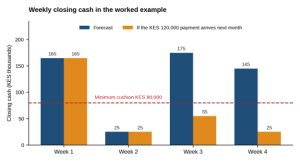
(Chart prepared for this article from the worked-example figures.)
When you spot a shortage, act before the week arrives. The steps below start with the ones that cost the least.
- Contact customers whose payments are due this week or are already overdue, and confirm their expected payment dates.
- Ask customers for a deposit or part-payment on large orders.
- Ask suppliers whether a large payment can be split across two weeks.
- Move spending that is not urgent, such as equipment purchases, into a week with a stronger balance.
- Arrange short-term funding, such as an overdraft or a Sacco loan, before the shortage, when you have time to compare costs.
- Keep tax payments on time, because late PAYE and other taxes add interest and penalties that widen the gap.
How do you keep the forecast up to date?
A forecast helps only while it matches what is really happening, so replace estimates with actual figures at the end of each period.
- Enter the actual closing cash from your bank, M-Pesa and cash records as the next period’s opening balance.
- Compare each forecast line with the actual amount and note the difference.
- Write down the reason for any large difference, such as a late customer or an unplanned repair.
- Correct the assumptions for future periods, for example, the number of days a customer takes to pay.
- Add a new period at the end so the forecast keeps covering the same length of time.
The table below compares week 1 of the shop’s forecast with what happened. A negative figure means less cash than planned.
|
Item |
Forecast |
Actual |
Effect on cash |
|
Till and cash sales |
150,000 |
138,000 |
−12,000 |
|
Credit customer collections |
60,000 |
45,000 |
−15,000 |
|
Suppliers |
90,000 |
90,000 |
0 |
|
Rent |
40,000 |
40,000 |
0 |
|
Operating costs |
15,000 |
17,000 |
−2,000 |
|
Closing cash, week 1 |
165,000 |
136,000 |
−29,000 |
Actual closing cash for week 1 was KES 136,000, which is KES 29,000 below the forecast. Week 2 now opens at KES 136,000 instead of KES 165,000, so expected closing cash for week 2 moves from KES 25,000 to negative KES 4,000 unless the shop acts. Till sales came in 8% below plan, which is worth checking before the same figure is repeated in weeks 3 and 4.
How does accounting software improve visibility?
A spreadsheet is enough for a first forecast, but manual tracking gets slower as invoices, payments and staff numbers grow.
Accounting software keeps invoices, receipts, supplier bills and bank entries in one place, so the receivables and payables you need for a forecast are already recorded. Reports that show overdue customer invoices and supplier bills due each week save you from searching through notebooks and chat messages.
Sound business accounting habits, such as recording every M-Pesa receipt on the day it arrives, keep those reports accurate. The same records feed your financial reporting, so the actual figures you compare with the forecast come from the same source as your profit and loss account.
Some software can also project inflows and outflows from the due dates you enter. Treat these projections as a starting point. They cannot know that a customer plans to pay late or that a supplier has changed terms, so review the dates against what you know.
Where should you start with your cash flow forecast?
Start with the next four weeks. Write down your opening cash, place every expected receipt and payment in the week it will really happen and mark any week that closes below your cushion. One page like this keeps the planning simple. It shows which payments to chase, which to delay and how much extra cash to arrange, so you decide before the pressure arrives and can speak to a lender or supplier with real numbers.
When the number of invoices makes manual updating slow, the Cash Flow Projection report in TallyPrime estimates expected inflows and outflows for a future month, quarter or year, and its columns can be set to weekly or fortnightly periods. Like any projection, it depends on the entries and due dates you record, so review its output against what you know about your customers and suppliers. To see how it works for Kenyan businesses, visit tallysolutions.com/ssa/accounting-software-kenya.
FAQs
- How far ahead should a small business forecast its cash flow?
A practical rule is a rolling 13-week forecast for day-to-day decisions and a 12-month forecast for planning. Rolling means you add a new week at the end each time the current week closes, so you keep looking the same distance ahead. Businesses that wait long for payment, such as those supplying schools or large companies on 60-day terms, need a longer view.
- What if I do not know exactly when customers will pay?
For a new customer with no payment history, assume payment 15 to 30 days after the due date until you learn their pattern. Run two versions, a best case and a worst case, and plan your cash around the worst case. Agreeing a payment date in writing and sending a reminder a few days before it gives you a firmer date to forecast.
- Should loan repayments be included in a cash flow forecast?
Yes. Include each instalment, both the principal and the interest, in the week it is due, since both leave your account. The loan proceeds go in as an inflow in the week you receive them, and any processing fees or insurance charged with the loan go in as outflows. If the rate is variable, ask your lender for the updated schedule and revise the forecast when it changes.
- How should seasonal sales be handled in a cash flow forecast?
Base each month on the same month in previous years rather than on an average of the whole year. In Kenya, school opening periods, the December festive season, harvest time and the long rains can move sales and stock buying sharply. Stock is usually bought before the busy season, so cash goes out before the extra sales come in. Use the stronger months to build a cushion for the slow ones.
- Can I create a cash flow forecast using accounting software?
Yes. Accounting software can pull unpaid invoices, supplier bills, loan schedules and recurring payments into a forecast, and some packages include a projection report. Check that the report lets you change dates and amounts, because customers and suppliers rarely pay exactly on schedule. Also confirm that it can group figures by week and export the result if you want to share it with your accountant or lender.
- What is the difference between a cash flow forecast and a cash flow statement?
A cash flow forecast looks ahead and estimates future receipts and payments. A cash flow statement looks back and reports cash that has already moved during a period, grouped into operating, investing and financing activities under IFRS. The statement is part of your financial reporting, while the forecast is an internal planning tool.
- How often should a cash flow forecast be updated?
Update a weekly forecast at the end of every week and a monthly forecast at the end of every month. Update it sooner when something large changes, such as a big order, a delayed payment, a new loan or a change in tax rules. If cash is very tight, some owners check their balance against the forecast every few days.