



Introduction
The introduction of the Health Security se National Security (HSNS) Cess, which replaces the old Compensation Cess. But this is not just a name change. The government is moving away from taxing based on "how much you sold" to a system based on "how much you can produce." This is known as Capacity-Based Taxation.
New Tobacco Tax From 1st February, key changes you need to know. Consumers of tobacco and pan masala products are facing a massive potential price hike, with speculative reports suggesting a four-fold increase that could turn an ₹18 cigarette into a ₹72 purchase. These significant changes are the result of a new tax framework set to take effect on February 1, 2026. This article breaks down the four most important things you need to understand about this new law.
To understand the government's motive, consider a common scenario. A local paan shop owner sells a pack of pan masala at its Maximum Retail Price (MRP). His competitor next door, however, sells the same product for the same price but gives the customer a bill for a much lower amount, pocketing the difference in cash. By "under-reporting" the sale value, the competitor pays less GST, gains an unfair advantage, and contributes to significant tax leakage.
HSNS Cess
HSNS Cess stands for Health Security se National Security Cess. It is a new tax being introduced by the Indian government starting February 1, 2026, specifically for the tobacco and pan masala industries.
This cess replaces the old GST Compensation Cess and is designed to create a dedicated fund for two main areas: Public Health and National Security.
Four Key Changes in India's New Tobacco Tax
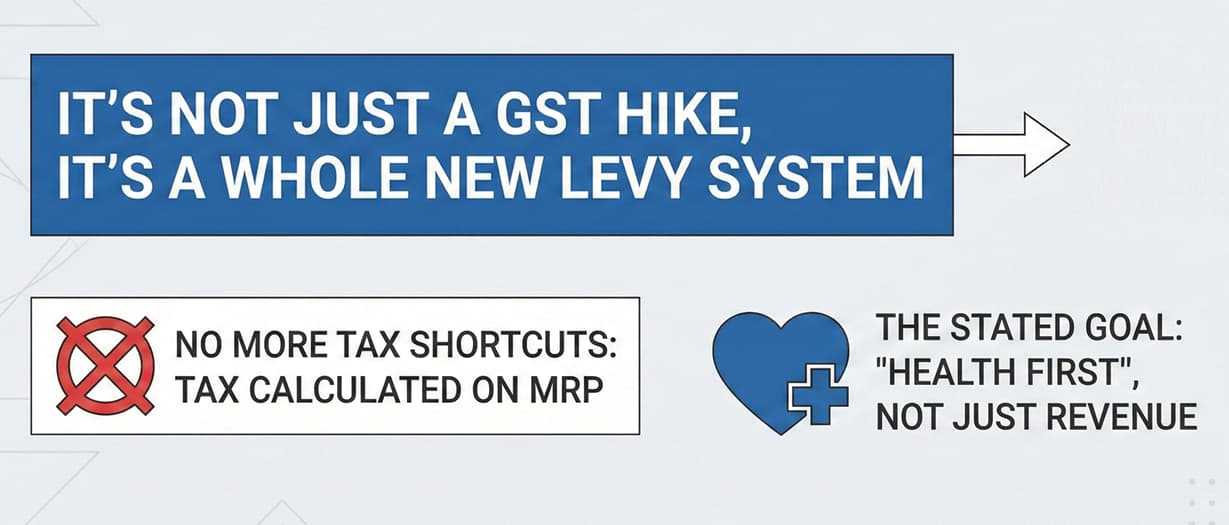
This is a complete structural change. The government is phasing out the old Compensation Cess and replacing it with the HSNS (Health Security se National Security) Cess. Additionally, the re-introduction of Central Excise Duty, which was mostly removed when GST arrived in 2017, means businesses must now manage multiple layers of tax rather than just one GST rate.
- It’s Not Just a GST Hike , It’s a Whole New Levy System
- No More Tax Shortcuts: Now all taxes are calculated on the MRP.
- The Stated Goal: "Health First," Not Just Revenue
- The Surprising Exception: Your Bidi Might Actually Get Cheaper
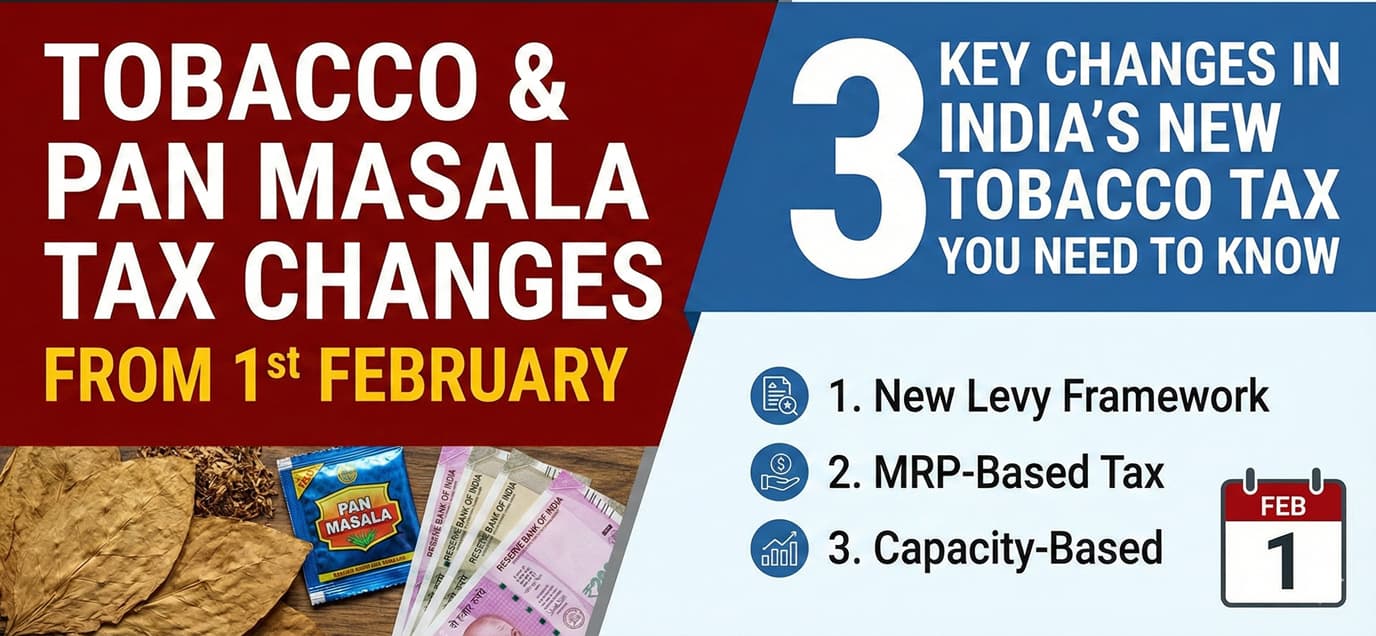
1. It’s Not Just a GST Hike - It’s a Whole New Levy System
The upcoming price increase due to two main reasons: not only is the GST rate on these products increasing from 28% to 40% as of September 2025, but the government is also completely overhauling the levy system on top of it. The old Compensation Cess is being completely replaced by two entirely new levies, effective February 1, 2026.
- Before: Compensation Cess (on top of GST)
- After: Additional Excise Duty + Health & National Security Cess (on top of GST)
This fundamental shift was introduced through two new bills: the Central Excise Amendment Bill 2025 and the Health and Security Cess Bill 2025.
2. No More Tax Shortcuts: Now all taxes are calculated on the MRP.
The most significant change is how the tax is calculated. The government will now levy all taxes based on the Maximum Retail Price (MRP) printed on the product's packaging, not on the taxable value declared by the seller.
This policy is designed to eliminate a common tax evasion tactic known as "under-reporting," where sellers issue a bill for a lower amount to reduce their tax liability and collect the remaining balance in cash. The tax is now fixed to the MRP printed on the packet, the tax amount becomes fixed and non-negotiable.
Here is how the new tax will be calculated, treating the MRP as inclusive of all taxes:
Example Calculation: For a product with an MRP of ₹1,000 and a 40% tax rate, the tax amount is calculated using the formula: (Retail Price * Tax Rate) / (100 + Tax Rate).
(₹1,000 * 40) / (100 + 40) = ₹40,000 / 140 = ₹285.71
In this scenario, ₹285.71 of the ₹1,000 MRP is the tax component. This means the taxable value of the product itself is ₹714.29 (₹1,000 - ₹285.71), and the tax is calculated on the final, all-inclusive retail price.
3. The Stated Goal: "Health First," Not Just Revenue
The government has officially stated that the primary objective of this aggressive tax policy is to protect public health by discouraging the consumption of "sin goods." This move prioritizes health outcomes over revenue generation alone.
The urgency of this policy is underscored by a critical statistic from a World Health Organization (WHO) report:
"According to a WHO report, tobacco-related products are responsible for approximately 13.5 lakh deaths in India every year."
The revenue collected from the new Health & National Security Cess will be directed into the central government's Consolidated Fund. This marks a significant policy shift; while the original Compensation Cess was designed to protect state revenues under the GST regime, the new cess centralizes the funds, giving the Union government direct control over their allocation for national health and security priorities.
4. The Surprising Exception: Your Bidi Might Actually Get Cheaper
While most tobacco products will move into the new, higher 40% GST slab, there is a significant exception: Bidis. This is particularly noteworthy given that reports indicate the affordability of tobacco products in India has "either stagnated or increased in the past decade." In a counter-intuitive move that targets manufactured cigarettes while treating a product with a different consumer base differently, Bidis will be moved from the 28% GST slab to the lower 18% GST slab. This reclassification could effectively make them cheaper, separating them from the broader price hikes affecting other tobacco products.
Thinking Behind Capacity-Based Taxation
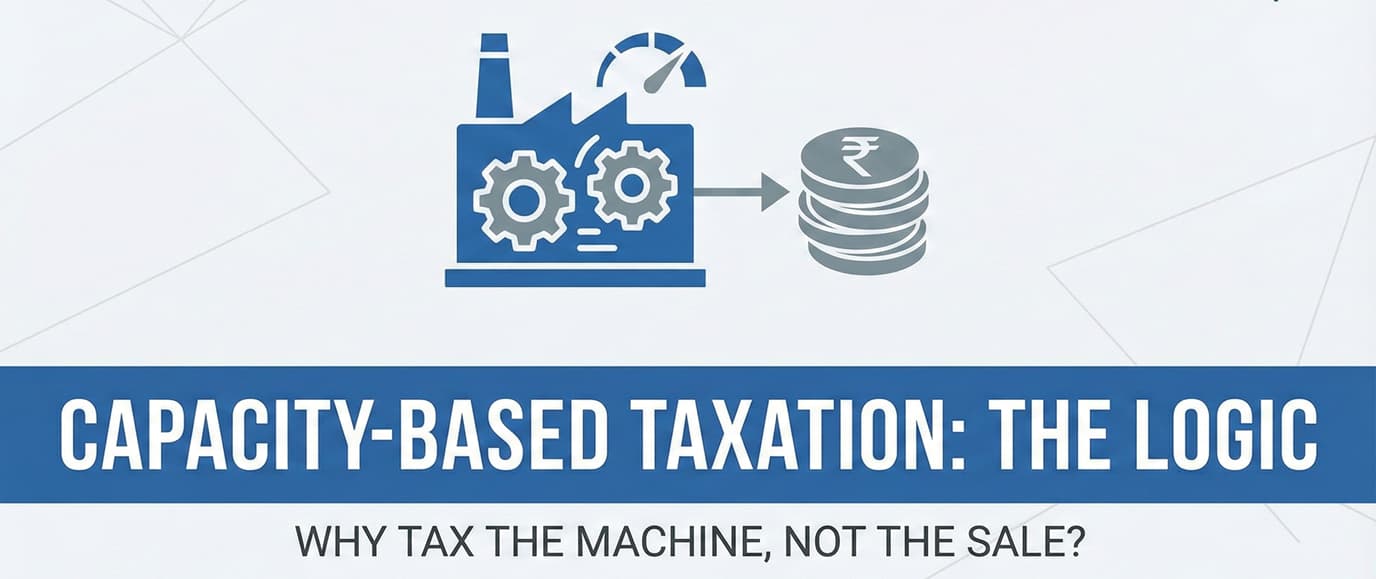
The "Thinking" behind Capacity-Based Taxation can be summed up in three simple points:
- Stops Tax Cheating: Sales records (bills) are easy to fake or hide. A physical machine and its production speed are much harder to hide from tax officers.
- Too Fast to Count: Modern machines pack over 2,000 pouches per minute. It is impossible for officials to count every pouch, so they simply tax the machine's "potential" instead.
- Predictable Revenue: By taxing the machine’s capacity, the government gets a fixed, guaranteed amount of money in advance (by the 7th of every month), regardless of how much is actually sold.
In short: The government is shifting from "Tell us what you sold" to "We know what your machine can produce, so pay for that."
Conclusion
These new tax regulations represent one of the government's most significant steps to curb the use of tobacco and related products in India. By fundamentally changing how these goods are taxed, the policy aims to make them prohibitively expensive. The key question that remains is whether this will lead to the intended public health benefits or inadvertently fuel a thriving black market for these products.
Frequently Asked Questions (Q&A)
- When do the new tobacco and pan masala taxes start?
The new tax framework will become effective on February 1, 2026. - What is the new tax rate on products like cigarettes?
The tax is multi-layered. On top of the 40% GST rate, products will be subject to an Additional Excise Duty (for example, ranging from ₹2,500 to ₹11,000 per 1000 cigarette sticks) and a new Health & National Security Cess. - Why is the government calculating tax on the MRP now?
This policy aims to prevent tax evasion. By calculating tax directly on the printed Maximum Retail Price, sellers can no longer declare a lower transaction value to reduce their tax liability. The tax is now fixed to the price the final consumer pays. - What are 'sin goods'?
'Sin goods' are products considered harmful to health and society, such as tobacco and pan masala. Under the new GST structure implemented in September 2025, these goods, along with luxury items, were moved into the highest 40% tax slab. - Where will the money from the new Health and National Security (HSNS) Cess be used?
The revenue collected from the HSNS Cess will go directly into the central government's Consolidated Fund and will be used to finance public health initiatives and national security functions.







