



When a Tax Line Item Triggered a Bigger Question
We were closing a month-end review when someone from the compliance team pointed at the tax summary and asked:
“Why does this invoice still show Compensation Cess?”
It was a fair question.
After all, we had already updated GST rates.
But that single line item opened up a much bigger issue —
we had changed the rates, but not the thinking behind the levy framework.
That’s when I realised:
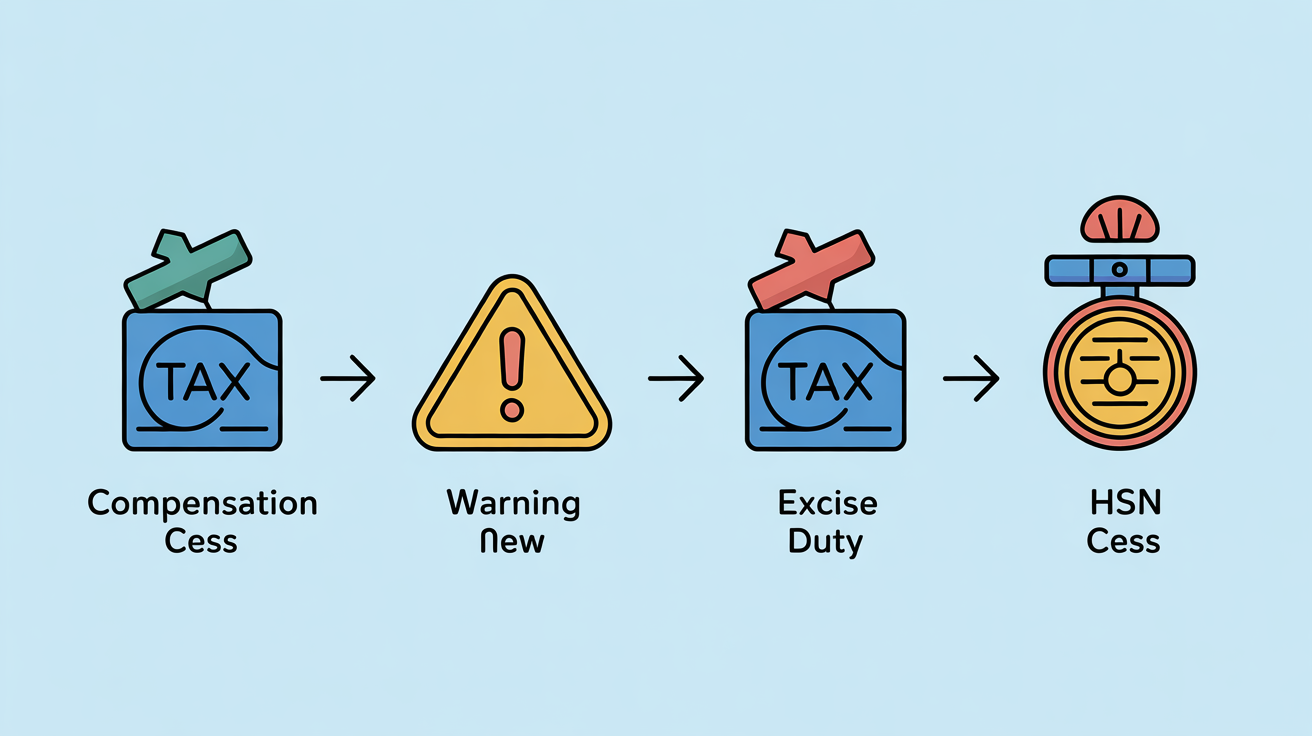
the shift from Compensation Cess to Excise & HSN-linked cess is not just a tax update — it’s a structural transition businesses must consciously manage.
What Changed: A Structural Shift, Not a Rate Change
Under the revised tax framework introduced by the Government of India:
- GST Compensation Cess has been withdrawn for certain products
- In its place:
- Central Excise Duty applies
- An additional HSN-based cess (often health or sector-specific) is introduced
- Tax applicability is now more closely tied to:
- HSN classification
- MRP or quantity-based valuation
- Product-specific attributes
This fundamentally changes how taxes are computed, tracked, and audited.
Why This Transition Is Risky for Businesses
In theory, this looks simple:
“Remove one cess, add another.”
In reality, the risks show up when:
- Old cess continues to appear on invoices
- New excise or HSN cess is applied inconsistently
- Item masters are not updated correctly
- Stock manufactured under the old regime is sold under the new one
From a CFO’s lens, this leads to:
- Incorrect tax payments
- Reconciliation issues
- Audit objections
- Classification disputes
The Most Common Transition Mistakes We’re Seeing
1. Treating It as a Temporary Adjustment
Many teams assume the change is short-term and delay proper system updates.
2. Updating Rates Without Revisiting Classification
HSN-linked cess makes correct classification non-negotiable.
3. Mixing Old & New Stock Without Clear Tracking
Transition stock becomes the biggest audit question.
4. Manual Overrides in Invoicing
Temporary workarounds lead to permanent errors.
Each of these may look manageable today — but they compound during audits.
How Finance Teams Should Approach the Transition Practically
Here’s a step-by-step framework that works in real business settings:
Step 1: Map Products to the New Levy Structure
Identify which products:
- Move from cess to excise
- Attract HSN-based cess
- Require MRP or quantity-based valuation
Step 2: Reconfigure Item & Tax Masters
Ensure systems reflect:
- Correct tax heads
- Updated cess logic
- Proper valuation rules
Step 3: Segregate Transition Inventory
Maintain clarity between:
- Pre-change production
- Post-change production
Step 4: Strengthen Documentation
Keep internal notes explaining:
- Tax changes
- Effective dates
- Impact on pricing
Auditors don’t just check numbers — they check logic.
Why System Readiness Matters More Than Manual Knowledge
No matter how strong your tax knowledge is, manual handling of a new levy framework doesn’t scale.
Businesses manage this transition better when their accounting systems:
- Support multiple levy types
- Allow clean tax restructuring
- Maintain audit trails automatically
- Reduce dependency on manual corrections
A CFO’s Take: The Real Risk Is Partial Adoption
The biggest mistake businesses make during tax transitions is half implementation.
- Rates updated, but masters untouched
- Invoices corrected, but reports wrong
- Compliance done, but audit readiness weak
The new levy framework demands end-to-end alignment — pricing, classification, accounting, and reporting.
Closing Thought
Tax regimes will continue to evolve.
What separates resilient businesses from reactive ones is how well they manage transitions.
Moving from Compensation Cess to Excise & HSN-linked cess is not about compliance alone —
it’s about building systems and habits that can absorb change without chaos.
Because in finance, clarity today prevents disputes tomorrow.







