Under UAE VAT Law, the responsibility to levy, collect and pay tax to the government is on the person who is making taxable supplies i.e. on the supplier. This means, whenever a registered supplier is making a taxable supply, he needs to charge VAT and pay the same to the government. The mechanism of collecting tax by a registered supplier from his customers is known as forward charge mechanism. For example, A-One Spares Ltd sold spare parts worth AED 100000 to General Automobiles Ltd and collected VAT of AED 5000 at the rate of 5%. The VAT of AED 5000 is collected on a forward charge basis. However, the UAE VAT Law and Executive Regulations notifies certain type of supplies on which VAT need to be charged on Reverse Charge Mechanism.
Before understanding those supplies which are liable for Reverse Charge VAT, first let us understand the concept of reverse charge mechanism.
What is VAT Reverse Charge Mechanism?
Under reverse charge mechanism, on certain notified supplies, the recipient or the buyer of goods or services is responsible to pay the tax to the Government, unlike in the forward charge, where the supplier is liable to pay the tax. The key change is the shift in the responsibility of paying tax, which is moved from the supplier to the buyer.
Why Reverse Charge Mechanism implemented?
In order to ensure that the VAT is collected on the supply of goods or service where the supplier is not a taxable person and the supply has been made in the state of UAE, the government has introduced the concept of reverse charge mechanism. Due to this, the recipient or the buyer is treated as a person making taxable supplies to himself and will be responsible to pay VAT to the government.
What are the supplies liable for Reverse Charge VAT in UAE?
In UAE VAT, broadly the import of concerned goods or services and supply of any crude or refined oil, unprocessed or processed natural gas, or any hydrocarbons for resale or to produce and distribute any form of energy are under reverse charge VAT. The UAE VAT Law has listed the following supplies which will be liable for VAT on reverse charge mechanism, provided the applicable conditions are met as prescribed in UAE Executive Regulations:
- Imports of concerned goods or concerned services for business purpose
- Taxable supply of any crude or refined oil, unprocessed or processed natural gas, or any hydrocarbons for resale or to produce and distribute any form of energy by registered supplier to registered buyer in the State of UAE
- Supply of goods or services by a supplier who does not have a place of residence in the state to a taxable person who has a place of residence in the State of UAE.
All of the above mention supplies are liable to reverse charge mechanism. However, for each of the above supplies, specific conditions are mentioned in the UAE VAT Executive Regulations which need to be full filled, to be liable for reverse charge VAT.
Tax payment under Reverse Charge Mechanism
Under the Reverse Charge Mechanism (RCM) in the UAE, the responsibility for reporting and paying VAT shifts from the supplier to the buyer (recipient of goods or services). This ensures proper tax collection, especially in cross-border or specific domestic transactions.
How tax payment works under RCM
- Buyer accounts for VAT
The recipient calculates VAT on the purchase and reports it as output tax in their VAT return. - Simultaneous input tax claim
In the same return, the buyer can claim the same amount as input tax, provided the purchase is for business purposes and eligible for recovery. - No cash outflow (in most cases)
Since output and input VAT are recorded together, there is typically no immediate cash payment, unless input tax recovery is restricted. - Applicable tax rate
VAT is calculated at the standard rate (5%) or as applicable, based on the nature of the supply.
Reporting in VAT returns
- RCM transactions must be clearly reported in the relevant sections of the VAT return.
- Proper documentation, such as import records or supplier invoices, should be maintained to support the transaction.
Reverse Charge VAT Example
In order to ensure that VAT is collected on the supplies where a supplier is not a taxable person in the state of UAE, the concept of Reverse Charge Mechanism is introduced in the UAE VAT. Under this, the recipient or the buyer of goods or services will be liable to pay tax to the government. Thus, as a recipient or buyer of goods or services under reverse charge mechanism, the following responsibility needs to be discharged:
- Determine the value on which tax needs to be levied
- Account the VAT due on reverse charge supplies
- Remit VAT to the government
- Claim Input Tax, if eligible.
- Maintain the records such as invoice and other documents to substantiate the tax payment and input tax claim
In order to make the concept of Reverse charge mechanism clearer, let us understand this with an example:
A-One Spare Ltd, a registered dealer in spare parts and accessories in Dubai imported spare parts worth AED 5500 from Speed Motors Ltd, located in India.
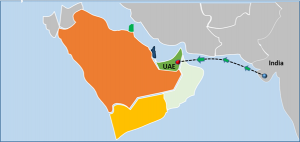
Here, A- One Spare Ltd, being a registered importer, is required to pay VAT @ 5% on AED 5500 i.e. AED 275 to the government.
Input tax deduction in case of Reverse Charge Mechanism
Under the Reverse Charge Mechanism (RCM), businesses in the UAE can claim input tax deduction on VAT accounted for, subject to eligibility conditions. This ensures that VAT does not become a cost when purchases are made for taxable business activities.
How input tax deduction works under RCM
- Simultaneous accounting
The buyer reports VAT as output tax and can claim the same amount as input tax in the same VAT return. - No net tax impact (if fully recoverable)
If the input tax is fully eligible, the transaction results in no additional VAT payable.
Conditions for claiming input tax
To claim input tax under RCM, the following conditions must be met:
- The goods or services are used for taxable business purposes
- The business holds valid supporting documents (e.g., supplier invoice, import documents)
- The VAT amount is correctly calculated and reported in the VAT return
- The expense is not blocked or restricted under UAE VAT law
How different is Reverse Charge VAT compared to Forward charge mechanism?
Let's make the comparative analysis of VAT on forward charge and reverse charge with an example of domestic supplies of goods at 5% versus the import of similar goods.
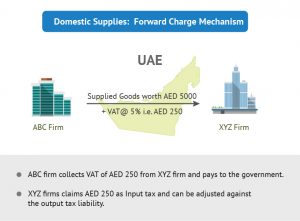
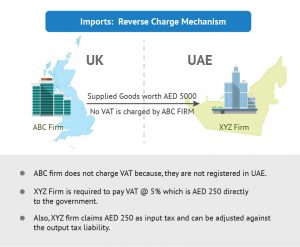
If you closely observe the illustration, the net result of reverse charge mechanism is same as that of forward charge basis. The only difference in reverse charge VAT is the shift in the responsibility of paying VAT which is moved from supplier to the recipient. In the above illustration, it is moved from ABC Firm to XYZ firm. In a way, the concept of reverse charge mechanism helps to alleviate the difference between local and international suppliers and puts both into the same position.
Consequences of not following Reverse Charge Mechanism
Failure to comply with the Reverse Charge Mechanism (RCM) in the UAE can lead to serious financial and legal consequences. Since the responsibility of reporting VAT shifts to the buyer, any oversight can directly impact VAT filings and compliance status.
- Administrative penalties
Businesses may face fines for incorrect VAT reporting, failure to account for VAT, or errors in tax returns as per UAE VAT regulations. - Underpayment of VAT
If RCM is not applied correctly, it can result in unpaid or underreported VAT, leading to additional tax liabilities. - Loss of Input Tax Credit
Incorrect handling of RCM transactions may result in denial of input tax recovery, increasing the overall tax cost. - Increased risk of audits
Non-compliance can trigger tax audits and scrutiny by the Federal Tax Authority (FTA). - Interest and late payment penalties
Delays in correcting errors or paying due VAT may attract interest and additional penalties.