The UAE e-invoicing framework routes every sales invoice through five participants before it reaches the buyer's accounting system. These participants include the supplier, the supplier's accredited service provider (ASP), the buyer's ASP, the buyer and the Federal Tax Authority (FTA), which receives the invoice data simultaneously with its delivery to the buyer.
This process follows the Peppol five-corner model, also known as the decentralised continuous transaction control and exchange (DCTCE) model. Instead of relying on paper or PDF invoices, the framework uses structured XML-based invoices that can be exchanged, validated and processed automatically by compatible software systems.
The implementation of the framework is being carried out in phases between mid-2026 and late 2027, with compliance timelines determined by the size and type of each business entity.
How does an e-invoice move from the supplier to the buyer?
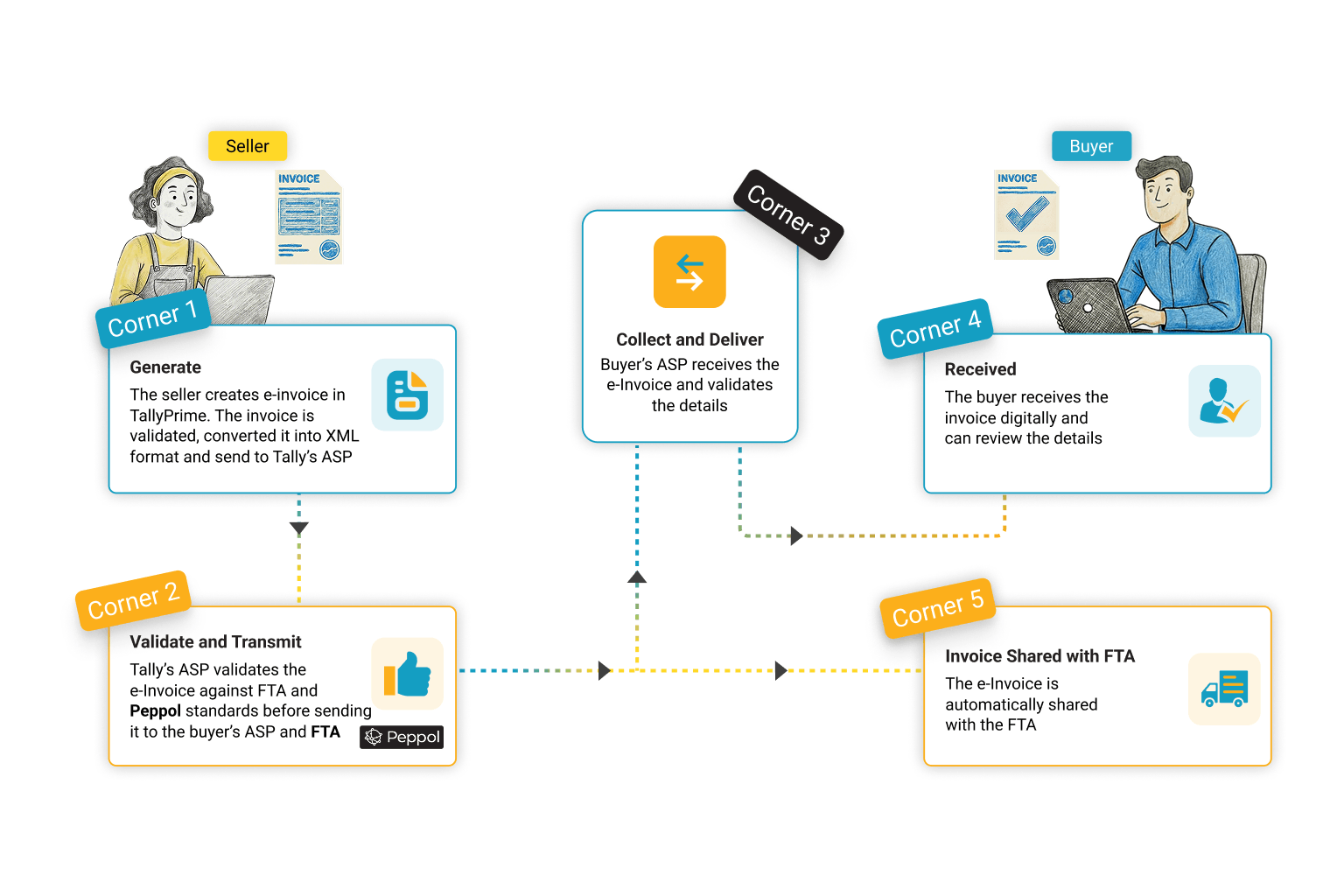
In practice, the workflow follows a fixed sequence once a business is live on the system.
- The supplier's accounting software generates the invoice as structured XML rather than a PDF.
- The invoice is sent to the supplier's ASP, which validates the data against the UAE data dictionary.
- The ASP transmits the invoice to the buyer's ASP over the Peppol network and reports the associated tax data to the FTA in parallel.
- The buyer's ASP validates the incoming data and delivers it into the buyer's accounting or Enterprise Resource Planning (ERP) system.
- The buyer's ASP sends a message-level status confirmation back through the chain, confirming the invoice was received and processed.
A PDF emailed to a customer, or an invoice printed on paper, does not qualify as an e-invoice under this system, regardless of how accurate the figures are.
What happens after an e-invoice is sent?
Once an invoice leaves the supplier's ASP, a few things happen largely out of the supplier's direct view:
- The buyer's ASP validates the invoice's structure and content before it reaches the buyer.
- The FTA receives tax data in parallel, rather than after the fact, which makes this a continuous transaction control model rather than a periodic filing system.
- Confirmation messages are routed back through the chain so both ASPs (and, by extension, both businesses) know whether the exchange succeeded.
- Invoice data must be stored within the UAE, or otherwise in accordance with the Tax Procedures Law, and made available upon the FTA's request.
- Any system failure that prevents a business from issuing or receiving e-invoices must be reported within a short, fixed window, as prolonged unreported outages carry their own penalties.
What information must every UAE e-invoice include?
An e-invoice is valid only if it meets two conditions: it satisfies the content requirements of a standard UAE tax invoice and is formatted to the PINT AE technical standard.
PINT AE is built on UBL, the same base standard used in other Peppol markets, adapted to include UAE-specific fields. Every invoice needs a unique invoice identifier, the date of issue, the tax registration number of the seller and, where relevant, the buyer, the currency and amounts involved and a code identifying the type of document. Businesses cannot add their own custom fields outside this set, which keeps the format consistent across ASPs and industries.
Retention billing, common in construction and real estate, has its own treatment. An e-invoice raised at a billing event should reflect only the net amount payable at that point, with VAT calculated on that net figure. A separate electronic tax invoice covering the retained amount and its VAT follows once that amount is released and becomes payable.
Conclusion
The UAE e-invoicing workflow is not a filing change so much as an infrastructure change, since it requires a working connection between a business's accounting system and an accredited service provider before a single invoice can move. Businesses with revenue above AED 50 million are furthest along the deadline curve and should already be testing with an ASP, while smaller businesses have a longer runway but the same underlying requirement to get their master data and software ready.
Accounting software such as TallyPrime, which supports structured data export and can be configured to meet evolving compliance requirements, is one way to get the underlying data in order well before a business's mandatory go-live date.