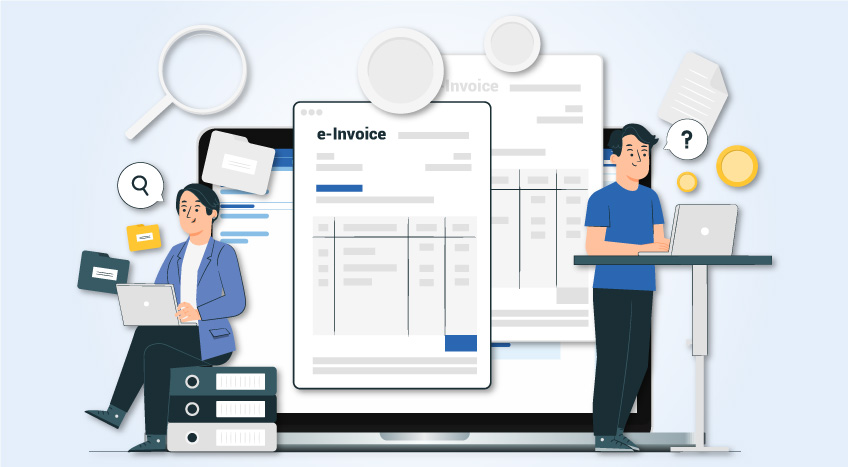
UAE’s e-invoicing requires wholesale and distribution businesses to issue, exchange and report invoices as structured XML data through an Accredited Service Provider, rather than as PDFs, scans or paper documents. For a wholesale business, this affects every purchase order, delivery note and sales invoice that moves between suppliers, warehouses and buyers, because each must pass through the Federal Tax Authority's e-Billing system before reaching the counterparty.
The rollout is phased by annual revenue, with a voluntary pilot having begun on 1 July 2026 and mandatory compliance starting on 1 January 2027 for businesses with annual revenue of AED 50 million or more.
How does UAE e-invoicing affect wholesale and distribution businesses?
Wholesale and distribution businesses process a large number of invoices every day across customers, suppliers, warehouses and branch locations. Managing these transactions manually can lead to data entry errors, delayed payments and difficulties in maintaining VAT compliance. The UAE's e-invoicing framework introduces a standardised method of exchanging invoice data electronically, helping businesses improve the precision and efficiency of their invoicing processes.
E-invoicing also improves transparency by providing the Federal Tax Authority (FTA) with near real-time access to transaction data. This helps businesses maintain accurate tax records, simplify audits and reduce the risk of non-compliance.
For wholesale and distribution companies operating across multiple locations, a standardised e-invoicing process creates greater consistency in billing and record-keeping. By preparing early, businesses can update their invoicing workflows, improve data quality and ensure their accounting and Enterprise Resource Planning (ERP) systems are ready to meet the UAE's regulatory requirements without disrupting day-to-day operations.
What information should wholesale and distribution businesses include in an e-invoice?
Here are some of the key pieces of information that need to be included in e-invoicing:
Business information
Every e-invoice must include the supplier's and buyer's business details to enable accurate validation and exchange through the UAE's e-invoicing network. This includes the legal names of both parties, their Tax Registration Numbers (TRNs), where applicable and their respective Peppol participant identifiers used for electronic invoice exchange.
Invoice details
Each invoice must contain essential transaction information, including the invoice type, invoice reference number, invoice issue date, supply date and the currency in which the transaction is recorded. These mandatory fields help ensure the invoice complies with the UAE's prescribed electronic format and can be successfully validated by an Accredited Service Provider (ASP).
Product and tax information
Wholesale and distribution invoices often include multiple products within a single transaction. Each line item should clearly specify the product description, quantity supplied, unit price, applicable VAT category, VAT rate and any discounts. Where relevant, advance payments or retention amounts should also be reflected in accordance with the UAE's e-invoicing guidelines.
Accurate master data
Maintaining accurate customer and supplier records is essential for successful e-invoicing. Clean and up-to-date master data helps reduce validation errors, minimise rejected invoices and support smoother invoice processing.
What challenges do wholesale and distribution businesses face during e-invoicing implementation?
Some of the key challenges that wholesale and distribution businesses face include:
Cleaning and updating master data
One of the biggest challenges for wholesale and distribution businesses is maintaining accurate customer and supplier records. Outdated addresses, missing TRNs or inconsistent business information can cause invoices to fail validation once e-invoicing becomes mandatory. Reviewing and updating this master data before implementation helps reduce invoice rejections and ensures smoother invoice processing.
Integrating ERP systems with the UAE e-invoicing framework
Businesses also need to ensure their ERP or accounting software can generate invoices in the format required under the UAE's e-invoicing framework. Existing data fields, such as tax categories, item codes and currencies, must align with the prescribed standards. Companies should also select an FTA-accredited ASP that integrates well with their existing systems.
Training employees on the new process
Successful implementation depends on more than technology. Finance, sales and warehouse teams should understand the new invoicing requirements, including the mandatory fields and the reasons an invoice may be rejected. Clearly defining responsibilities for resolving validation errors can help minimise delays after the mandate takes effect.
Testing the e-invoicing workflow before implementation
Conducting pilot testing before the compliance deadline allows businesses to identify technical or operational issues early. Testing invoice generation, validation and exchange through an ASP helps ensure the entire process works as expected, reducing the risk of rejected invoices, payment delays and potential non-compliance once e-invoicing becomes mandatory.
How does TallyPrime simplify e-invoicing for wholesale and distribution businesses?
TallyPrime, developed by Tally, enables businesses to generate, validate and exchange UAE-compliant electronic invoices over the Peppol network. Tally is a full member of OpenPeppol and an authorised Accredited Service Provider (ASP) recognised by the UAE Ministry of Finance, helping businesses comply with the UAE's e-invoicing framework.
Some of the key capabilities offered by TallyPrime include:
- Guided onboarding for EmaraTax registration and e-invoicing setup.
- Built-in invoice validations to identify missing or incorrect information before submission.
- Support for both single invoice processing and bulk invoice exchange for high-volume transactions.
- Bilingual interface with support for English and Arabic.
- Integration with the EmaraTax portal to simplify VAT return preparation.
At present, TallyPrime's UAE e-invoicing functionality is awaiting final accreditation from the UAE Ministry of Finance. Once approved, businesses will be able to use the platform to exchange electronic invoices in accordance with the UAE's e-invoicing framework.
Conclusion
UAE e-invoicing is approaching quickly for wholesale and distribution businesses with annual revenue close to or above AED 50 million. While the mandatory go-live date is 1 January 2027, the ASP appointment deadline of 30 October 2026 leaves limited time for the data cleanup, system integration and testing needed to prepare for compliance. Confirming which implementation phase applies, validating buyer and supplier records and testing invoice exchanges during the voluntary phase can help businesses avoid rejected invoices, payment delays and potential FTA penalties.
Software is only one part of that preparation. Businesses also need accurate master data, trained staff and an ERP system capable of supporting structured e-invoicing. TallyPrime, which is working towards ASP accreditation as a certified Peppol Service Provider, aims to help businesses generate, validate and exchange compliant e-invoices within the UAE's framework.