e-Invoicing is a recent trend in the evolving landscape of business taxation. Many countries have already implemented it in their taxation regulations. The UAE government has announced e-Invoicing for all B2B transactions which will be made mandatory in 2026.
This blog will give you a comprehensive understanding of e-invoicing in the UAE, a fully digitised e-invoicing system for both B2B and Business-to-Government (B2G) transactions seeking to ensure transparency and accuracy in the invoicing process.
What is an e-Invoice?
According to the UAE Ministry of Finance, “e-Invoice is a structured form of invoice data that is issued and exchanged electronically between a supplier and a buyer and reported electronically to the UAE Federal Tax Authority.”
This means that invoices will now have a standard format and should be machine readable. All VAT registered entities around the country will have to adhere to the e-Invoicing system and issue invoices in this standard format. Adhering to this format will be necessary to report your transactions to the government under rules for VAT compliance. It is important to note that unstructured invoice formats such as pdf, word document, images, scanned copies and emails are not e-Invoices.
The e-invoicing system of UAE
The UAE e-Invoicing system will enable your ERP or taxation software to connect directly with the UAE government's official e-Invoicing portal. This integration allows you to seamlessly generate and upload invoices in the specified government-approved format with a single click.
Key features
- System Integration: Your ERP or billing software communicates directly with the government e-Invoicing portal through secure APIs or connectors.
- Automated Invoice Upload: Invoices are automatically prepared in the required digital format and transmitted to the government system, ensuring compliance.
- Ease of Use: The process is streamlined, allowing you to submit compliant invoices without manual login to the government portal and filling in details each time.
- Real-Time Compliance: Instant submission and acknowledgment from the government system help maintain up-to-date records and compliance.
How it works
- Your invoice data is created in your ERP/taxation platform.
- With the help of your ASP and integrated e-Invoicing capabilities of your ERP/accounting software, the invoice is converted to the government’s mandated format
- The invoice is transmitted directly to the UAE e-Invoicing portal.
- The portal validates, stores, and may provide an acknowledgment or reference number for your records.
e-invoicing implementation timeline
The rollout follows strict phases:
- Pilot: Selected businesses from July 1, 2026.
- Voluntary: Any business from July 1, 2026.
- Phase 1: Revenue ≥ AED 50M appoint ASP by July 31, 2026; mandatory by January 1, 2027.
- Phase 2: Revenue AED 20-50M by January 31, 2027; mandatory July 1, 2027.
- Phase 3: Smaller businesses by April 30, 2027; mandatory October 1, 2027.
Benefits of e-invoicing
E-invoicing streamlines the invoicing process by enabling the digital exchange of invoices between businesses. It reduces errors, accelerates payments, and ensures greater compliance and transparency. Here are some key benefits businesses face while transitioning to e-invoicing in the UAE:
- Reduction in invoice processing cost
e-Invoicing can significantly reduce invoice processing costs for businesses and governments by up to 66%.
- Improve cashflows by optimizing invoice cycle time
With the new system, there will be validations and controls built-in the entire e Invoicing process. This will significantly reduce errors and deliver invoices to the buyers in real-time. This leads to faster payment and better working capital management.
- Exchange invoice beyond borders
UAE has decided to use the PEPPOL network for setting up an invoice chain, which means that businesses have access to a wider network and can be seamlessly exchanged with businesses outside the UAE.
- Simplify compliance
Since e-Invoicing mandates the reporting of invoice tax data to the FTA through UAE Accredited Service Providers, certain fields in VAT returns can be automatically prepopulated speeding up VAT return filing and refund processing.
e-invoicing requirements in UAE
To comply with the UAE’s upcoming e-invoicing framework, businesses must align their invoicing processes with the standards set by the Federal Tax Authority (FTA) and the Ministry of Finance. The system is expected to follow a structured, digital-first approach, ensuring transparency, accuracy, and real-time reporting of transactions.
Below are the key requirements businesses should be aware of:
- Structured electronic format
Invoices must be generated in a machine-readable format (such as XML or JSON) instead of traditional PDFs or paper invoices. This enables seamless data exchange between systems and authorities. Businesses may need to use certified e-invoicing platforms or service providers to generate, validate, and transmit invoices in compliance with government standards.
- Real-time or near real-time reporting
Invoice data is expected to be reported to tax authorities either instantly or within a defined timeframe, reducing the risk of errors and tax evasion.
- Authentication & validation
e-Invoices may require digital signatures or unique identifiers (such as QR codes) to ensure authenticity and prevent fraud.
- Archiving & record keeping
Businesses must securely store e-invoices for a specified period (typically at least 5 years under UAE VAT law) and ensure easy retrieval during audits.
- System readiness & integration
ERP or accounting systems should be upgraded to support e-invoicing formats, validation rules, and API-based integrations with government systems.
- Compliance with data security standards
Businesses must ensure data privacy, secure transmission, and protection of sensitive financial information in line with UAE regulations.
By preparing early and upgrading their invoicing systems, UAE businesses can ensure smooth compliance with e-invoicing requirements while improving operational efficiency and reducing manual errors.
e-invoicing framework in UAE
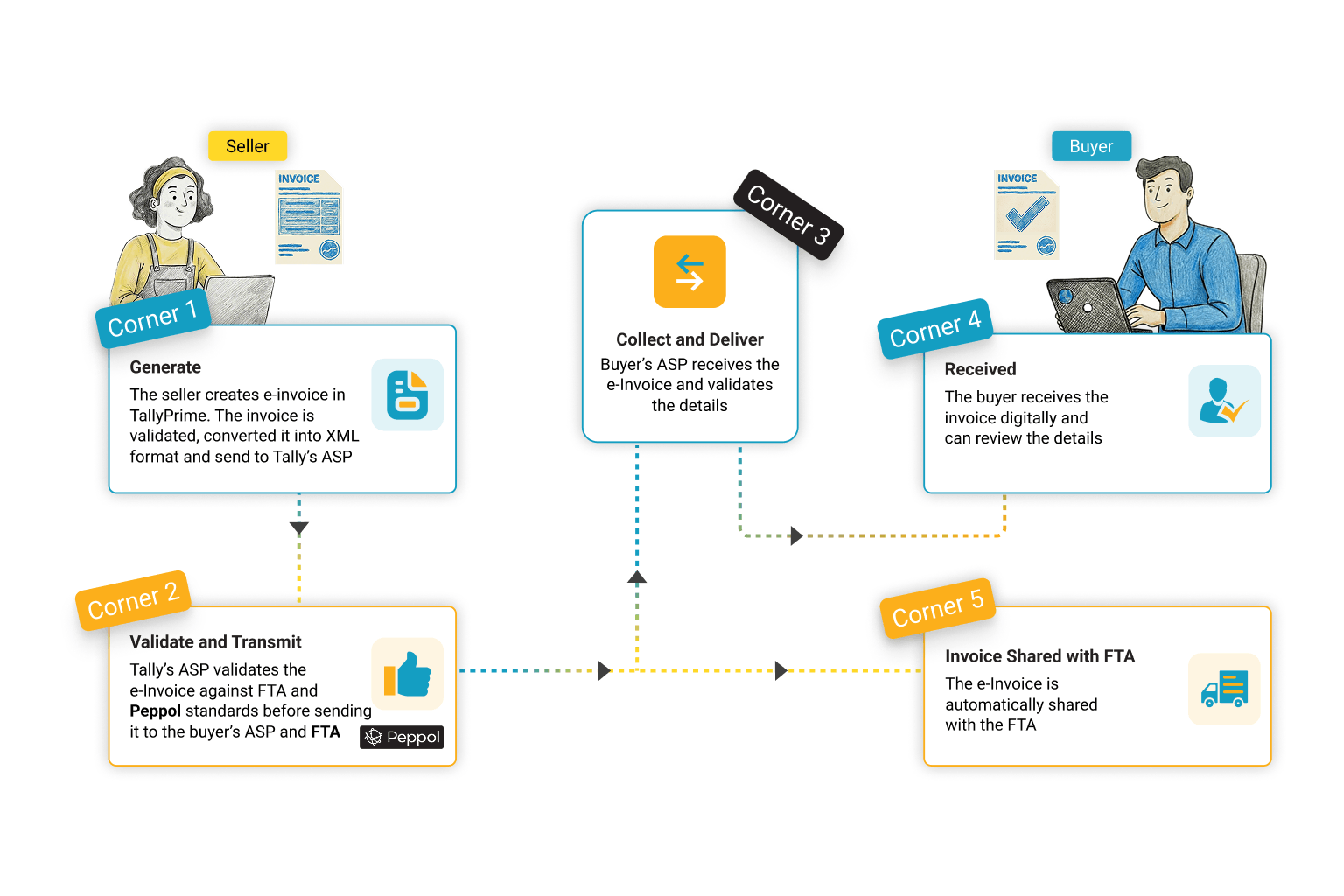
The UAE e-invoicing framework follows a 5-corner model, designed to enable secure, standardized, and real-time exchange of invoice data between businesses and tax authorities. This model ensures that invoices are validated, transmitted, and reported seamlessly through accredited service providers.
What are the “Corners” in the UAE e-invoicing model?
- Corner 1 (Supplier): The business issuing the invoice
- Corner 2 (Supplier’s ASP): Accredited Service Provider handling validation and transmission on behalf of the supplier
- Corner 3 (Buyer’s ASP): Accredited Service Provider receiving and validating the invoice for the buyer
- Corner 4 (Buyer): The business receiving the invoice
- Corner 5 (Tax Authority Platform): Government system that receives and monitors tax data
How the framework works
Scope of e-invoicing in UAE
The scope of e-invoicing in the UAE defines which businesses, transactions, and documents fall under the upcoming regulatory framework. As the UAE moves towards a fully digital tax ecosystem, e-invoicing is expected to apply broadly across VAT-registered entities to ensure transparency and compliance.
Who is required to comply?
- VAT-registered businesses operating in the UAE will be the primary entities required to adopt e-invoicing.
- This includes mainland companies, free zone entities, and foreign businesses registered for VAT in the UAE.
- Both large enterprises and SMEs will fall within scope, depending on implementation phases.
Transactions covered
e-Invoicing is expected to apply to:
- Business-to-Business (B2B) transactions
- Business-to-Government (B2G) transactions
- Selected Business-to-Consumer (B2C) transactions, where applicable
Types of documents included
The framework will likely cover:
- Tax invoices and simplified tax invoices
- Credit notes and debit notes
- Other VAT-related transactional documents as specified by authorities
- Cross-Border Considerations
- Cross-border transactions involving UAE VAT-registered entities may also fall within scope, especially where reporting obligations exist.
- Additional guidelines may apply for imports, exports, and international supplies.
UAE e-invoicing penalties and fines
Failure to enroll in the UAE e-invoicing system within the prescribed timelines can result in recurring financial penalties under Cabinet Decision No. 106 of 2025.
Businesses that do not implement the e-invoicing system or fail to appoint an accredited service provider may face a penalty of AED 5,000 per month (or part thereof) until compliance is achieved.
These penalties apply once e-invoicing becomes mandatory for the business, making timely enrolment essential to avoid ongoing fines.
How to prepare for e-invoicing
With the UAE moving towards mandatory e-invoicing, businesses must take proactive steps to ensure a smooth and timely transition. Early preparation not only helps avoid penalties but also improves operational efficiency and compliance readiness.
Key steps to prepare for e-invoicing in UAE
- Assess your current invoicing process: Review your existing invoicing system to identify gaps in compliance with structured e-invoicing requirements.
- Upgrade your accounting or ERP system: Ensure your system can generate invoices in a structured, machine-readable format (such as XML) and support required integrations.
- Choose an Accredited Service Provider (ASP): Select a government-approved ASP to handle invoice validation, transmission, and reporting as per UAE regulations.
- Validate master data: Verify critical data such as TRNs, customer details, and tax information to ensure accuracy in e-invoices.
- Train your finance and IT teams: Equip your teams with the necessary knowledge on e-invoicing processes, compliance requirements, and system usage.
- Ensure system integration: Prepare for API-based integration between your ERP/accounting software and the ASP platform for seamless data exchange.
- Run testing and pilot programs: Conduct trial runs to ensure your invoicing system works correctly before mandatory implementation.
- Stay updated with regulatory guidelines: Monitor announcements from the Ministry of Finance and FTA for timelines, mandates, and updates.
Frequently Asked Questions
What is the process for generating and submitting e-invoices in the UAE?
Businesses generate e-invoices using FTA-compliant accounting or e-invoicing software that captures mandatory VAT details such as TRN, invoice number, VAT amount, and supply date. These invoices are stored digitally and used for VAT reporting through the FTA portal. As the UAE gradually rolls out its e-invoicing framework, system-to-system reporting will become more structured.
Do businesses in the UAE need to maintain paper invoices after switching to e-invoicing?
No, businesses are not required to maintain paper invoices if they use compliant e-invoicing systems. However, digital invoices must be securely stored and accessible for at least five years (or longer for real estate transactions), as required by UAE VAT regulations.
How does e-invoicing affect the VAT filing process in the UAE?
E-invoicing simplifies VAT filing by enabling accurate, real-time recording of sales and purchases. Since invoice data is digitally structured, it reduces manual errors, speeds up reconciliation, and ensures VAT returns are filed with greater accuracy and consistency.
Is e-invoicing mandatory for all types of businesses in the UAE?
Currently, e-invoicing is not mandatory for all businesses, but it is strongly encouraged as part of the UAE’s digital tax transformation. Mandatory adoption will be implemented in phases, starting with certain sectors and business sizes, so early adoption helps businesses stay future-ready.
How does the UAE government monitor e-invoices for VAT compliance?
The UAE government monitors VAT compliance through digital VAT returns, audit trails, and data analytics submitted via the FTA portal. As e-invoicing adoption increases, authorities can cross-check invoice data to identify discrepancies, under-reporting, or non-compliance more efficiently.
Can e-invoices be issued to international clients under UAE regulations?
Yes. UAE businesses can issue e-invoices to international clients, provided the invoices comply with UAE VAT rules. For zero-rated or exempt supplies, invoices must clearly state the applicable VAT treatment and include all required details.
What are the key features to look for in e-invoicing software for UAE businesses?
An ideal e-invoicing solution should include FTA compliance, VAT calculation accuracy, secure digital storage, audit trails, integration with accounting systems, multi-currency support, and automated VAT reporting to support smooth compliance.
How does e-invoicing impact the reconciliation of payments and receivables in the UAE?
E-invoicing improves reconciliation by providing real-time invoice tracking, automated matching of invoices with payments, and clear visibility into outstanding receivables. This reduces disputes, improves cash flow management, and enhances financial accuracy.
What are the security measures in place to protect e-invoices in the UAE?
E-invoices are protected through data encryption, access controls, secure cloud storage, and audit logs. Compliant software ensures invoice integrity, prevents unauthorised modifications, and supports regulatory audits when required.
How can businesses transition smoothly from traditional invoicing to e-invoicing in the UAE?
A smooth transition involves selecting FTA-compliant software, training staff, digitising existing records, and gradually running parallel systems before full adoption. Early planning helps minimise disruption and ensures readiness for future mandatory e-invoicing requirements.