The UAE’s 5-corner invoicing model is a decentralised invoice sharing and validation system based on the PEPPOL framework. It is set up to securely exchange invoices between the buyer and the seller while simultaneously sending the data to the FTA. This model creates a secure digital loop to ensure that all invoices are validated and interoperable across different accounting, ERP, and government systems.
What is the 5-Corner e-invoicing model?
The 5-Corner e-Invoicing Model is the UAE’s structured framework for the secure exchange, validation, and reporting of electronic invoices under the Federal Tax Authority (FTA) mandate. It is built on the globally recognised PEPPOL network and follows a decentralised continuous transaction control and exchange (DCTCE) approach. Instead of businesses reporting invoices directly to the FTA, accredited service providers (ASPs) act as intermediaries to validate, standardise, and securely transmit invoice data between trading partners and the tax authority.
What are the 5 corners of the 5-corner e-invoicing model?
As the name suggests there are five different corners in the e-Invoicing model adopted by UAE:
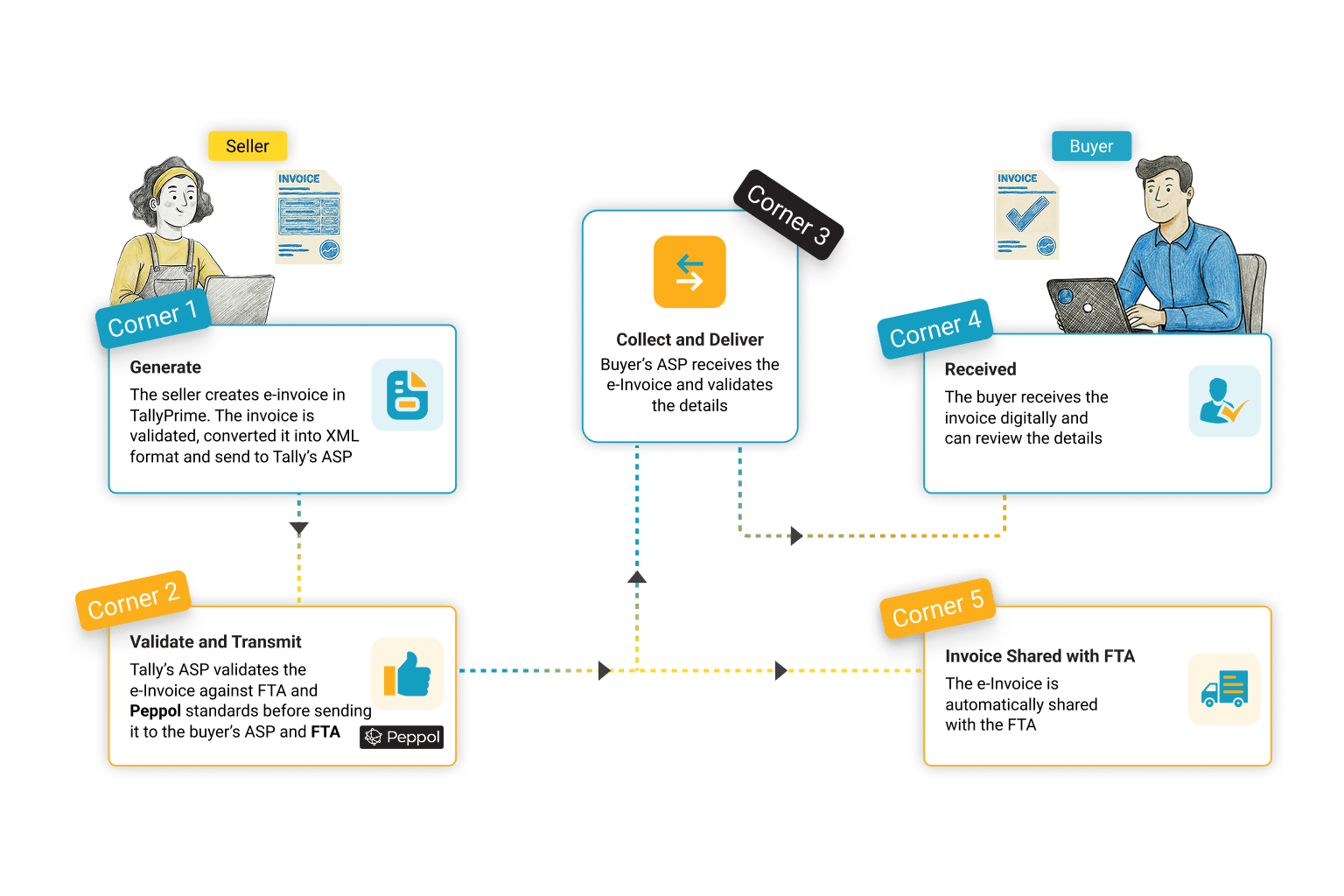
Corner 1: Seller/Supplier
The supplier or seller creates the e-invoice in their system using the PINT-AE standard and sends it to the seller ASP. The PINT AE standard is the invoicing format chosen by the UAE FTA for all invoices that will be sent through the new system. This format ensures that all XML invoices have the required UAE tax details, such as VAT numbers and particular transaction data, to remain compliant with the FTA. It defines specific data fields and an XML structure for legal and valid invoices.
Corner 2: Seller ASP
ASP is an accredited service provider, accredited by the FTA to handle e-invoice transactions. On the receipt of the e-invoice from the seller, the ASP validates it, checks all the buyer data, converts it to a standardised format, and transmits it to the buyer’s ASP. If the invoice is valid, they send the data to the FTA; if the invoice is invalid, they send it back to the seller.
Corner 3: Buyer ASP
This is the ASP on the buyer’s side. They receive the invoice data from the seller’s ASP, validate it, and then send the e-invoice to the buyer.
Corner 4: Buyer
The buyer then receives e-invoices from their ASP. The validated invoice is stored in their accounting system, which the buyer reviews for all details.
Corner 5: FTA
The FTA receives the e-invoice data from the supplier ASP. It stores the data, validates it and provides Message Level Status (MLS) confirmations to the ASP, which is sent to the seller.
Let us understand how e-invoicing workflow connects all 5 corners:
What are the main aspects of the 5-corner e-invoicing model?
The following are the main aspects of the 5-corner UAE E-invoicing Model:
- Decentralization of data (DCTCE): DCTCE stands for “decentralised continuous transaction control and exchange. All the data in this model flows to the FTA only through the ASPs, and not directly, which in turn enhances efficiency and security.
- Standardised: This model uses the e-invoicing Peppol network and the PINT-AE standard for consistency. PINT-AE refers to the Peppol International Data Dictionary for the UAE).
- Compulsory rollout: The system will roll out mandatorily for all businesses in phases, that are registered under VAT in the UAE from 2027 onwards, with large businesses starting out first.
- ASPs: Businesses must partner with Accredited Service Providers to connect to the network, making them a crucial part of the entire 5-corner e-invoicing UAE model.
Key benefits of the 5-corner e-invoicing model for businesses
Below are the key benefits for users, taxpayers, and businesses:
- Faster invoice processing and payments
Structured, machine-readable invoices eliminate manual data entry and reduce processing errors. This enables quicker validation, smoother accounts payable workflows, and faster payment cycles between trading partners.
- Reduced compliance burden
Since invoices are validated and reported to the FTA through accredited ASPs in real time or near real time, businesses no longer need to manage separate tax reporting submissions for each transaction. The system automates compliance, reducing administrative effort and risk.
- Improved accuracy and fewer errors
The use of the PINT-AE standard ensures mandatory VAT fields and transaction details are correctly structured. Automated validation checks by the ASP reduce invoice rejections, duplication, and human errors.
- Enhanced security and fraud prevention
Invoices are transmitted through secure PEPPOL-certified access points, reducing the risk of invoice tampering, fraud, and fake documentation. Continuous validation improves transparency across the transaction lifecycle.
The 5-corner e-invoicing model is a fool-proof system intended to improve the tax visibility of the FTA and increase compliance in the UAE financial system, while reducing fraud and preventing tax evasion amongst companies.