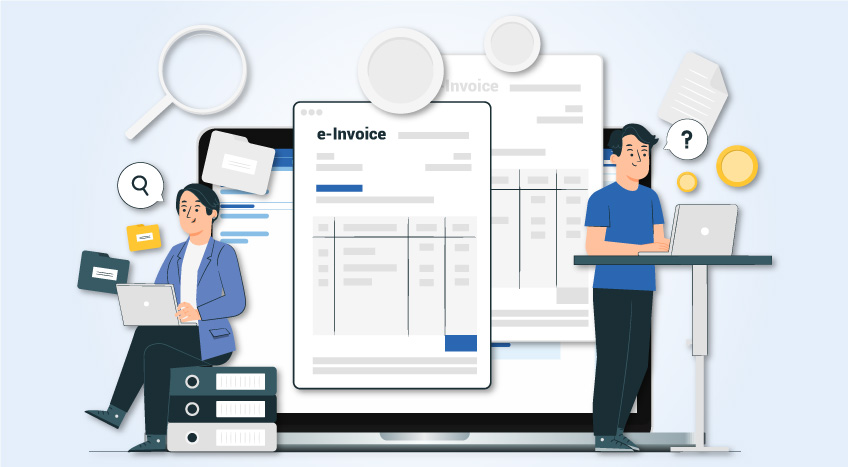
UAE businesses can expect a major shift in their operations due to automation and new regulations associated with the new PEPPOL e-invoicing system. The new system will significantly change how electronic invoices are securely issued and transmitted to the recipient as standard invoice formats will become mandatory. The new system will use Accredited Service Providers (ASPs) to automatically send the relevant tax data to the FTA for monitoring, compliance and transparency. It will use a secure network to exchange invoice data, automate business processes to lower administrative costs, and speed up invoice processing.
Models used for e-invoicing
It is essential for businesses operating in the UAE to understand traditional e-invoicing vs PEPPOL.
Traditional e-invoicing uses a 2-corner or 3-corner model
Traditional e-invoicing, also known as Electronic Data Interchange (EDI), uses 2-corner models or 3-corner models. These enable users to exchange invoices electronically. Traditional e-invoicing is based on closed networks.
2-corner model
The 2-corner model facilitates a point-to-point exchange between a seller/supplier/sender and a buyer/receiver. It involves directly exchanging invoices, with few security and authorisation mechanisms in place. For example, sending invoices through email or uploading them to a portal for the receiver to view.
3-corner model
The 3-corner model is built on the two-corner model and is based on networking. It adds a central platform or service provider that handles messaging between the sender and receiver. It is a comparatively comprehensive framework that can provide a more compliant solution, ensuring smoother e-invoice creation and exchange and better communication.
PEPPOL uses 4-corner or 5-corner models
PEPPOL uses an open, decentralised network that enables businesses to trade globally and achieve high scalability. The suppliers/senders and buyers/receivers connect via access points for communicating and use standards that ensure interoperability.
4-corner model
The 4-corner model is based on a decentralised open network. It consists of sellers, buyers, seller access points, and buyer access points. The 4-corner model relies on connections among these four corners to establish a standard by which they abide. Having a standard in place ensures that all participants communicate clearly and removes the barriers that arise from traditional e-invoicing systems.
5-corner model
The latest e-invoicing framework is the PEPPOL 5-corner model, also known as the Decentralised Continuous Transaction Control and Exchange (DCTCE) model. It builds on the 4-corner model and adds another corner: the tax authority. In the UAE, the fifth corner is the Ministry of Finance and the Federal Tax Authority.
E-invoicing processes
The e-invoicing processes reveal the main differences in their operation and in the generation of e-invoices.
Process of e-invoice exchange with a 2-corner model
- An EDI, such as an FTP, is used to send e-invoices directly from the supplier to the buyer.
- Both the supplier and the buyer must agree on a standard e-invoice format and the transmission method.
Process of e-invoice exchange with a 3-corner model
- The sender and receiver must each have an agreement with the central platform independently of the other.
- An interoperability agreement must be established to process e-invoices.
- Operators must spend time setting up the system and testing to ensure proper invoice processing.
Process of e-invoice exchange with 4-corner PEPPOL framework
- The supplier enters the invoice data using their ERP/accounting software.
- The invoice data is securely sent from the seller to the seller's access point.
- The invoice data is then forwarded to the buyer’s access point.
- This invoice data is forwarded to the access points through the service metadata locator (SML) and the service metadata publisher (SMP) as the supplier’s access point recognises the buyer’s access point.
- The invoice data is securely sent through the open network.
- The buyer’s access point sends the invoice to the buyer.
Process of e-invoice exchange with the latest 5-corner PEPPOL framework
- The sender enters the invoice data using their accounting software and submits it using their service provider.
- The sender’s service provider validates the invoice and, if necessary, converts it to XML.
- The sender’s service provider sends it to the receiver’s service provider. At the same time, the sender’s service provider reports tax data to the tax authority.
- While the invoice is being validated, a confirmation message is sent to the sender’s service provider.
- The receiver’s service provider submits the invoice to the receiver in a standard format.
- When the invoice gets validated, the receiver’s service provider reports tax data to the tax authority.
- If validation fails, the receiver’s service provider communicates with the sender’s service provider and the tax authority. Tax data will not be reported to the tax authority by the receiver’s service provider.
- When tax data is reported successfully, the tax authority will send a confirmation to the sender’s service provider. Then it does the same to the receiver’s service provider.
- The sender’s service provider sends the confirmation to the sender, while the receiver’s service provider sends the confirmation to the receiver.
Limitations of traditional e-invoicing
Traditional e-invoicing worked wonders when it launched because the needs were simple and there was no standard set of rules businesses had to follow. It was simple to set up and required agreements between buyers and sellers. Setting up the systems became more complex as new connections had to be added or existing ones were modified. These systems offered limited scalability and little to no interoperability, both of which are essential in today’s global trading environment. Another major issue with legacy systems is their lack of security capabilities. Even though security was established to some extent, the network provided minimal protection for the exchanged invoice data.
Legacy systems that relied on human intervention led to inaccurate data entry and a higher risk of manual errors. This became burdensome for businesses, labour-intensive, and costly in the long run. Invoice processing also took significant time, preventing finance teams from focusing elsewhere. Today, generating invoices with traditional e-invoicing methodologies is no longer an effective option due to security concerns, a limited feature set, connectivity constraints, minimal to no scalability, and a lack of interoperability.
Why the PEPPOL frameworks matter
PEPPOL models were developed to address the problems posed by traditional e-invoicing systems. The four-corner PEPPOL model addressed the shortcomings of traditional e-invoicing models and built a robust architecture that delivered interoperability, scalability, security, and efficiency. The 5-corner model took e-invoicing a step further by integrating with tax authorities to ensure tax could be reported effectively when a valid e-invoice is generated. PEPPOL frameworks give businesses the tools to become interoperable and trade globally. A study found that invoice processing costs went down by up to 66% when businesses used the PEPPOL framework to generate and exchange e-invoices.
E-invoicing in the UAE
The UAE government has mandated that all businesses (B2B, B2G, G2B, and G2G) use e-invoicing to generate and exchange e-invoices in a standard XML format. The non-standard invoices used by businesses so far will no longer be acceptable under the Ministry of Finance and the Federal Tax Authority rules, as stated on their official websites. The benefits of PEPPOL UAE e-invoicing are as follows.
- Near real-time invoice creation and distribution due to automation
- Minimal human intervention and better accuracy
- Secure networks to ensure safe e-invoice data exchange
- Better auditing due to direct tax data reporting
- Increased transparency means better decision-making
- Improves ease of doing business
- Decrease in commercial disputes
- Better cash flow due to electronic approvals
- Global compatibility and interoperability
- Improved invoice data security
- Seamless invoice exchange by appointing ASPs
- Cost savings in archiving and retrieval
- Simplified compliance
- Meet sustainability goals to decrease paper wastage
Traditional e-invoicing systems use the 2- and 3-corner models, in which only a limited set of entities is included. However, these systems are highly limited in all aspects. They do not have a place in the new economy, which requires faster processing times and accurate invoice generation. The 4-corner and 5-corner models offer higher flexibility and features. The UAE is planning to launch the PEPPOL 5-corner model to ensure compliance, digitalisation, automation, savings, and interoperability globally. It will bring an evolutionary change in how businesses create and exchange e-invoices while also ensuring automated tax compliance.