Under the UAE's e-invoicing mandate, a buyer must appoint its own Accredited Service Provider (ASP), receive invoices only in the structured PINT-AE XML format and confirm that the invoice data on its side is reported to the Federal Tax Authority (FTA). A PDF or scanned invoice sent to a VAT-registered buyer after the mandate applies has no legal standing as a tax invoice, and the buyer cannot use it to claim input tax.
The UAE has built its system around a five-corner model. The seller issues an invoice through its ASP, which the ASP validates and routes the file to the buyer's ASP. The buyer's ASP delivers the invoice to the buyer's accounting system and reports tax data to the FTA. Because the buyer's ASP is a separate corner in this chain, the buyer carries obligations of its own rather than simply waiting to receive a document.
Key responsibilities of buyers under UAE e-invoicing
Here are some of the key responsibilities of buyers:
Appoint an Accredited Service Provider (ASP)
Every buyer receiving e-invoices must appoint an Accredited Service Provider. The buyer cannot depend on the supplier's ASP to fulfil its obligations. The buyer's ASP acts as the secure gateway for receiving validated invoices, exchanging data with suppliers and confirming invoice information with the FTA.
Ensure systems can process PINT AE XML invoices
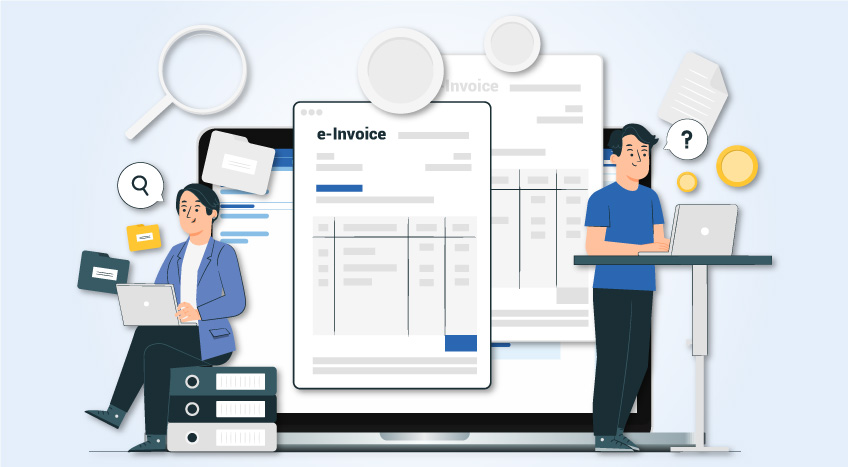
Buyer accounting or ERP systems should be capable of receiving and processing structured PINT AE XML invoices rather than PDFs or scanned documents.
These invoices include information such as:
- Seller and buyer Tax Registration Numbers (TRNs)
- Business identifiers
- Invoice line items
- Tax category codes
- Invoice totals
Without XML compatibility, businesses may need manual processing, reducing the efficiency and automation intended by the UAE e-invoicing framework.
Maintain accurate master data
Buyers are responsible for keeping their business information accurate with their ASP.
This includes:
- Tax Registration Number (TRN)
- Legal business identifiers
- Registered business details
- Address information
Incorrect or outdated master data can cause invoice validation failures, delay invoice delivery and postpone input tax recovery.
Receive and reconcile electronic invoices
Once invoices reach the buyer's system, businesses should reconcile them with purchase records and accounting entries. An integrated ERP or accounting system helps automate this process and reduces manual intervention while maintaining accurate financial records.
When should buyers be ready for e-invoicing?
The rollout is taking place in phases based on the seller's revenue, but a buyer needs to be ready before their trading partners go live, not after. A voluntary pilot opened on 1 July 2026 for a working group of businesses. Mandatory e-invoicing begins on 1 January 2027 for businesses with annual revenue of AED 50 million or more, and extends to smaller businesses from 1 July 2027.
Government entities are to follow suit from 1 October 2027. A buyer that deals with a supplier already in scope needs a working ASP connection before that supplier's go-live date, regardless of the buyer's own revenue band.
Which buyer transactions are covered?
During the initial rollout, the UAE e-invoicing framework applies to:
- Business-to-business (B2B) transactions
- Business-to-government (B2G) transactions
Business-to-consumer (B2C) transactions remain outside the scope until future phases are announced.
A buyer's role in UAE e-invoicing runs in parallel with the seller's, not behind it. Appointing an ASP, keeping TRN and registration data accurate and confirming the accounting system can process PINT AE XML are all steps a buyer needs to complete on its own timeline, tied to when its trading partners go live rather than its own revenue band alone.
Accounting software such as TallyPrime can support this transition by helping businesses maintain accurate master data and invoice records as UAE e-invoicing requirements take effect.